Hunting Whitetails in Manitoba’s Bush Country
Hunting whitetails in Manitoba's dense bush country can feel like trying to find a needle in a haystack—the cover is thick, the deer are notoriously secretive, and the elements can be unforgiving. Many hunters feel overwhelmed by the sheer scale of the wilderness and the difficulty of spotting game in such heavy terrain, often comparing it to the more open farmland where deer are visibly feeding. This comprehensive guide will walk you through proven strategies and practical advice to successfully hunt whitetails in Manitoba's bush, turning those frustrating hunts into rewarding experiences.
Decoding Manitoba's Bush Whitetail Habitat
Manitoba's bush country isn't just one type of forest; it's a mosaic of aspen parkland, mixed wood boreal, and even stretches of coniferous forest. Each area presents unique challenges and opportunities for whitetail hunters. Understanding these diverse habitats is the first step in unlocking success in the timber.
Understanding Bush Cover and Bedding Areas
Whitetails in the bush are masters of concealment. Unlike their open-country cousins who might bed in a cattail slough or a small blip of standing corn, bush deer often utilize thick, nasty cover that humans tend to avoid. Think dense willow thickets along a creek bottom, tangled hazel brush on a south-facing slope, or areas of regenerating clear-cuts where young aspens and poplars grow shoulder to shoulder, forming an impenetrable wall. These spots provide thermal cover, protection from predators like wolves, and a sense of security that allows deer to relax and chew their cud.
Identifying these bedding areas is crucial. Often, they are surprisingly close to food sources or travel corridors, but they are almost always characterized by extreme density. A prime bedding spot might be a cluster of mature spruce trees on a slight rise, offering both overhead cover and a vantage point. Deer will often bed with the wind at their back, allowing them to smell danger approaching from behind while watching their downwind side. Look for subtle deer trails leading into these thickets, broken branches, and most importantly, old rubs and scrapes from previous seasons that indicate consistent buck activity, even if it's not a direct bedding sign. Knowing where the deer feel safe is half the battle; the other half is figuring out how to approach without blowing them out.
Identifying Food Sources and Travel Corridors
Even the most reclusive bush whitetail needs to eat, and understanding their cafeteria is paramount. In Manitoba's bush, food sources can be diverse and spread out. In spring and summer, deer browse on a variety of forbs, new growth, and succulent leaves. As fall approaches, their diet shifts to harder mast, like acorns if you're in an area with oak trees (rare in much of Manitoba's primary bush but present in some southern pockets), or more commonly, the persistent leaves of aspen, dogwood, and willow. Farmers' fields, even those deep within the bush, provide crucial high-calorie forage like peas, canola, or alfalfa. Small clearings or old homesteads that have reverted to natural growth can also offer crucial browse.
Travel corridors are the highways and byways deer use to move between bedding areas and food sources, or from one secure cover block to another. These aren't always obvious trails. Sometimes, they're subtle depressions in the forest floor, worn down by generations of hooves. Other times, they're simply the path of least resistance through a dense section of woods—a narrow gap in a willow run, or the edge of a beaver pond. Look for distinct funnel points: saddles in ridges, narrow strips of timber connecting larger blocks of cover, or pinch points where heavy brush meets a more open area. These are prime locations for setting up a stand or planning a still-hunt route. Consider how a deer would logically move through the landscape to minimize exposure and maximize efficiency, and you'll likely find their preferred routes. For example, when you're Hunting a Manitoba Bush Edge, you'll often find these distinct travel lanes.
The Impact of Water and Topography
Water is an often-overlooked, yet critical, element in bush whitetail habitat. While deer don't typically spend much time in water, access to it is vital. Small creeks, intermittent streams, sloughs, and beaver ponds act as both hydration sources and natural barriers, channeling deer movement. A frozen slough in late season can become an unexpected crossing point, while a boggy section in early fall might be avoided, forcing deer to circumnavigate it. Pay close attention to how water features influence travel. A well-used trail often parallels a creek or cuts across a narrow point of a slough.
Topography, even subtle changes in elevation, can be a game-changer. While Manitoba isn't known for towering mountains, the bush country has its fair share of rolling hills, ridges, and valleys. A south-facing slope might offer warmer bedding in winter, while a north-facing slope could hold cooler, denser cover in early fall. Deer frequently use the leeward side of ridges to avoid prevailing winds, or the crest of a ridge to travel while maintaining a visual advantage. Understanding how these contours affect wind direction and thermal currents is paramount. Deer will almost always use topography to their advantage, whether it's cresting a rise to survey an area before dropping into a feeding zone or skirting a steep hill to stay out of sight. You might find more success if you learn about Hunting a Manitoba River Valley or a Hunting a Poplar Bluff at First Light.
Pre-Season and In-Season Scouting for Bush Bucks
Effective scouting is the bedrock of successful bush hunting. You can't just stumble into the woods on opening day and expect to find a mature buck. It takes diligent effort, both before the season even begins and throughout the hunting period, to unravel the mysteries of the bush.
Leveraging Technology and Satellite Imagery
Before you even step foot in the woods, modern technology offers an incredible advantage. Satellite imagery, found on mapping apps like GoHunt, allows you to "scout" vast tracts of bush country from the comfort of your home. You can identify potential bedding areas (dense dark green patches), open clearings (lighter green), water sources, and especially critical, funnel points and travel corridors. Look for changes in vegetation, distinct edges where different types of cover meet, and even old logging roads or cutlines that might be obscured on a traditional map but clearly visible from above. The ability to mark waypoints, measure distances, and understand topography digitally can save you countless hours of aimless wandering in the field.
Beyond just identifying features, these apps can help you understand ownership, especially when you're looking for Hunting Whitetails on Manitoba Crown Land. Many hunters neglect the power of these digital tools, but integrating them into your routine for Scouting a Manitoba Game Hunting Area is a game-changer. During the pre-season, identify 3-5 potential areas that look promising, then plan your physical scouting trips to confirm what you see on the screen. Always remember that satellite imagery can be outdated, so ground-truthing is always necessary, but it provides an invaluable starting point.
Boots-on-the-Ground Sign Reading
There's no substitute for getting your boots dirty. Once you've narrowed down areas with your digital scouting, it's time to hit the ground. Focus on finding fresh sign: tracks, droppings, rubs, and scrapes. Tracks will tell you where deer are moving and how often. Larger, deeper tracks often indicate bigger deer. Droppings, especially fresh ones, confirm recent activity in an area.
Rubs and scrapes are the holy grail of buck sign. Rubs, where a buck has rubbed his antlers on a sapling or tree, indicate his presence and aggression, especially during the pre-rut and rut. Look for fresh sap dripping from the rub, indicating it was made recently. Scrapes, patches of bare earth pawed by a buck, often with an overhanging branch (a "licking branch") he's rubbed his preorbital glands on, are communication hubs. Bucks will often check scrapes frequently. The bigger the rubs and the more active the scrapes, the higher the likelihood of a mature buck in the vicinity. Don't just look for one sign; try to piece together a "story" of deer movement by connecting several pieces of sign, understanding that deer sign can often lead you to understand Reading Whitetail Sign in Manitoba Aspen.
Adapting to Seasonal Changes
Manitoba's seasons dictate whitetail behavior, and your scouting needs to adapt. Early fall, when leaves are still thick, requires different tactics than late November when the ground is frozen and snow might be falling. In early archery season, deer are often still on a relatively consistent feed-to-bed pattern. As the rut approaches in October and November, bucks become more mobile, cruising for does. This is when rubs and scrapes intensify, and traditional travel corridors might see increased traffic.
Later in the season, after significant snowfall, deer may "yard up" in sheltered areas, often coniferous stands, to escape deep snow and brutal cold. Food sources might become limited, pushing them towards specific areas where browse is still available or to agricultural fields. Your scouting needs to be ongoing. What was a hot spot in September might be quiet in December. A good hunter constantly observes, learns, and adjusts their approach based on the current conditions and the ever-changing deer patterns. This adaptability is key when Hunting the Rut in Early to Mid November or even Hunting the Late December Season.
Effective Hunting Techniques for Dense Cover
Once you've scouted and understood the terrain, it's time to put your plan into action. Hunting whitetails in dense bush demands patience, stealth, and often, a different approach than hunting open country.
The Art of Still-Hunting and Tracking
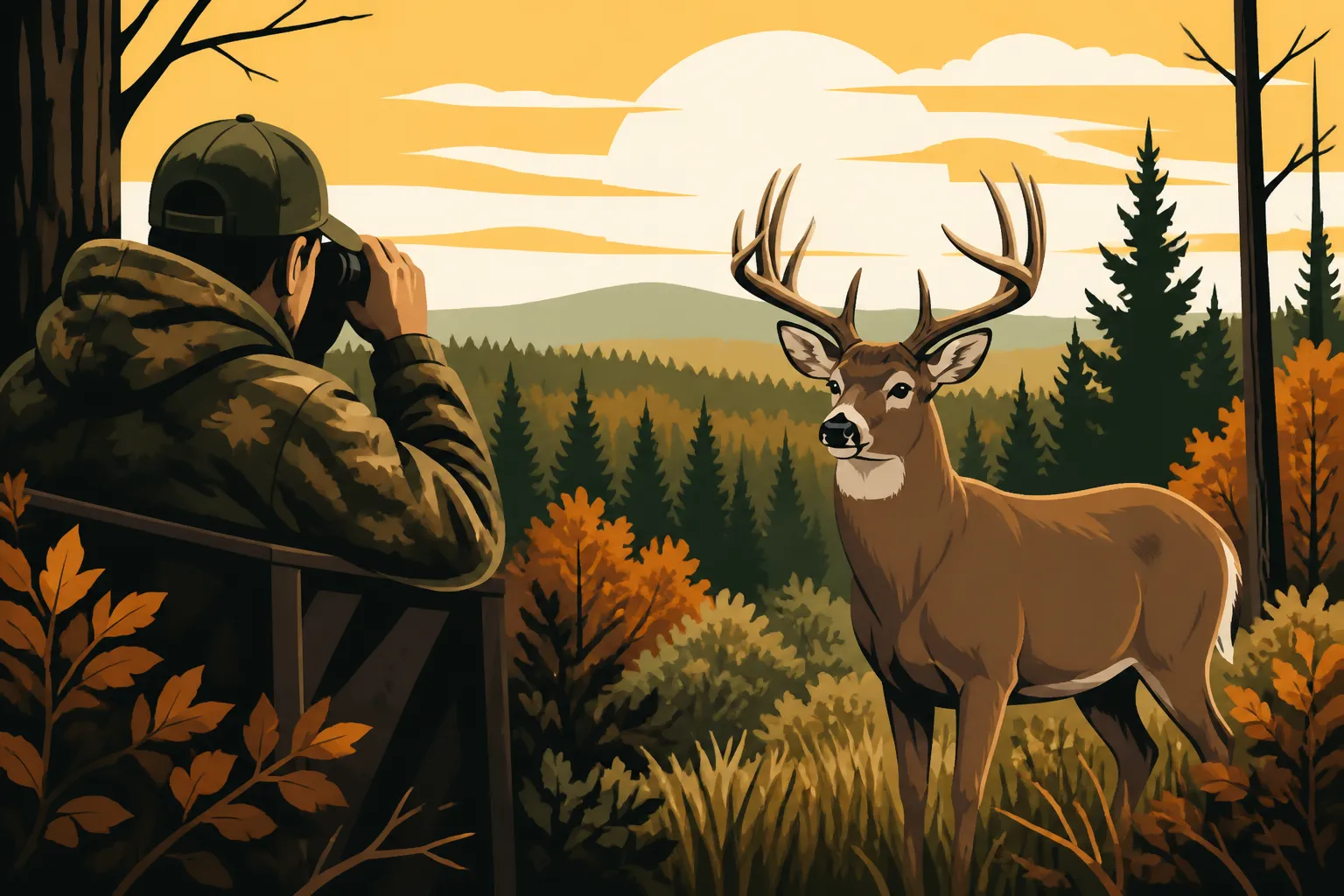
Still-hunting is perhaps the most challenging and rewarding method in the bush. It involves moving through the woods incredibly slowly, pausing frequently, and scrutinizing every shadow and texture for the tell-tale outline of a deer. Think of it less as walking and more as a series of slow, deliberate movements, interspersed with long periods of standing motionless, scanning and listening. The key is to blend into the environment, mimicking the natural pace of a predator. Take one or two steps, then stop for several minutes, scanning 360 degrees. Use your binoculars often, even in thick cover, to pick apart suspicious shapes.
Tracking involves following fresh deer sign, particularly tracks, to locate an animal. This is an art form in itself, especially after a fresh snow, where you can literally follow a buck's path. Pay attention to the track's gait, depth, and whether the deer is moving purposefully or browsing. If tracks suddenly diverge or show signs of alarm (longer strides, hoof drag marks), the deer may have sensed your presence. Wind direction is critical here; you always want to track into the wind, or at least with a crosswind, to keep your scent from spooking the deer ahead of you. It's a method that truly connects you to the wilderness, requiring intense focus and an understanding of Reading Sign After a Fresh Snow.
Strategic Stand Placement and Ambush Tactics
While still-hunting is active, stand hunting involves patiently waiting in a strategic location, letting the deer come to you. In the bush, stand placement is paramount. You need to identify key choke points, travel corridors, or pinch points where deer are funneled naturally. Consider placing your stand where two types of cover meet, along a field edge adjacent to dense bush, or overlooking a natural funnel between bedding and feeding areas. Wind direction is non-negotiable; always set up your stand so your scent is carried away from the likely approach of the deer.
Many bush hunters opt for portable treestands or ground blinds, which offer flexibility and concealment. For a tree stand, look for a tree that offers good cover and a clear shooting lane down a primary trail. For ground blinds, situate them against a natural backdrop, breaking up the outline, and ensure you have clear shooting lanes through the brush. Remember, deer are highly attuned to changes in their environment, so setting up weeks in advance can allow them to get accustomed to the new presence. Always ensure your stand is secure and safe. You might learn more about Hanging a Stand on a Manitoba Bush Edge to perfect this tactic.
Utilizing Calls and Rattling in the Bush
Calling and rattling can be incredibly effective in Manitoba's bush, especially during the rut. The dense cover often limits visibility, making auditory communication vital for deer. Grunt calls mimic the sound of a deer, either a buck or a doe, and can draw curious deer in for a closer look. Fawn bleats can sometimes lure in does, and sometimes even a buck looking for a receptive doe.
Rattling involves clashing antlers together to imitate two bucks fighting. This can pique the interest of dominant bucks, who may come in to investigate or challenge the "intruders." The key to successful rattling in the bush is understanding sound propagation. Sound doesn't carry as far or as clearly in thick timber as it does in open country. Therefore, your rattling sequences might need to be shorter, more frequent, and slightly louder than you'd use in more open terrain. Always be ready with your weapon drawn when rattling, as a curious buck might appear suddenly and silently from the thick cover. Learning how to gauge Rattling Volume in Open Parkland and applying that knowledge to the bush, or understanding Grunt Calls Late in Manitoba's Rut, can significantly increase your odds.
| Hunting Technique | Best Use Case | Pros | Cons |
|---|---|---|---|
| Still-Hunting | Dense cover, fresh snow, highly active deer | Very immersive, allows flexibility, covers ground | Requires extreme patience, high chance of spooking deer, physically demanding |
| Stand Hunting | Known travel corridors, pinch points, food sources | Allows long periods of observation, less physically demanding, reduces scent cone | Fixed location, relies on deer movement patterns, can be cold/boring |
| Calling/Rattling | Rut phase, bucks cruising, limited visibility | Can actively draw deer to you, exciting | Can alert wary deer, timing is crucial, limited effectiveness outside of rut |
Essential Gear and Safety Considerations
Hunting Manitoba's bush country isn't a walk in the park. The terrain can be challenging, the weather unpredictable, and the distances vast. Having the right gear and prioritizing safety are non-negotiable.
Clothing, Footwear, and Navigation Tools
Your clothing choices are paramount. Layers are key to adapting to Manitoba's rapidly changing weather, which can swing from mild to bitterly cold in a single day, especially during the fall and winter seasons. Start with a moisture-wicking base layer, add insulating layers (fleece, down, wool), and top it off with a waterproof and windproof outer shell in a suitable camouflage pattern or hunter orange. Remember, Manitoba has strict How Much Blaze Orange Manitoba Requires regulations. Good quality, insulated, waterproof boots with excellent ankle support are a must for traversing uneven, often wet or frozen, bush terrain. Nothing ends a hunt faster than cold, wet feet.
Navigation is critical. A reliable GPS unit or a smartphone with a hunting app like GoHunt, pre-loaded with offline maps of your hunting area, is absolutely essential. Don't rely solely on cell service, as it's often nonexistent deep in the bush. Always carry a physical compass and a topographic map as a backup, and know how to use them. A portable charger for electronic devices is also a smart addition. Getting lost in Manitoba's vast bush can quickly turn into a dangerous situation, so invest in dependable navigation tools and ensure you know how to use them proficiently.
Firearms, Archery Equipment, and Optics
Your choice of weapon should be appropriate for the dense cover. For rifle hunters, a fast-handling rifle in a cartridge suitable for deer, offering good knockdown power at typical bush ranges (often under 150 yards), is ideal. Lever actions or short-barreled bolt actions are popular choices. Ensure your rifle is zeroed and you've practiced shooting from various positions, including off-hand, as shot opportunities can be fleeting. Archery hunters often prefer compact bows for maneuvering through brush, and broadheads that offer both penetration and a wide cutting diameter for quick, ethical kills. Always adhere to Legal Firearms and Bows for Big Game regulations.
Optics play a crucial role. Good quality binoculars (8x or 10x) are invaluable for picking apart dense cover, identifying deer, and confirming shooting lanes. A rangefinder is also highly recommended, especially for archery hunters or those using rifles in varied terrain, to accurately gauge distances. In low light conditions typical of dawn and dusk in the bush, quality optics can make the difference between seeing a buck and simply spotting a vague shape.
Emergency Preparedness and Bush Safety
Manitoba's bush is wild, and preparation for the unexpected is vital. Always carry a small survival kit that includes a fire-starting method, a knife, a first-aid kit, a headlamp, emergency shelter (even a large orange garbage bag can work in a pinch), and enough water and high-energy snacks for at least a day longer than you plan to be out. Inform someone of your hunting plans, including your exact location and expected return time, and stick to it. A two-way satellite communication device (like a Garmin inReach or Zoleo) is a lifesaver in areas without cell service, allowing you to call for help in an emergency.
Weather can change dramatically, leading to hypothermia or frostbite if you're not prepared for Hunting Safely in Deep Winter Cold. Watch for wildlife, including bears and wolves, and know how to react in an encounter. Hunting with a partner is always a good idea in remote areas, and if you hunt alone, ensure you have robust safety protocols in place. Remember, getting a deer is secondary to getting home safely.
After the Shot: Tracking and Recovery
Harvesting a whitetail in Manitoba's bush is a moment of triumph, but the work isn't over. Tracking, processing, and extracting your animal from dense cover present their own unique set of challenges.
The Challenge of Tracking in Thick Bush
Tracking a wounded deer in thick bush is one of the most demanding aspects of hunting. It requires patience, attention to detail, and often, a methodical grid search. After the shot, mark your exact shooting location and the last spot you saw the deer. Give the animal time—at least 30 minutes for a gut shot, or even a few hours for a suspected shoulder or leg hit—before taking up the trail. Rushing can push a wounded deer further, making recovery much harder.
Follow the blood trail meticulously, marking each spot of blood with flagging tape or toilet paper. Look for other signs: broken twigs, scuffed leaves, or even tracks. If the blood trail becomes sparse, expand your search in ever-widening circles from the last confirmed sign. Pay attention to the type of blood (bright red and frothy often indicates a lung shot, dark red with bits of gut material suggests a gut shot) as this will inform your strategy and waiting time. If you lose the trail, consider returning at first light the next day, as fresh eyes and better light can often pick up what you missed. A systematic approach, often involving a grid search with a partner, is crucial for success.
Meat Care in Remote Conditions
Once you've recovered your whitetail, immediate meat care is essential, especially in Manitoba's varying temperatures. The bush often means you're far from a cooler or processing facility. The first step is field dressing the animal quickly to allow the carcass to cool down. Remove all organs, then prop the cavity open with a stick to promote airflow. If temperatures are mild, you may need to skin the animal entirely or at least quarter it to cool the meat more rapidly.
In colder temperatures, like those experienced during Meat Care in Manitoba's Cold Snaps, the risk of spoilage is lower, but you still need to prevent freezing if you plan to transport it without immediate processing. Transporting a whole carcass through dense bush can be incredibly challenging. Quartering the animal into manageable pieces can make extraction much easier, especially if you're alone or have limited assistance. Always have game bags to protect the meat from dirt, insects, and debris during transport. Planning for meat care before you head out, considering the weather and remoteness, will prevent waste and ensure you bring home quality venison.
Navigating Difficult Extractions
Getting a mature bush whitetail out of remote, thick cover is often the hardest part of the hunt. Many hunters underestimate the physical effort required. A buck can weigh upwards of 200-300 pounds, and dragging that through tangled brush, over fallen logs, and across uneven terrain is exhausting. Consider what tools you might need: a sturdy deer sled can make dragging significantly easier, especially in snow or on relatively smooth ground. A good quality pack frame or even heavy-duty garbage bags can be invaluable if you decide to quarter the animal and pack it out.
If you're hunting with a partner, taking turns dragging or carrying quarters can make the process more manageable. If possible, plan your extraction route beforehand, looking for the path of least resistance, even if it's not the most direct route to your vehicle. Old logging trails, snowmobile paths, or even frozen waterways can provide easier avenues for extraction. Ensure you have plenty of water, snacks, and daylight to complete the task safely. Remember that getting the animal out and cared for properly is a crucial part of the hunting experience.
Disclaimer
Hunting is an inherently dangerous activity. This guide provides general information and recommendations. All hunters are responsible for understanding and complying with current Manitoba hunting regulations, obtaining proper licenses and permits, and adhering to all safety protocols. Always prioritize safety, respect wildlife, and practice ethical hunting. Conditions in the bush can change rapidly, and proper preparation, including emergency supplies and communication, is crucial.