Calling Coyotes at First Light
Many hunters know the frustrating silence that often greets them when chasing elusive predators. You've braved the pre-dawn chill, hiked into your spot in the dark, and meticulously set up, convinced today's the day you'll finally outsmart a coyote. Yet, when that first hint of light streaks across the Manitoba horizon, the woods can feel eerily quiet. Getting coyotes to commit at first light requires more than just showing up; it demands a strategic approach, understanding their dawn habits, and finessing your calling techniques. This comprehensive guide will equip you with the insights and methods to turn those quiet mornings into successful hunts.
Why First Light is a Golden Hour for Manitoba Coyotes
There's a reason seasoned predator hunters swear by first light. It's not just about tradition; it's rooted deeply in coyote behaviour and the natural rhythm of the wild. Understanding why this window is so crucial will drastically improve your success rates and help you anticipate their movements.
Coyote Activity Peaks at Dawn
As the darkness begins to recede and the world slowly wakes up, coyotes are often at their most active. They've spent the night hunting, patrolling their territories, and generally being opportunistic predators. First light often marks the transition period where their nightly hunt is winding down, but they're still keenly aware and often looking for one last easy meal before settling into their daytime bedding areas.
Think about it: during the darkest hours, coyotes rely heavily on their sense of smell and hearing. But as light improves, their vision becomes a more significant asset. This means they're more confident in moving, observing, and reacting to what they see. A sound heard in the deep dark might cause hesitation, but a sound coupled with increasing visibility makes them bolder. They’re less likely to commit to a sound they can’t confirm visually in pitch black, but once they can make out shapes and distances, that confidence grows. This is especially true for coyotes living on the edge of agricultural land in the Manitoba Parkland Region, where they might be finishing up a night of mousing in stubble fields or checking out farmyards before retreating to heavier cover.
Calm Conditions and Thermal Shifts
Another significant factor playing into the early morning advantage is often the weather itself. Those pre-dawn hours frequently bring calmer winds and stable air, especially during the fall and winter months that define much of Manitoba's coyote hunting season. Stable air means your calls carry further and your scent is less likely to swirl and betray your position. We've all experienced those frustrating days when the wind decides to change direction every five minutes, making any kind of predator hunting a nightmare. First light often offers a window of relative calm before the sun fully rises and heats the landscape, causing thermals to start lifting or swirling.
As the sun begins to warm the ground, you'll notice thermal currents starting to shift upwards. This means that if you're set up on high ground, your scent will likely rise and dissipate, rather than being carried down into the areas where coyotes might be approaching from. Conversely, if you're in a low-lying area, thermals might still be pushing scent downhill, which could be a disadvantage. Learning to predict these subtle shifts is key to choosing a stand that keeps you downwind of their likely approach, or at least doesn't send your scent directly to them. This transition period, right when the ground is starting to warm but before the full thermal lift, is often ideal.
The "Last Meal" Opportunity
Coyotes, like most predators, are incredibly efficient. They don't want to expend more energy than necessary. After a long night of hunting, they're often opportunistic for one more, easy score before bedding down. This is where your first light calling comes in. A distress call mimicking a wounded rabbit or a lost fawn presents an irresistible opportunity – a chance for a high-calorie meal with minimal effort.
This 'last meal' instinct is particularly strong in Manitoba during late fall and winter when natural food sources might be scarcer, or animals are simply trying to pack on calories for colder temperatures. If you're hunting in areas like the Manitoba's Southwest Farmland or the Interlake Between the Lakes, where small game like rabbits and voles are abundant, a distress call can sound incredibly natural and urgent to a passing coyote. It speaks directly to their most basic survival need. Imagine a coyote, perhaps having had a mediocre night of hunting, hearing a squealing rabbit just as the grey light of dawn appears – that's a powerful motivator to investigate.
Essential Gear and Setup for Early Morning Calling
Successfully calling coyotes at first light isn't just about blowing a call; it's a symphony of preparation, proper equipment, and a well-thought-out setup. The low light conditions and keen senses of a coyote mean your gear and how you position yourself are absolutely critical.
The Right Calling Equipment
When that first light barely cuts through the gloom, your choice of call can make or break your hunt. For first light, I lean heavily on versatility. While electronic calls like those offered by FoxPro or Lucky Duck are incredibly effective, especially when you need to cover a lot of ground with varied sounds, a good set of hand calls should never be underestimated. An e-caller allows you to place the sound away from your position, drawing the coyote's attention there, rather than directly to you. This is a huge advantage, especially with wary coyotes that might hang up at a distance.
For early morning, start soft. A low-volume mouse squeak or a subtle bird distress can often be just enough to pique a coyote's curiosity without immediately putting them on high alert. If you're using an electronic call, set the volume low initially. As the light increases and you've established if any coyotes are close, you can gradually increase the volume or switch to more urgent sounds like rabbit distress or fawn bleats. Many hunters swear by pup distress calls in the early morning, as they tap into a coyote's protective instincts. If you're serious about your calling, investing in a good quality e-caller that offers a wide range of realistic sounds is a game-changer. I've found that having a remote control allows for subtle adjustments without moving, which is vital when a coyote is closing the distance in dim light. For scouting and planning your approach, I often use apps like GoHunt to visualize terrain and potential stand locations, which helps me choose the right calls for that specific habitat.
Stealth and Concealment: Your Best Allies
Coyotes have incredible eyesight, even in low light. As the sun creeps over the horizon, their vision improves rapidly. This makes top-notch concealment absolutely non-negotiable. Don't skimp on good camouflage that blends with the specific habitat you're in – whether that's the sparse cover of a Manitoba Aspen Parkland Bluff or the dense evergreens of the Boreal. A full head net, gloves, and completely still posture are critical. Any movement, even a slight twitch, can blow your setup.
Scent control is equally vital. After a night of activity, coyotes are still relying heavily on their nose to detect danger. Use scent-eliminating sprays on your clothes, and store your hunting gear in scent-free containers. Pay attention to how you approach your stand, ensuring you walk into the wind or crosswind to avoid leaving a scent trail where coyotes are likely to approach. Remember, a coyote doesn't need to see you to know you're there; a whiff of human scent is often enough to send them packing before you even get a chance to call. We've all been busted by a coyote that circled downwind; it's a frustrating lesson you only need to learn once or twice before scent control becomes paramount.
Optics and Firearm Selection for Low Light
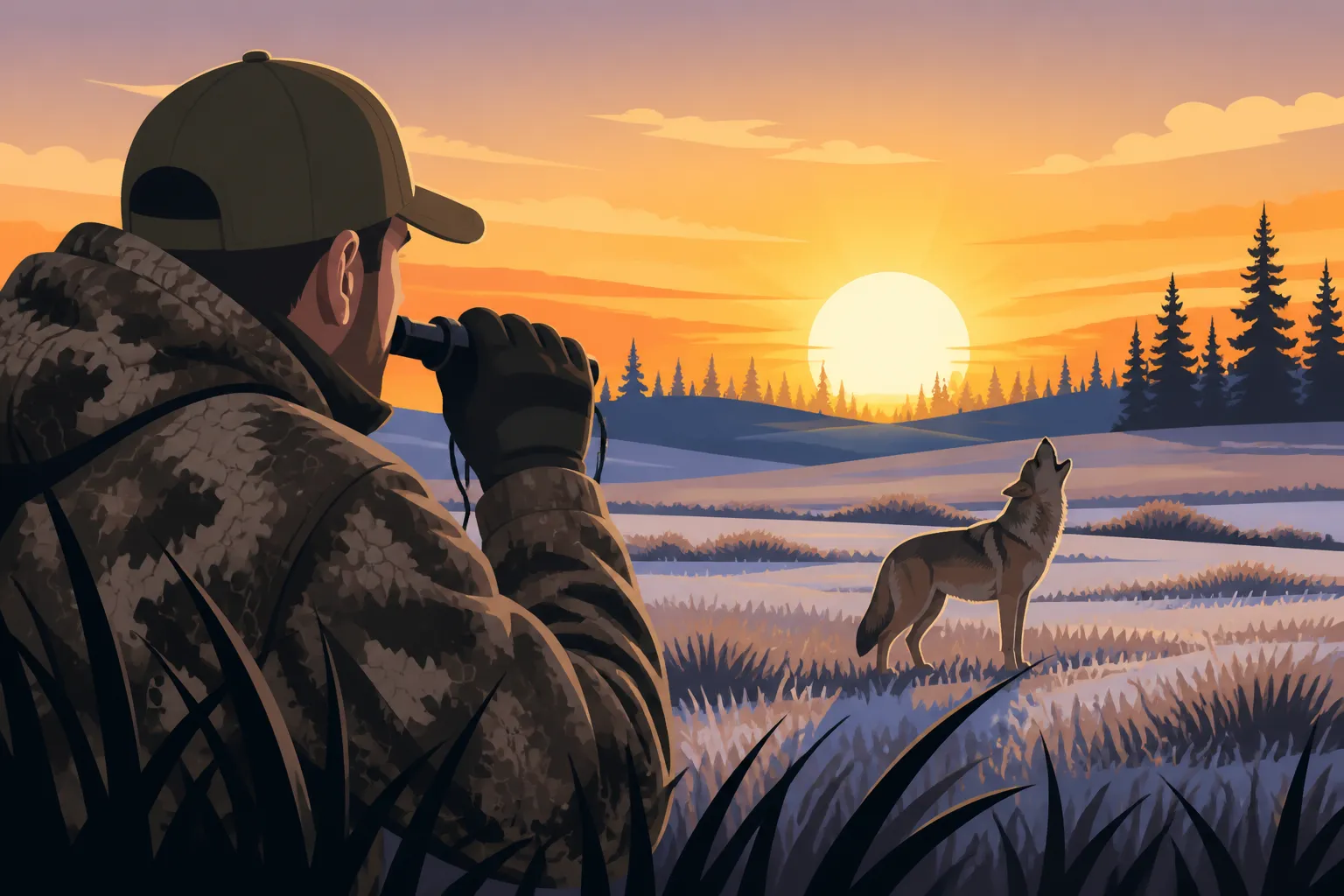
Given that you're hunting in low light, quality optics are paramount. A good pair of binoculars (8×42 or 10×42 with excellent light-gathering capabilities) can help you pick out a coyote emerging from cover long before you can see it with the naked eye. Your rifle scope should also be designed for low light, with a large objective lens (e.g., 50mm or 56mm) and good quality glass. Many modern scopes offer illuminated reticles, which can be incredibly helpful for precise aiming in twilight conditions.
For firearms, common calibers like .223 Remington, .204 Ruger, or .22-250 Remington are popular choices for coyotes due to their flat trajectory and minimal recoil. Just make sure your chosen caliber is appropriate for the distances you anticipate shooting and that you are using legal ammunition as per Legal Rifle Calibres for Big Game regulations, though coyotes fall under small game, it's always good to be aware. A stable shooting platform is also crucial. A bipod or shooting sticks will provide the stability needed for an accurate shot, especially when your nerves are jangling as a coyote closes in. Practicing your shooting in varying light conditions, similar to what you'd experience at dawn, will build confidence and improve your chances when it counts.
Mastering the Calls: Techniques for First Light Coyotes
Calling coyotes at first light isn't about being the loudest; it's about being smart, subtle, and incredibly patient. The nuances of your calling sequence can mean the difference between drawing in a curious predator and sending a wary one heading for the hills.
Starting Slow and Soft
We've all been there: the adrenaline is pumping, and you just want to let out a booming call to announce your presence. Resist the urge! At first light, coyotes are often close, either still hunting or moving to bedding areas. Blasting a loud, aggressive call right off the bat can easily spook a nearby animal. Instead, start incredibly soft. Think mouse squeaks, subtle bird distress, or even quiet, inquisitive whines.
Picture this: you've set up overlooking a promising cutline or a Hunting a Willow Ring Around a Pothole that leads into a dense bush edge. The air is still, and you know coyotes frequent this area. Your first series of calls should be barely audible beyond 50-75 yards. Use an electronic call with the volume almost on its lowest setting, or a hand call used very softly. This simulates small prey just beginning their day, or a less-dominant animal in distress. If there's a coyote within earshot, it will hear it, and curiosity will often override caution, especially if they're still hungry. Remember, the goal is to entice, not to alarm. Maintain these soft calls for 5-10 minutes, always scanning, before considering any escalation.
Varying Your Sequence and Sound Types
Once you've established a soft baseline, and if you haven't had any response, it's time to incrementally vary your sequence. This is where having a good repertoire of calls, or an e-caller with multiple options, truly shines. Don't just stick to one sound; coyotes can become accustomed to repeated, monotonous calls. Instead, mix it up.
A common and highly effective first-light sequence often involves:
- Initial soft distress (5-10 minutes): As discussed, this is your gentle invitation.
- Locator Howl (1-2 soft howls): After a period of distress, a soft, questioning howl can often provoke a response from a nearby coyote without being too aggressive. This is not a challenge howl but more of a "Is anyone there?" sound. If you're uncertain about how many coyotes are present or if they're actively holding in the area, a quiet Calling Coyotes in Manitoba Farm Country sequence might begin with a soft howl.
- Pup Distress (3-5 minutes): If no response to the howl, or if you heard a distant response, switch to pup distress. These sounds (whimpers, yelps, distress calls of young coyotes) are incredibly effective, especially on female coyotes, as they tap into their protective instincts. It's a primal trigger.
- Escalated Distress (5-10 minutes): If still no action, then you can increase the volume and urgency of your distress calls. A more aggressive rabbit squeal or a wounded bird call can convince a coyote further out that the meal is worth the effort.
The key is to use brief calling segments (30-60 seconds) followed by extended periods of silence (3-5 minutes), always scanning 360 degrees. Coyotes often circle downwind, so keep your head on a swivel. Some hunters using advanced apps like GoHunt even use timers to manage their calling sequences and silent periods, ensuring they don't overcall or miss crucial listening windows.
Reading the Response and Adjusting
The most critical skill in calling coyotes isn't just making sounds; it's listening and observing intently, then adjusting your strategy based on their response. We've all been taught to listen for a coyote howl or bark in response, and those are great, but sometimes the cues are much more subtle. A flicker of movement in the distant trees, the sudden silence of other birds, or even just a gut feeling that you're being watched.
If a coyote howls back, you know you've got their attention. Now, you need to assess distance and direction. If they're close, tone down your calling, go softer, and mimic a struggling animal moving away from them. This can often draw them in, thinking the "meal" is trying to escape. If they're far, maintain a moderate volume, making sure your calls are still heard but not so loud they sound unnatural. If a coyote hangs up at a distance, circling downwind but not committing, it's often a sign they're wary. At this point, you might try a very soft, intermittent call, or even complete silence for an extended period, letting their curiosity bring them closer. Sometimes, the best call is no call at all. Be patient, watch for any movement, and be ready to shoot as soon as they offer a clear, ethical shot. This mental game of anticipating and reacting is what makes coyote hunting so addictive and challenging.
Reading the Landscape and Weather for Success
Beyond the calls themselves, understanding how the environment influences coyote movement and your calling effectiveness is paramount. Manitoba's diverse landscapes, from open fields to dense bush, present unique challenges and opportunities for the first-light caller.
Choosing Your Stand: Approach and Backdrop
Your choice of stand location is perhaps the most critical decision you'll make, especially for a first-light hunt. You need a spot that offers good visibility, a clear shooting lane, and a suitable backdrop that breaks up your silhouette. But just as importantly, you need to consider your approach. Always plan to approach your chosen stand into the wind or with a crosswind. This minimizes the risk of spooking coyotes on your way in.
For example, if you're hunting near a known travel corridor like a Hunting a Field of Standing Corn or a frozen creek bed, identify a vantage point that allows you to see downwind and to the sides. A natural rise, a cluster of evergreens, or the edge of a timber block provides excellent cover. When scouting, I often use tools like GoHunt or other topographic maps to identify these key locations well in advance. Pay attention to how the light will hit at dawn; you don't want to be silhouetted against the brightening sky, making you an easy target for their sharp eyes. A good backdrop of trees or even a shadowed hillside can make you virtually invisible. Think about the sun's path and where shadows will be cast. A south-facing slope might get light too quickly, revealing you, while a north-facing slope might hold shadows longer, giving you an advantage.
Understanding Thermal Currents at Dawn
We touched on this briefly, but it deserves more attention. Thermal currents, or thermals, are air movements caused by temperature differences. At first light, as the sun begins to warm the ground, colder air in low-lying areas will start to rise. This creates predictable air currents that can carry your scent. In flat, open country, thermals are less pronounced, but in rolling hills, coulees, or river valleys (like the Hunting Near the Assiniboine River), they can be a significant factor.
Generally, early morning is characterized by stable air or downward thermals in higher elevations, then gradually reversing to upward thermals as the sun warms the land. This means if you start your hunt on higher ground, your scent might initially be pushed downwards into the valley or low ground where coyotes are likely moving. As the morning progresses, and the ground warms, the thermals will reverse, carrying your scent upwards. The trick is to set up in a way that uses these thermals to your advantage, or at least neutralizes them. Many experienced hunters will start a stand on a ridge in the very dim light, allowing their scent to drift down into the low ground where coyotes are, but then move to a lower position or exit before the thermals fully reverse. Learning Scouting a Manitoba Game Hunting Area should always include a detailed look at topography and anticipated wind/thermal direction.
Impact of Recent Weather Conditions
Manitoba weather is notoriously unpredictable, and recent conditions can dramatically impact coyote behavior at first light. A fresh snowfall, for instance, can make coyotes more active as they search for food, and Reading Sign After a Fresh Snow can give you invaluable clues about their travel routes and recent activity. Snow also deadens sound, so you might need to adjust your call volume accordingly.
Conversely, extremely cold temperatures, like those we experience during Hunting Safely in Deep Winter Cold, might make coyotes less willing to travel long distances, preferring to stay in heavy cover. In such conditions, focusing your efforts on dense bush edges or areas with abundant prey (like deer wintering grounds, where coyotes might scavenge on weakened animals) can be more productive. Heavy rain or strong winds can also suppress coyote activity, making calling more challenging. However, the period immediately after a storm breaks can be excellent, as coyotes often become very active, making up for lost hunting time. Always check the forecast and adapt your strategy to the current and recent weather patterns.
Disclaimer
The information provided in this article is for general guidance and informational purposes only. Hunting regulations, seasons, and licensing requirements in Manitoba can change. Always consult the most current Manitoba Hunting Guide and regulations published by the provincial government before planning any hunting activity. Ensure you understand and abide by all local, provincial, and federal laws. Safety should always be your top priority in the field.