Hunting a Willow Run for Whitetails
Many hunters in Manitoba know the frustration of seeing deer sign everywhere but never actually seeing the deer themselves, especially in those seemingly impenetrable thickets. These dense, often overlooked "willow runs" are actually whitetail magnets, offering cover, food, and security. This guide will help you understand, scout, and effectively hunt these crucial whitetail habitats, transforming those frustrating thickets into prime hunting grounds.
Unpacking the Mystery of Willow Runs for Whitetails
You might drive past them on the highway, or skirt around them on your way to a more "traditional" treestand location, but those seemingly chaotic tangles of willows and brush are gold mines for whitetail deer. They’re often dismissed as too thick to hunt, too noisy to move through, or just not as appealing as a nice, open aspen bluff. But that's exactly why they're so effective for deer, and why you should be paying closer attention.
Defining the Habitat
So, what exactly is a willow run? In Manitoba, it typically refers to a low-lying, often wet or semi-wet area dominated by various species of willow (like pussy willow, sandbar willow, or Bebb's willow), mixed with other dense shrubs such as alder, dogwood, and sometimes young aspen or balsam poplar. These areas can vary wildly in size, from small, elongated strips along a field edge or drainage ditch, to sprawling, almost impenetrable blocks of cover within larger bush country or interspersed among sloughs and potholes. They are characterized by their incredible density, creating a natural fortress where deer feel safe from predators and the elements.
Often, these willow runs are found in transition zones – where open prairie meets bush, along creek beds, in the depressions of the aspen parkland, or on the edges of agricultural fields. They thrive in areas with consistent moisture, acting like natural sponges in the landscape. Their dense, tangled growth provides an overhead canopy that offers shade in summer and some protection from wind and snow in winter, while the thick understory is a nightmare for anything larger than a deer to navigate silently. It's a prime example of where Manitoba's diverse habitat creates unique hunting opportunities.
Why Whitetails Love Them
Deer are masters of survival, and their primary concerns are safety, food, and thermal regulation. Willow runs deliver on all three counts with flying colours. For safety, the sheer density of a willow run makes it incredibly difficult for predators—whether coyotes, wolves, or humans—to sneak up on them. A deer can often hear a hunter approaching long before being seen, giving them ample time to slip away undetected through the maze of branches. This creates a sense of security that deer crave, making these areas prime bedding locations during daylight hours.
Beyond security, willow branches themselves are a browse food source, especially in late fall and winter when other forage becomes scarce. Deer will strip the bark and browse the buds, offering crucial nutrition when the snow is deep. The undergrowth within these runs often contains other forbs and browse species, providing a year-round pantry.
Furthermore, willow runs offer excellent thermal cover. In the scorching Manitoba summer, the dense canopy provides a cool, shaded refuge from the sun and biting insects. Come winter, the thick interwoven branches act as a windbreak, trapping insulating layers of snow and allowing deer to conserve precious energy in bitter cold. When you're Hunting Whitetails at Thirty Below, you can bet those deer are tucked deep into the thickest cover they can find, and willow runs are often the first choice.
Common Layouts and Features
Willow runs aren't all created equal, and understanding their typical layouts can give you a significant advantage. You'll often encounter them as:
- Linear Strips: These are common along drainage ditches, old fence lines, or small creeks. They act as natural travel corridors, funnelling deer movement between larger blocks of cover, bedding areas, and feeding grounds. Think of them as deer highways, especially where they connect two desirable locations.
- Edge Cover: Many agricultural fields, particularly in the Parkland region, are bordered by dense willow breaks. Deer will often bed just inside this cover and emerge into the fields to feed at dusk, retreating back into the safety of the willows at dawn. Hunting a Standing Canola Field Edge or a Swathed Grain Field at Dusk will often involve keeping a close eye on these willow edges.
- Islands of Thicket: In more open country, willow runs can form isolated pockets or "islands" of dense cover, often around sloughs or low spots. These act as central bedding hubs from which deer will radiate out to feed, returning to the security of the island.
- Expansive Blocks: In true bush country, willow runs can form vast, contiguous blocks, interspersed with small aspen stands or wet areas. These are the most challenging to hunt but can hold incredible numbers of deer, offering a lifetime of hunting opportunities within their confines.
Understanding these patterns will significantly improve your scouting efforts and help you predict where deer are most likely to travel and bed within these dense habitats.
Mastering Scouting in Willow Runs
Scouting a willow run can feel like navigating a maze blindfolded, especially when the leaves are still on. It’s not like glassing an open field or picking out rub lines in a sparse woodlot. This requires a different kind of detective work, focusing on intimate sign and understanding how deer use these confined spaces. Forget trying to see a mile; here, you're looking for clues literally at your feet.
Pre-Season Reconnaissance
Even before the season opens, a good pre-season scout can be invaluable. This is when you're not trying to be quiet, but rather to map out the lay of the land. Use tools like satellite imagery (check out GoHunt's mapping features for this, they're fantastic) to identify the outlines of willow runs, their connections to other cover, water sources, and feeding areas. Look for obvious trails, especially those that run along the edges or through the thinner sections. Sometimes, old logging trails or ATV paths might cut through a willow run, creating a slightly more open route that deer will readily use.
Walking the perimeter of the willow run during summer or early fall can reveal a lot. Look for entry and exit points into adjacent fields or larger bush. Pay attention to fence crossings – deer will always take the path of least resistance. You might also find faint trails leading into the dense interior. Don’t be afraid to poke your head into the edge, but save the deep dives for when conditions are right for close-up sign reading. Remember, in Manitoba, ticks can be quite prevalent in dense undergrowth during warmer months, so dress appropriately and check yourself thoroughly.
Reading Fresh Sign
Once hunting season approaches, or even during a mid-season cold front, fresh sign becomes your roadmap. Within a willow run, deer sign can be subtle but incredibly telling.
- Trails: Look for distinct trails snaking through the willows. These are often much narrower and more tunnel-like than trails in open timber. Pay attention to how worn they are. Heavily used trails, particularly those with fresh tracks, are hotbeds of activity. Look for trails that lead from a willow island to a field, or from one dense section to another.
- Tracks: Fresh tracks in soft earth or recent snow are your best friend. A single set of large tracks could indicate a mature buck using the run. Follow them, if possible, to see where they lead. Are they heading to a bedding area? A water source? Or out to a feeding area?
- Droppings: Fresh droppings indicate recent deer presence. Large piles, especially those found in dense cover, might suggest a bedding area.
- Rubs and Scrapes: These are less common deep within the densest part of a willow run but can be found on the slightly more open edges or where a strong trail runs past a small tree. A rubbed willow branch is a clear sign a buck has passed through. During the rut, bucks will often create community scrapes along these travel corridors. For more on this, check out Reading Whitetail Sign in Manitoba Aspen, as many of the principles apply here too.
Using an app like GoHunt to mark these signs on your map as you find them is crucial. It helps you build a picture of deer movement over time and identify key areas within the seemingly uniform cover.
Identifying Key Travel Corridors
The real trick to hunting willow runs is identifying the specific travel corridors that deer use most frequently. These aren't always obvious. Deer, like humans, prefer the easiest route. Look for:
- Natural Funnels: Areas where the willow run narrows, or where a slight rise in elevation forces deer into a tighter path. These are ambush points.
- Crossings: If the willow run spans a wet area, creek, or drainage, deer will often cross at the easiest, driest points. Look for worn down banks or tracks in the mud.
- Connecting Points: Where a willow run connects to a different type of cover (e.g., a larger aspen stand, a cornfield, or a river bottom), these junction points are usually high traffic areas.
- Internal Trails: Sometimes, within a large block of willows, there will be a more defined "main trail" that branches off into smaller bedding trails. Finding these main arteries is critical.
Consider using motion-activated trail cameras on these key corridors. Set them up discreetly, facing down a trail, and check them regularly. They can confirm deer presence, identify specific animals, and help you pinpoint the exact times deer are using these routes, which is vital for planning your hunt.
Effective Hunting Strategies for Willow Runs
Once you’ve done your homework and identified promising willow runs, it’s time to put a plan into action. Hunting these dense areas requires a different mindset and approach than open timber or field hunting. Patience, stealth, and smart positioning are your best allies.
Stand Placement for Success
Deciding where to hang a stand in a willow run can be tricky, as tall, sturdy trees might be scarce. Often, you'll be looking for a sturdy aspen or poplar on the edge of the willow run, or perhaps a mature willow itself that can support a small stand or ladder stand. Your goal is not necessarily to see deep into the run, but to cover the key travel corridors you identified during scouting.
- Edge Stands: If the willow run borders a field, position your stand on the downwind side of a major trail that deer use to enter or exit the field. This allows you to catch them in transition. Ensure you have a clear shooting lane into the trail.
- Internal Ambushes: If you find a relatively open pocket or a significant trail intersection within a larger willow run, this can be a killer spot. You might need to trim a few branches (check regulations first!) to create shooting lanes, but the advantage of being deep in their sanctuary can pay off. Being slightly elevated, even just 10-12 feet, can make a huge difference in visibility and scent control. Remember to consider wind direction carefully, as your scent will swirl in dense cover. A great resource for this is Hanging a Stand on a Manitoba Bush Edge, as the principles for concealment and approach are very similar.
- Ground Blinds: Often, a well-placed pop-up ground blind is the most practical solution in a willow run. They offer excellent concealment, block your scent, and allow for comfortable, all-day sits. Brush them in heavily with local vegetation to break up their outline. Position the blind a bit off the trail, so deer don't see it until they're past your shooting lane, focusing on a clear shot at the trail.
When placing your stand or blind, always have a quiet entry and exit route. Spooking deer on your way in or out can ruin the spot for days.
Still-Hunting the Edges
For those who prefer to be on the move, still-hunting the edges of a willow run can be incredibly effective, especially with a fresh dusting of snow to muffle your steps. This isn't about crashing through the middle; it's about slow, deliberate movement along the perimeter, pausing frequently to observe and listen.
- Wind is King: Always hunt into the wind. Your scent will be blowing away from where you expect deer to be.
- Slow Motion: Take one or two steps, then stop for several minutes, scanning every shadow and branch. Use binoculars to pick apart the dense cover. Look for horizontal lines (a deer's back) or vertical lines (a leg or neck) in a world of vertical willows.
- Listen Intently: Deer moving through willows make noise – crunching leaves, snapping twigs. Listen for these subtle sounds, and try to pinpoint their location before they pinpoint yours.
- Focus on Transition Zones: Pay extra attention to where the willow run transitions into another habitat type, like a marsh, an aspen stand, or a field. These edges are often where deer are most active.
- Patience and Persistence: You might cover only a few hundred yards in an hour, but the payoff can be huge. The goal is to spot the deer before it spots you, giving you time for a shot.
This tactic works particularly well when Hunting Whitetails in Manitoba's Bush Country where willow runs are often intertwined with other dense cover.
Leveraging Calls and Decoys
While willow runs are dense, they’re not devoid of sound, and deer are highly vocal, especially during the rut. Using calls can be a game-changer here, bringing a curious buck out of the thicket.
- Grunts and Bleats: A simple fawn bleat can pique a doe's curiosity, often bringing her and any following bucks to investigate. During the rut, aggressive buck grunts or even a snort-wheeze can challenge a dominant buck, drawing him out to confront a perceived intruder. Remember that Grunt Calls Late in Manitoba's Rut can be particularly effective, as bucks are actively seeking out does and challenging rivals.
- Rattling: For an extra dose of realism, try rattling antlers. The sound of two bucks fighting can be irresistible to a dominant buck, especially if he thinks he can steal a doe or challenge an invader. Start with light sparring, then escalate to more aggressive clashing. In open parkland, you might need Rattling Volume in Open Parkland but in a willow run, the sound carries surprisingly well and often sounds more intense due to the echo and confinement.
- Decoys (Limited Use): While large decoys are hard to set up in thick willows, a small, collapsible doe decoy placed on an edge where a buck might see it before entering the run could work. The key is visibility and realism. Ensure the decoy is facing away from your shooting lane, so a buck approaching it presents a good shot opportunity. Always check local regulations on decoy use.
The key to calling in willow runs is to be patient and subtle. Don't overcall. Mimic realistic deer behaviour, and give any responses time to develop. A buck might circle downwind, so be ready for him to appear from an unexpected direction.
Timing Your Willow Run Hunt
Hunting willow runs isn't just about location; it's about timing. Deer use these habitats differently throughout the hunting season, influenced by factors like food availability, breeding cycles, and weather. Understanding these nuances will help you plan your most effective hunts.
Early Season Opportunities
When Manitoba's Archery Season Opens, willow runs offer fantastic early-season opportunities. In late August and September, deer are often still in their summer patterns, focusing on food and staying cool. The dense canopy of a willow run provides excellent shade during warm days, making them prime bedding locations.
- Food and Water: Look for willow runs that are adjacent to early-season food sources like alfalfa, peas, or even standing corn. Deer will often bed just inside the willows and move to these fields at dawn and dusk. Setting up an ambush point on a main trail leading from the willow run to a feeding area can be highly productive.
- Cooling Off: During warm early-season days, deer will seek out the coolest, shadiest spots. Willow runs, especially those bordering water, are often significantly cooler than open timber. This makes them ideal spots for midday still-hunting or stand sitting, as deer are less likely to be moving in open areas.
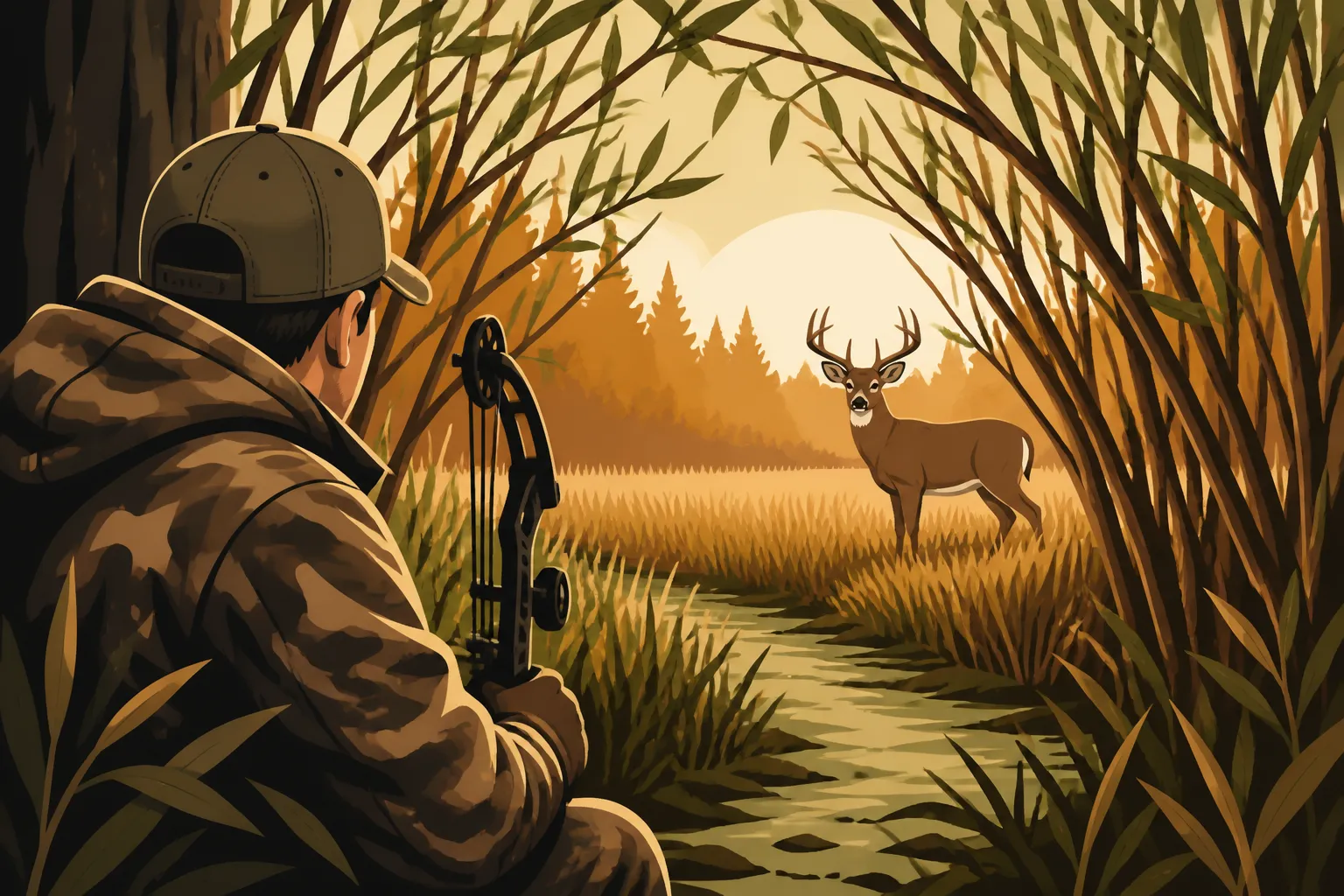
- Archery Advantage: The dense cover of a willow run makes it ideal for bowhunting. Shots are often close, requiring good stealth and shot placement. You can get away with less visibility than in rifle country, focusing on short, clear shooting lanes on known trails.
The biggest challenge in the early season is the thick foliage, which can limit visibility. This is where those internal travel corridors you found during scouting become critical.
The Rut in Willow Runs
The whitetail rut transforms deer behaviour, and willow runs become even more active during this frantic period, especially Hunting the Rut in Early to Mid November. Bucks are on the prowl, endlessly searching for does, and does are seeking security.
- Buck Highways: During the rut, bucks will use willow runs as high-traffic cruising lanes, scent checking for does. The dense cover provides them with a sense of security as they travel. Set up stands or blinds to intercept these cruising bucks, especially where a willow run acts as a funnel between two larger blocks of cover.
- Doe Bedding: Does, when receptive or trying to escape persistent bucks, will often duck into the thickest willow cover they can find. If a buck is trailing a hot doe, he'll eventually follow her in. This makes sitting near doe bedding areas within willow runs incredibly effective.
- Chasing and Hiding: The dense structure provides excellent cover for chasing and hiding. You might hear crashing and snorting within the run as bucks chase does, or as a doe tries to shake a suitor. Be ready to react quickly if deer burst into a clearing or onto a trail.
- Calling Effectiveness: As mentioned earlier, the rut is prime time for calling. Bucks are less cautious and more prone to investigate grunts, bleats, and rattling in their pursuit of breeding opportunities. Use GoHunt's rut reports and deer activity forecasts to pinpoint peak movement days.
During the rut, consider hunting longer hours, even through the midday, as deer activity can be sporadic and intense at any time.
Late Season Tactics
As winter sets in and snow blankets the Manitoba landscape, willow runs continue to be vital deer habitat. Hunting the Late December Season or other extended seasons often means facing bitter cold, and deer adapt by seeking the best thermal cover.
- Thermal Cover: With leaves gone and snow on the ground, the dense, interwoven branches of willow runs become critical thermal cover. They block the wind, trap snow for insulation, and help deer conserve energy when temperatures plummet. Deer will bed deep within these runs, often remaining there for extended periods during daylight hours.
- Snow Funnels: Deep snow can further restrict deer movement, funnelling them onto the most defined trails within and around willow runs. Tracks become much more visible, allowing you to pinpoint exact travel routes. Follow fresh tracks on these trails, moving slowly and deliberately.
- Browse Availability: Willow itself is a critical browse food in winter. Deer will spend time nipping at willow tips and stripping bark, making these areas both bedding and feeding zones.
- Stand Selection: For late-season hunts, focus on stands or ground blinds that offer maximum protection from the wind and cold. Heated blinds, if permitted and practical, can greatly extend your sit time. Target trails leading to major feeding areas, or deep internal trails that connect bedding pockets.
Hunting a willow run in late season often means still-hunting or patiently waiting in a blind, bundled in warm layers. Pay attention to the coldest, most blustery days, as deer will be hunkered down in the thickest cover. When you're Hunting Safely in Deep Winter Cold, knowing where the deer are concentrating for warmth is half the battle.
A Note on Ethics and Respect
Hunting willow runs can be incredibly rewarding, but it’s crucial to do so ethically and with respect for the land and the animals. This means:
- Private Land Permission: Many willow runs are on private land, especially those bordering fields. Always obtain explicit permission from the landowner before stepping foot on their property. Building good landowner relations is paramount.
- Minimize Disturbance: These are sensitive areas. Try to minimize your impact. Stick to established trails where possible, and avoid over-pressuring a specific run, especially if it's a critical bedding area.
- Shot Placement: The dense cover means shot opportunities can be fleeting. Practice shooting in tight windows and only take ethical shots you are confident in. Tracking a wounded animal in a dense willow run is incredibly challenging, especially when visibility is limited.
By approaching willow runs with careful planning, proper scouting, and a respectful mindset, you’ll unlock some of Manitoba’s most productive—and often overlooked—whitetail hunting.
| Willow Run Hunting Strategy | Best Season | Key Advantage | Typical Setup | Challenge |
|---|---|---|---|---|
| Edge Ambush | Early/Rut | Intercepts deer transitioning to fields | Treestand/Ground Blind on perimeter | Wind shifts, deer staying deep |
| Still-Hunting | All Seasons | Active search, covers ground | On foot, quiet clothing | Noise, limited visibility |
| Internal Ambushes | Rut/Late | Deep in bedding area, high security | Ground Blind, elevated stand (if possible) | Hard to access, limited shooting lanes |
| Calling (Rut) | Rut | Draws curious bucks out of cover | Any setup, focus on sound | Buck circling downwind, over-calling |
| Post-Snow Tracking | Late Season | Clear sign, funneled movement | On foot, slow and deliberate | Bitter cold, short daylight |
Disclaimer
The information provided in this guide is for general informational purposes only. Hunting regulations and conditions can change rapidly. Always consult the most current Manitoba Hunting Guide, provincial regulations, and local authorities before planning any hunting trip. Ensure you have all necessary licenses and permits, and adhere to all safety guidelines.