Telling a Ruffed Grouse From a Spruce Grouse
For hunters heading into Manitoba's diverse landscapes, the thrill of upland bird hunting is a unique experience. However, a common frustration arises when you flush a grouse and aren't entirely sure if it's a Ruffed Grouse or a Spruce Grouse. These two species, while both providing excellent sport and table fare, occupy slightly different niches and require different hunting approaches, making proper identification key to understanding their habits and knowing what you've bagged. This guide will walk you through the distinct characteristics and behaviors that will help you confidently tell these fantastic birds apart in the field.
The Core Differences: More Than Just Plumage
It’s easy to think a grouse is a grouse when it explodes from the underbrush, but taking a moment to observe – even for just a second – can give you crucial clues. These birds, despite their similarities in overall shape and size, are adapted to quite different environments and display behaviours unique to their species.
Habitat as Your First Clue
Think of habitat as your very first, and often most reliable, identifier. Where you find the bird tells you a lot about what kind of grouse it might be.
When you're walking through a mixed forest, perhaps where poplar and aspen stands meet a bit of spruce, or along an old logging road with plenty of secondary growth, you're squarely in prime Ruffed Grouse country. These birds absolutely thrive in early successional forests – areas that have been logged, burned, or disturbed and are now growing back with a mosaic of young trees, shrubs, and dense undergrowth. They love edges, where different types of cover meet, providing both food and escape routes. You'll often find them along trails, creek bottoms with willow runs, or in the transition zones between open fields and dense bush. If you’re pushing through thick pockets of saplings and alders, particularly in the Parkland or Boreal Fringe regions of Manitoba, and a bird flushes with an explosive whirring of wings, odds are excellent it's a Ruffed Grouse. They use this varied cover for drumming, feeding on buds and berries, and escaping predators. You'll want to be ready for fast-flying action in these environments. Ruffed Grouse Hunting Manitoba's Bush Trails delves deeper into these specific areas.
In contrast, Spruce Grouse are creatures of the deep, dark coniferous woods. Picture dense stands of black spruce and jack pine, often on poorer soils, with a thick carpet of moss and needles underfoot. These are the kinds of forests you'd find in the Eastern Shield Country or the Northern Boreal parts of Manitoba. They don't typically venture out into the open or into deciduous stands like ruffed grouse do. If you're hunting in a mature, unbroken conifer forest, especially one with significant evergreen cover, and you encounter a grouse, it's far more likely to be a Spruce Grouse. They blend in perfectly with the shadows and needle-covered branches, making them notoriously hard to spot until they move. Their diet is heavily reliant on conifer needles, which is why they stick so closely to these specific tree types. So, before you even see the bird, the type of forest you're in should be setting off alarm bells in your head as to which species you're likely to encounter. Check out Spruce Grouse Hunting in Black Spruce for more on their specific coniferous haunts.
Plumage and Physical Markers
Once you've narrowed down the habitat, it's time to look at the bird itself. The plumage offers some of the most definitive ways to tell them apart, even if it's just a fleeting glimpse.
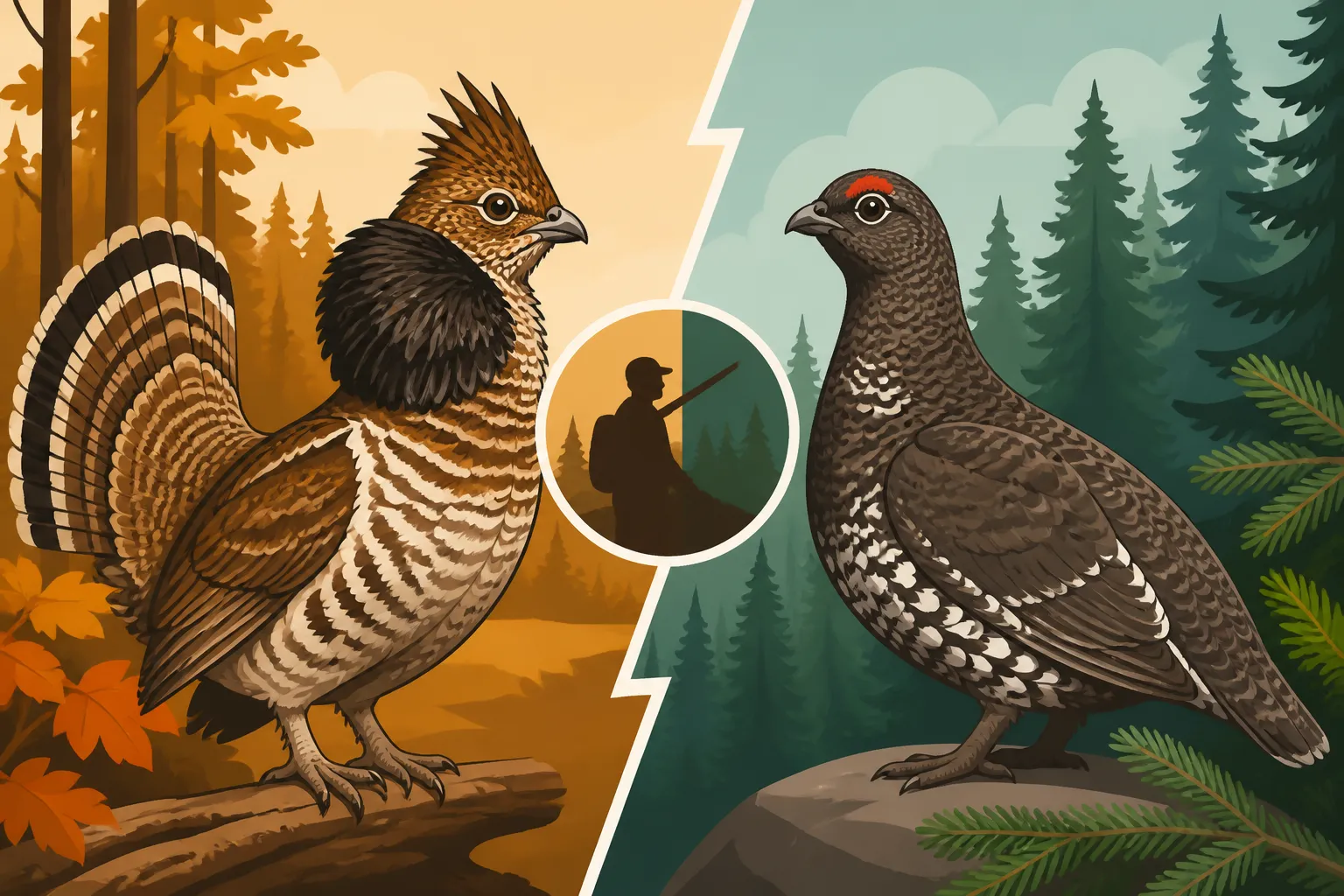
The Ruffed Grouse is often considered the classic woodland game bird, and its appearance is quite distinctive. The most obvious feature, and the one that gives it its name, are the prominent "ruffs" – iridescent black or dark brown feathers on the sides of its neck. While these are usually laid flat, they can be flared out during courtship displays. They also typically have a small crest on their head that can be raised. Their body plumage is a beautiful, intricate pattern of browns, grays, and black, providing superb camouflage against the forest floor. The overall impression is one of complex barring and mottling. Perhaps the most striking feature is their tail, which they fan out when displaying or startled. This tail is broadly banded, usually with a wide, dark subterminal band (a band near the tip) that often has a pale grey or buff edge. The colouration can vary quite a bit across their range, from a grayer phase to a more reddish-brown phase, but the banding on the tail and the presence of the ruffs are consistent markers.
Spruce Grouse, on the other hand, have a much darker, almost sooty appearance, especially the males. They lack the prominent ruffs and crest of their ruffed cousins. Male Spruce Grouse are particularly striking with their dark, barred chests and a distinctive patch of bright red skin (the "comb") above each eye, which is especially vibrant during the breeding season but can be visible year-round. Their flanks often show white spotting. The females are still darker than ruffed grouse, with a more muted, mottled brown and black pattern, but without the strong banding. The key difference from a ruffed grouse, however, is their tail. While they do have tail feathers, they don't have the same prominent, fanned tail with a distinct dark band. Instead, their tail feathers are typically blackish with a less distinct, often rufous or orange-brown tip, rather than a clear grey band. This difference in tail pattern is often the dead giveaway, even in flight. If you see a grouse that looks darker, less ornate, and flashes a hint of red above its eye, particularly in a dense pine stand, you're almost certainly looking at a Spruce Grouse.
Behavioural Traits in the Field
Beyond habitat and plumage, how these birds act when you encounter them is a huge clue. Their personalities, if you will, are quite different.
Ruffed Grouse are, to put it mildly, explosive. When you walk into their personal space, especially during hunting season, they don't dilly-dally. They'll hold tight, relying on their camouflage, until you're practically on top of them. Then, wham! They burst into the air with a thunderous flutter of wings, often darting through trees at incredible speed. This sudden, loud flush is designed to startle predators and throw off their aim. They'll typically fly directly to a nearby tree, often perching on a branch and blending in once again, making them incredibly tough to get a bead on unless you're quick and decisive. They are generally nervous birds, always on alert, constantly pecking at the ground for food, and quick to seek cover. They rarely tolerate human presence for long before flushing. This flight behaviour is a hallmark of Upland Bird Hunting in Manitoba.
Spruce Grouse, conversely, are famously, almost comically, tame. They're often called "fool hens" because of their apparent lack of fear. You can sometimes walk right past them on the ground, or they might just take a few steps away rather than flushing dramatically. If they do flush, it's usually a much quieter, slower affair, a sort of half-hearted flutter for a short distance before landing on a low branch or simply walking further into the dense cover. They seem to have evolved in environments with fewer ground predators and don't possess the same inherent fear response as their ruffed cousins. I've heard stories, and experienced it myself, of walking right up to a Spruce Grouse and watching it peck at needles or gravel without a care in the world. This doesn't mean they're easy targets, as their camouflage is exceptional, but their docile nature is a dead giveaway. If a grouse is acting remarkably calm, seemingly unconcerned by your presence in dense conifer cover, it's almost certainly a Spruce Grouse. This distinctive behaviour is one of the key indicators.
Specific Distinguishing Features: A Hunter's Checklist
Let's get down to the nitty-gritty details that can help you clinch that ID, even with a quick look. It's often about focusing on those one or two key features that stand out.
Tail Feathers and Patterning
The tail is, without a doubt, one of the most consistent ways to distinguish between these two grouse species. It's often visible, especially if the bird is perched or, in the case of the ruffed grouse, when it's fanned out during a flush.
For the Ruffed Grouse, envision a beautifully patterned fan. The most defining feature is that broad, dark band near the tip of the tail, often referred to as the subterminal band. This band runs almost the entire width of the fanned tail. On top of that, this dark band is typically bordered by a paler band, usually grey or buff, creating a very clear, high-contrast pattern. Think of it like a finely crafted piece of art, with distinct lines and shading. Even if you just see the tail as the bird rockets away, that clear, broad, dark band is the signature of a Ruffed Grouse. This is true whether the bird you're seeing is a grey phase or a red phase.
Now, shift your focus to the Spruce Grouse. Their tail, while still composed of numerous feathers, simply lacks that striking, broad, dark subterminal band. Instead, the tail feathers are generally darker, often blackish, and the tips might be edged with a reddish-brown or rufous colour, but it's not a prominent, continuous band. The overall impression is much more uniform and less distinctly patterned than the Ruffed Grouse tail. If you see a grouse with a dark tail that has a subtle, almost faded-looking reddish edge, you're likely looking at a Spruce Grouse. This difference is so clear that many experienced hunters can make a positive ID based solely on the tail flash as a bird flies away.
Ruffs, Combs, and Other Accents
Beyond the tail, paying attention to the head, neck, and specific markings can be incredibly helpful. These "accents" are usually very clear, especially if you get a good look at a perched bird or one moving slowly on the ground.
The Ruffed Grouse earned its name for a reason: those prominent feathered ruffs on the sides of its neck. While they can be flattened, in a display or when the bird is alarmed, these ruffs can be puffed out, making the neck appear much thicker and more substantial. They also have a noticeable crest on their head, which can be raised or lowered. This crest gives their head a slightly more "peaked" or "crested" appearance compared to the smooth, rounder head of a spruce grouse. Think of a tiny punk rocker hairstyle. These features, along with the detailed barring on their body plumage, create a highly camouflaged yet distinct pattern.
For the male Spruce Grouse, the most striking feature is the bright red comb above each eye. This isn't just a bit of red skin; it's quite prominent, especially during the breeding season, but often visible even in the fall. It's a clear, unmistakable splash of colour on an otherwise dark bird. Females and juveniles might not have such a vivid comb, but males almost always do. Additionally, the male Spruce Grouse typically has a black chest with distinct white spotting along its flanks, creating a mottled but still darker appearance than a Ruffed Grouse. The female spruce grouse is a bit more cryptic, a mottled brown with black bars, but again, she lacks the ruffs and crest of her Ruffed Grouse counterpart. If you see a bird with a sleek, dark body, a black chest with white spots, and those unmistakable red eyebrows in a conifer forest, you’ve found your Spruce Grouse. These subtle yet critical differences are what you'll want to hone in on.
Leg Feathering and Feet
While not always the most obvious distinguishing feature, the legs and feet can offer a quick, confirmatory check, especially if you're looking at a downed bird or one at rest. Both Ruffed Grouse and Spruce Grouse, being ground-dwelling birds of colder climates, share the characteristic of having feathered legs. This feathering extends down to their toes in some cases, providing insulation against cold ground and snow, and also aiding in walking on soft surfaces like deep snow or boggy ground.
However, the differences here are subtle and less pronounced than the tail or head markings. Both species have sturdy legs and feet adapted for scratching through leaf litter and walking over varied terrain. There isn't a significant enough difference in the extent or colour of their leg feathering to be a primary identification point in the field. What's more important to remember is that their legs are feathered, which distinguishes them from many other game birds you might encounter that have bare legs. So, while not a unique identifier between these two, it's a shared characteristic that reinforces their grouse identity. If you're using a dog, particularly a flushing dog that might retrieve, this feature will be clear on examination. Using a good field guide or even an app like GoHunt on your phone can help you confirm features if you're unsure.
Practical Tips for Identification in Manitoba
Knowing the textbook differences is one thing; applying them quickly and effectively in the field is another. Here are some practical ways to sharpen your identification skills while hunting in Manitoba's wild spaces.
Where to Focus Your Search
Your initial hunting strategy, guided by habitat, is truly your biggest asset in telling these grouse apart before you even see them. It's all about understanding their preferred environments.
For Ruffed Grouse, actively seek out those transitional areas. Think about the edges of agricultural fields bordering new forest growth, the fringes of old burns that are now dense with young aspen and willow, or creek beds lined with thick alder and regenerating poplar. They love areas where a patchwork of different tree ages and species creates a varied food source and ample escape cover. In Manitoba, areas like the Aspen Parkland region or the southern edges of the Boreal Forest are prime Ruffed Grouse habitat. When you’re Hunting Whitetails in Manitoba's Bush Country, you'll often find ruffed grouse in the same areas that deer frequent, as both thrive in diverse, early successional forests. GoHunt, with its detailed satellite imagery and land cover maps, can be an invaluable tool for scouting these mixed wood and edge habitats before you even step foot in the bush. Look for those lighter green shades indicating deciduous forest mixed with darker greens for conifers, or even old logging cuts.
Conversely, to find Spruce Grouse, you need to commit to the deep, dense evergreen forests. Forget the open edges; these birds are tied to the shelter and food source provided by extensive stands of black spruce and jack pine. You'll find them on dry, sandy ridges grown over with jack pine, or in the boggy lowlands dominated by black spruce, often with a thick moss understory. These are the kinds of forests that feel dark and silent, even in the middle of the day. Head further north into Manitoba's true Boreal Forest, or into specific areas of the Eastern Shield Country, and you'll find their domain. When you're Hunting Manitoba's Northern Boreal for other species, keep an eye out for these "fool hens" in the conifer thickets. These are often the same remote areas where you might find more solitary game. Utilizing detailed mapping resources to identify these coniferous strongholds will significantly increase your chances of encountering Spruce Grouse and correctly identifying them by their surroundings.
Observing Flight and Reaction
How a grouse reacts to your presence is incredibly telling and can often confirm your suspicions even if you only get a fleeting look.
The signature of a Ruffed Grouse is that explosive, heart-stopping flush. It's a burst of wings and sound that comes out of nowhere, usually as the bird rockets away through the densest cover it can find. This "explosion" is a defensive mechanism, meant to disorient you and give the bird a head start. They often fly straight and hard, sometimes drumming their wings even more loudly as they go, making it a challenging shot for even the most seasoned hunter. After the initial flush, they'll typically fly a good distance, often perching high up in a tree to observe their surroundings from safety. If you kick up a bird and it sounds like a small airplane taking off and then disappears into a thick tangle of branches, you've almost certainly encountered a Ruffed Grouse. Practice Walking Up Sharp-Tailed Grouse in Manitoba and other upland birds, and you'll start to recognize this distinctive flight pattern.
Spruce Grouse offer a stark contrast. Their nickname, "fool hen," isn't just for show. When disturbed, they often show little urgency. Instead of exploding into flight, they might simply walk away slowly, seemingly unconcerned, or fly a very short distance – often just to a low branch – and then remain perfectly still, relying on their exceptional camouflage to disappear into the conifer needles. I've literally walked past them on game trails, only realizing they were there when they moved a couple of feet or I spotted their distinctive markings. Their flight, if it happens, is usually much quieter and less powerful than a Ruffed Grouse. They're not built for high-speed evasion through deciduous trees; they're built for blending into dense conifers. If you approach a grouse in a dense spruce stand and it seems almost reluctant to leave, or flies only a short distance without much fuss, you can be pretty confident it’s a Spruce Grouse.
Photography and Field Guides
Sometimes, even with all the knowledge in the world, the moment of truth is just too fast, or the light is too poor. That's when modern tools and traditional resources come in handy.
In today's world, almost everyone carries a smartphone with a decent camera. If you manage to get a photo of a grouse, even a blurry one, it can be incredibly helpful for later identification. A quick snapshot of a bird you're unsure about can capture those crucial plumage details, tail patterns, or even the red comb on a male spruce grouse. You can then review the photo at your leisure, perhaps once you're back at camp or even at home, comparing it against reliable sources. This is especially useful if you're new to grouse hunting or exploring a new GHA. Even a picture of the habitat where you found the bird can provide clues. Many hunters use apps for GoHunt that include bird identification guides, allowing you to cross-reference images and descriptions right in the field.
Beyond photography, a good, old-fashioned field guide is an indispensable tool for any upland bird hunter. These guides provide detailed illustrations or photographs, descriptions of habitat, calls, and distinguishing features. Keep one in your pack, or even better, invest in a waterproof, pocket-sized version. Before your hunt, take some time to familiarize yourself with the key identification markers for both Ruffed and Spruce Grouse. This pre-hunt study will prime your brain to look for those specific details when you're in the field. Having these resources at hand helps solidify your understanding and prevents misidentification, ensuring you correctly identify and appreciate these fantastic game birds.
Here's a quick comparison to help you keep these distinctions straight:
| Feature | Ruffed Grouse | Spruce Grouse |
|---|---|---|
| Primary Habitat | Mixed woods, aspen/poplar stands, forest edges, regenerating forests | Dense coniferous forests (black spruce, jack pine) |
| Typical Flight | Explosive, loud, fast, darts through trees, flies far | Quiet, slower, short flights, often walks away |
| Behaviour | Nervous, alert, flushes readily, often perches high | Tame, docile ("fool hen"), relies on camouflage |
| Tail Pattern | Prominent, broad dark subterminal band with pale edge | Dark, less distinct pattern, often rufous/orange tips, no strong band |
| Head/Neck | Prominent neck ruffs, small head crest | Males have bright red combs above eyes, no ruffs or crest |
| Body Colour | Mottled browns/greys, intricate barring | Darker, sooty (males black chest with white spots), less intricate |
| Legs | Feathered legs (common to both) | Feathered legs (common to both) |
It's clear that while both are indeed grouse, their differences are more profound than just a slight variation in colour. By understanding their distinct habitats, appearances, and behaviors, you'll not only become a more knowledgeable hunter but also gain a deeper appreciation for the nuanced ecosystems of Manitoba. Knowing which grouse you've spotted can help you better understand their populations, choose the right hunting methods, and enjoy the diverse challenges these two upland birds offer.
Disclaimer
This article is for general informational purposes only and does not constitute professional advice. Laws, prices and regulations vary by location and change over time. Consult a qualified professional for guidance on your specific situation.