Shooting Distances on a Manitoba Hunt
One of the biggest anxieties many hunters face, especially when venturing into new territory like Manitoba, is knowing just how far they can ethically and consistently make a clean shot. It’s not just about how far your rifle or bow can shoot, but how far you can shoot accurately under real-world hunting conditions, which are often far from a calm shooting range. This guide is here to help you navigate the common shooting distances you might encounter across Manitoba's diverse landscapes and the key factors that influence your ethical range, so you can hunt with confidence.
Understanding Your Ethical Shooting Range
Before we even talk about specific distances, it's crucial to understand what "ethical range" truly means. It's not a hard number dictated by a regulation book, but a personal commitment to making a clean, humane kill every single time. This range can fluctuate based on countless factors, from your equipment to the weather to your own physical and mental state in that pivotal moment.
The Role of Practice and Proficiency
Let's be honest: hitting a target at 200 yards from a bench rest on a sunny, windless day is a completely different ballgame than making the same shot on a buck at last light, with snow swirling and your heart pounding from an adrenaline surge. Your ethical range is the maximum distance at which you can consistently place a killing shot under the most challenging conditions you might reasonably expect to encounter in the field. This means practicing in varied positions—standing, kneeling, prone, or even leaning against a tree—and in different weather. If you’re truly honest with yourself, many hunters find their ethical range shrinks considerably when the pressure is on.
Think about it: have you practiced quick target acquisition, or just slow, deliberate shots? Have you tried shooting after a brisk walk to simulate climbing a ridge or still-hunting through thick bush? These real-world scenarios are what define your actual capability, not just the best group you ever shot. Many experienced hunters will tell you that dialing in your rifle or bow at the range is just the first step; validating your personal limits in simulated field conditions is what truly prepares you for success. If you're looking for an outfitter that prioritizes ethical shot placement, resources like BookYourHunt can often provide insights into guides who emphasize extensive client preparation and conservative shooting distances.
Factors Affecting Your Shot Placement
So many variables can throw off a shot. Wind is a huge one in Manitoba, especially across open prairie or large lake country. A steady 15 mph crosswind can push an arrow significantly off course at 40 yards, and even a rifle bullet will drift more than you think at 200+. Light conditions, particularly at dawn and dusk, can make range estimation tricky and obscure your sight picture. The animal's stance, whether it's broadside and calm, or quartering away and fidgety, plays a massive role.
Then there's your own physical state: are you fatigued from a long hike? Are you shivering from the cold? Your mental state also matters: buck fever is a real phenomenon that can turn a calm, practiced shooter into a shaky mess. Knowing these limitations and choosing to pass on a shot that feels "iffy" is the hallmark of a responsible hunter. Don't let the excitement override your judgment. It's always better to walk away empty-handed than to risk wounding an animal.
Typical Shooting Distances for Manitoba Big Game
Manitoba offers incredibly diverse hunting experiences, from wide-open fields to dense boreal forest. This variety means that typical shooting distances can vary dramatically depending on the species and habitat you're hunting.
Whitetail Deer: Bush, Parkland, and Farmland Scenarios
Whitetail deer are, without a doubt, Manitoba's most popular big game animal, and you'll find them in almost every corner of the province. Their habitat dictates shot distance more than anything else.
In the dense bush country, like parts of the Interlake or Sandilands Provincial Forest, most shots are incredibly close-range. Think 20 to 80 yards, often through narrow lanes in thick poplars or spruce. Bowhunters thrive here, and even rifle hunters often find themselves shooting at distances that feel like archery range. The challenge isn't distance, but seeing the deer through the cover and stopping it for a shot. For more on this, check out Hunting Whitetails in Manitoba's Bush Country.
Moving into the aspen parkland, which is a mosaic of small bluffs, bush pockets, and open fields, distances open up a bit. Here, 50 to 150 yards is common. A deer might step out of a bluff to cross an alfalfa field, or you might catch one moving along a bush edge. Rifle hunters still have the advantage, but a proficient archer can certainly find opportunities. Many hunters utilizing mapping tools like those offered by GoHunt will study the terrain to identify these transition zones where shots might stretch out slightly.
On the wide-open farmland, especially in southwestern Manitoba, your shooting distances can jump dramatically. It's not uncommon to see deer, especially bucks, out in vast stubble fields or along tree lines at 200, 300, or even 400 yards. This is where long-range shooting skills become critical. A well-placed blind overlooking a large field might offer consistent 200-yard opportunities. However, even here, many successful hunters focus on catching deer entering or exiting fields at dawn and dusk, trying to keep shots under 150 yards where possible. Hunting Whitetails on Manitoba Farmland offers more detail on these specific tactics.
| Species | Typical Archery Range (Yards) | Typical Rifle Range (Yards) | Factors Influencing Range |
|---|---|---|---|
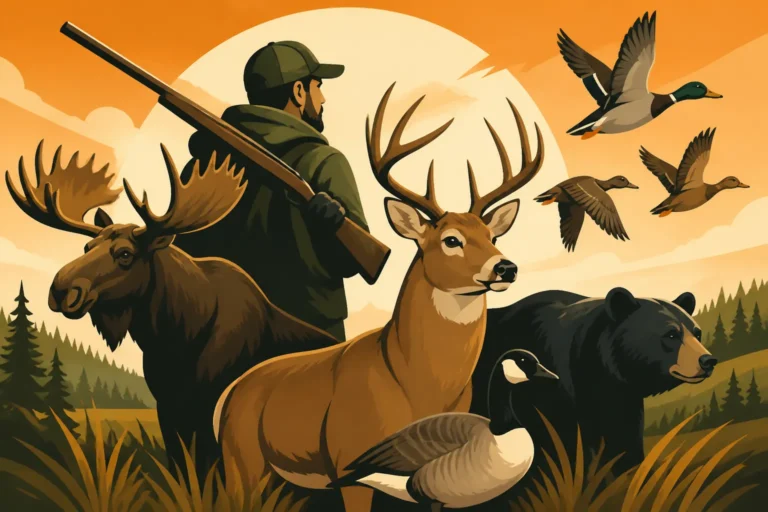
| Whitetail Deer | 15-40 | 50-300+ | Habitat (bush vs. open field), hunter concealment, wind |
| Black Bear | 10-30 | 20-100 | Bait site setup, thick cover, animal's behavior at bait |
| Moose | 20-50 | 50-200 | Dense bush, calling tactics, hunter's ability to move quietly |
| Elk | 20-50 | 50-250 | Parkland openings, calling, movement during rut |
| Waterfowl (Ducks) | N/A | 20-50 (shotgun) | Decoy spread, wind, bird flight path, lead calculation |
| Waterfowl (Geese) | N/A | 25-60 (shotgun) | Field layout, decoy spread, wind, pattern density |
| Upland Birds | N/A | 15-40 (shotgun) | Flushing distance, cover, dog work |
Black Bear, Moose, and Elk: Bush Encounters
Hunting the larger game animals in Manitoba often means venturing deeper into the bush, where shots tend to be closer and more deliberate.
For black bear hunting, especially over bait, your shot distances are usually very short, often between 10 and 30 yards. The entire setup is designed to bring the bear in close, offering you a high-percentage, ethical shot. Whether you're in a ground blind or a treestand, you've typically pre-ranged all the shooting lanes around the bait. The challenge here is patience and shot placement through thick hide and heavy bone, rather than distance. If you're arranging a guided bear hunt, discussing these expected ranges with your outfitter is crucial, and sites like BookYourHunt can help you find outfits with good reputations for ethical baiting practices. For more on this, see Baiting Black Bear in Manitoba.
Moose hunting in Manitoba's boreal forest is generally a close-range affair. Whether you're calling a bull in the rut or still-hunting through dense timber, most shot opportunities arise within 50 to 150 yards. Moose are massive animals, but they can disappear into the forest remarkably quickly. Making a clean, decisive shot is paramount. Often, the sound of your call will bring them in surprisingly close, so be ready for a short shot. Accuracy and quick follow-up are more critical than long-range capability. Calling Moose in Manitoba's Boreal Forest provides further context on how these close encounters often unfold.
Elk hunting, particularly in the parkland regions like the Duck Mountains, can present a mix of opportunities. During the rut, bugling bulls might come screaming in, offering shots at 30-80 yards. However, elk also frequent large open meadows or agricultural fields, where shots can stretch to 200-250 yards. It’s a dynamic hunt, and you need to be prepared for both tight timber shots and longer-range engagements across openings. Understanding the terrain through tools like GoHunt, which provide detailed topographical and satellite imagery, can help you anticipate these varied shot distances.
Waterfowl and Upland Bird Distances: A Different Kind of Challenge
Switching gears to wingshooting, the concept of "shooting distance" changes quite a bit. Here, it’s not about how far your bullet travels, but how your shotgun pattern performs and how quickly you can acquire a moving target.
Decoying Ducks and Geese
Waterfowl hunting in Manitoba is legendary, especially in the grain fields and marshes that concentrate millions of birds. The goal with ducks and geese, particularly when hunting over decoys, is to bring them into optimal shotgun range. For ducks, this is typically 20-40 yards, though some will pass closer or wider. For geese, especially Canada geese and specklebellies, 25-50 yards is the sweet spot. Snow geese, in their massive flocks, often require slightly longer shots, sometimes out to 60 yards, depending on how they commit to the spread.
The real skill here is judging distance to a moving target and leading it correctly. Many hunters use visual cues, like the size of the bird's head or the visible detail in its feathers, to judge if it's "in range." Patterning your shotgun with your chosen ammunition is absolutely essential to know your effective killing range. A tight choke might extend your reach, but it also means a smaller, less forgiving pattern at closer ranges. The wind also plays a huge role, not just for the birds' flight paths but for how they decoy, often giving you opportunities for close-range, low-flying shots. If you're considering a guided waterfowl trip, many Manitoba outfitters excel at setting up spreads that bring birds right into that optimal range, which you can often research on platforms like BookYourHunt. For insights into field setups, see Setting a Goose Spread in Swathed Barley.
Walking Up Upland Birds
Upland bird hunting for sharp-tailed grouse, ruffed grouse, and Hungarian partridge presents another set of unique challenges. These hunts are often about flushing birds, and your shooting distance is dictated by how far the bird flushes from you.
Sharp-tailed grouse in the prairie grasslands can sometimes flush at 30-40 yards, especially if you're walking them up without a dog. They often fly hard and fast, requiring quick swings and leads. Ruffed grouse in the thick aspen and spruce stands, however, often burst out at incredibly close ranges, sometimes as little as 10-15 yards, presenting a sudden, chaotic shot through trees. Hungarian partridge on farmland edges tend to flush in coveys, often scattering at 20-30 yards. The key with all upland birds is being ready, gun mounted, and swinging smoothly. It's less about maximum distance and more about reflexive, instinctive shooting at close, often obscured, targets. Walking Up Sharp-Tailed Grouse in Manitoba will give you more context on these exciting, close-quarters hunts.
Training and Equipment for Manitoba Distances
No matter what you're hunting in Manitoba, your training and equipment are paramount to extending your ethical shooting range, not just your maximum capability.
Caliber, Bow Weight, and Ballistics
Choosing the right caliber for your rifle or adequate draw weight for your bow is the foundation. For big game in Manitoba, standard calibers like .270, .30-06, .308, and 7mm Rem Mag are all excellent choices, capable of ethical kills at distances well beyond most hunters' practical limits. The key is to match the bullet to the game and to your rifle's accuracy. Knowing your rifle's ballistics—how much a bullet drops at various ranges—is absolutely critical for any shot over 100 yards. This is where range finders become indispensable.
For bowhunters, ensuring your bow is properly tuned and that your arrows are matched to your setup makes all the difference. Many Manitoba regulations specify minimum draw weights, such as those outlined in Bow Draw Weight Rules in Manitoba, but your personal comfort and accuracy with that weight are what truly matter. Practice from various distances and positions, making sure your form holds true even when tired.
Optic Selection and Rangefinding
Your optics are just as important as your firearm or bow. A good quality scope that gathers light well will give you precious extra minutes at dawn and dusk, and clear glass is non-negotiable for precise shot placement. Variable power scopes offer versatility, allowing you to dial down for close, fast shots in the bush and dial up for more precise aiming across open country.
A quality rangefinder is an absolute must-have for any big game hunter. It takes the guesswork out of distance estimation, which can be notoriously difficult in unfamiliar terrain, especially in flat prairie or rolling parkland. Pre-ranging key landmarks from your stand or blind can save you valuable seconds when an animal appears. Some hunters even create small range cards for their setups. When planning a hunt, tools like GoHunt often include features that allow you to map out potential shooting lanes and pre-range distances from specific stand locations, which is invaluable.
The Mental Game: Patience and Discipline
Ultimately, the most important factor influencing your shooting distance on a Manitoba hunt is your mental discipline. It's about knowing when to hold 'em and when to fold 'em. Pass on the marginal shot. Wait for the animal to present a perfect broadside opportunity. Take a deep breath. Squeeze the trigger. If you're unsure of the distance or the shot angle, or if the animal is moving erratically, let it walk. There will always be another opportunity. This is a lesson learned over many years in the field, and it’s one that every ethical hunter eventually embraces. Good preparation, whether it's through diligent practice or booking with a reputable outfitter you found on BookYourHunt, will build the confidence needed to make sound decisions under pressure.
Disclaimer
This article is for general informational purposes only and does not constitute professional advice. Laws, prices and regulations vary by location and change over time. Consult a qualified professional for guidance on your specific situation.