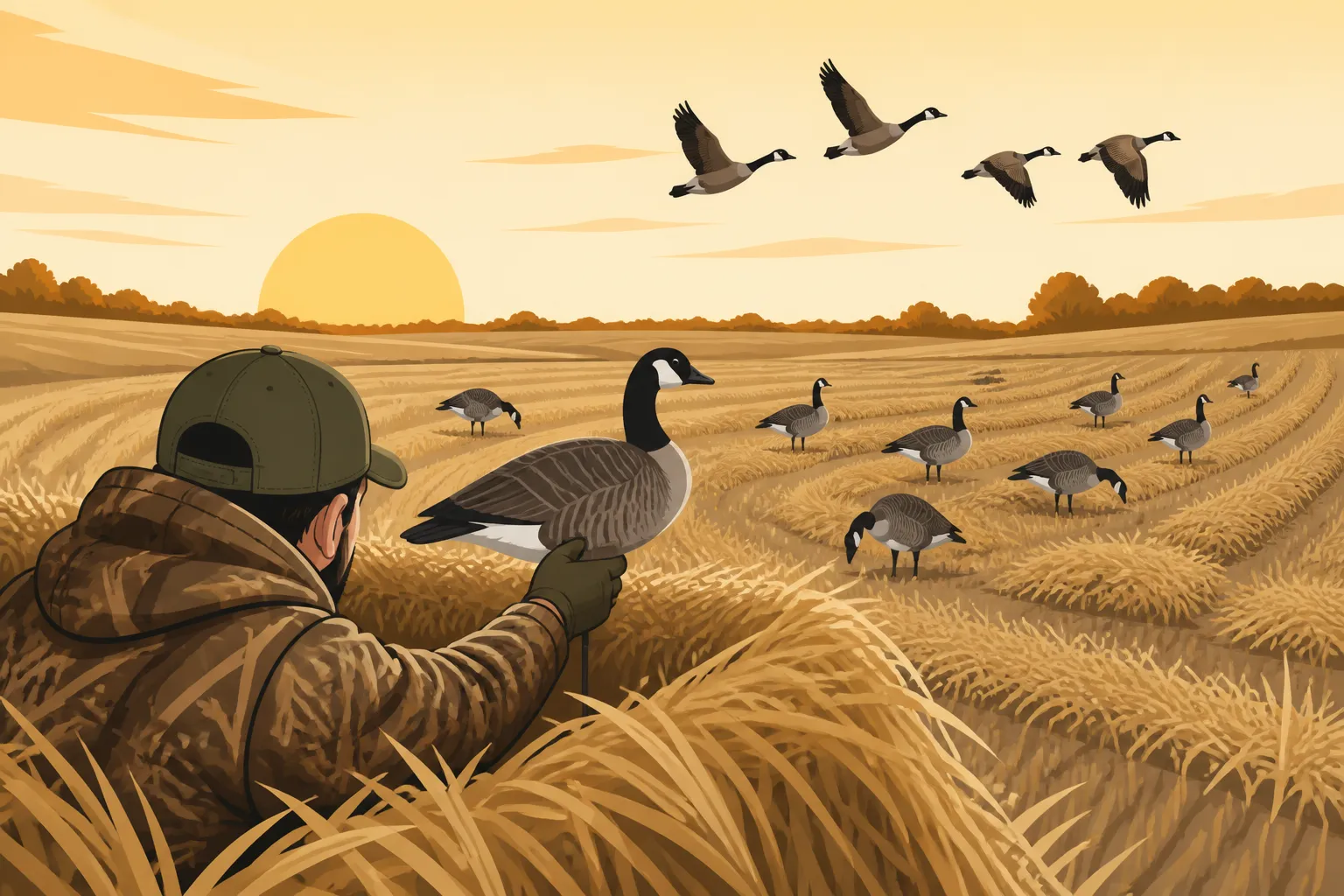
Setting a Goose Spread in Swathed Barley
There's nothing quite as frustrating as watching a perfect flock of geese commit, only to flare at the last second, leaving you scratching your head in a wide-open barley field. You've put in the time, scouted the birds, and hauled your gear, but something in your spread just isn't convincing them to finish. This guide is all about dialing in your decoy setup specifically for swathed barley fields in Manitoba, helping you understand goose behavior, optimize your spread, and turn those frustrating flares into successful retrieves.
Understanding the Goose and the Barley Field Environment
Hunting geese in Manitoba is a thrilling pursuit, but it demands a deep understanding of both the birds' habits and the specific landscape you're hunting. Swathed barley fields present a unique set of opportunities and challenges that, once mastered, can lead to incredible success.
Why Swathed Barley is a Goose Magnet
Swathed barley refers to barley that has been cut and laid down in rows by a swather, allowing it to dry before being combined. It's a common sight across Manitoba's agricultural belt in late summer and early fall, and for good reason, it's an absolute feast for migrating geese. Unlike standing crops where accessing grain can be a challenge, swathed barley offers an all-you-can-eat buffet that's easily picked through. The grain heads are exposed, the stalks are broken, and the entire field becomes a gigantic, ready-made bird feeder.
From a goose's perspective, these fields offer an ideal combination of readily available, high-energy food and a sense of security. The long, neat rows of cut barley provide a bit of visual texture and cover that geese instinctively feel comfortable landing among. They're not landing in a perfectly flat, exposed stubble field; there's a natural "messiness" that mirrors how they might feed in wilder areas, even if it's agricultural. The golden color of the swaths blends in with their plumage, and the slight rustle of the drying stalks can provide a subtle, comforting background noise. It’s no wonder that once a flock finds a good swathed barley field, they'll often return to it day after day until the food source is depleted or they're pushed off by hunting pressure. For a deeper dive into the general tactics, check out our guide on Field Hunting Geese in Manitoba Stubble.
Reading Goose Behavior in Agricultural Settings
To set an effective spread, you first need to understand how geese operate on the ground. When geese land in a field, especially one with abundant food like swathed barley, they're not just flying in randomly. They're looking for a specific kind of reassurance. They fly in family groups, often landing slightly upwind of the main feeding flock, then walking into the spread, mingling, and beginning to feed. Their feeding behavior is methodical – heads down, picking at the grain, occasionally lifting their heads to scan for danger.
Observing these natural patterns is crucial. Before you even set a single decoy, spend time scouting. This means watching from a distance, noting where they land, how they approach, and how they position themselves. Do they prefer the center of the field, or do they hug the edges? Do they land in tight clusters or spread out? Pay attention to the wind direction on the days they feed, as this will dictate their approach and your optimal spread orientation. Many hunters use tools, even digital ones like GoHunt's mapping features, to mark these observations directly on aerial photos of the fields. Geese are wary creatures, and any deviation from their perceived norm will cause them to flare. Your spread needs to mimic their natural, relaxed feeding environment as closely as possible. Our article on Scouting Fields for Manitoba Waterfowl offers excellent tips for this crucial preparatory step.
Essential Gear and Decoy Types for Barley Spreads
A successful goose spread in swathed barley relies heavily on the quality and variety of your decoys, as well as how effectively you can hide yourself within that setup. The right gear makes all the difference when trying to fool sharp-eyed waterfowl.
Decoy Selection: Full Bodies, Shells, and Silhouettes
The market for goose decoys is vast, but for swathed barley, you'll want a combination of types to achieve realism and volume. Each type has its strengths and weaknesses, and a truly effective spread often uses a mix.
- Full Body Decoys: These are the gold standard for realism. They replicate the three-dimensional look of a goose standing or feeding. When set properly, especially with a few "feeder" poses scattered among them, full bodies create an incredibly convincing scene. The downside is their bulk and cost. Hauling several dozen full bodies into a remote barley field can be a workout, and they are generally the most expensive option. However, their realism is unmatched, and they should form the core, or "anchor points," of your spread, especially closest to your blinds. Brands like Avian-X and Avery make excellent full-body decoys with realistic paint schemes and flocking that reduces glare.
- Shell Decoys: These are essentially the top half of a goose, designed to sit on the ground or be placed on short stakes. Shells offer a great balance between realism and portability. They're lighter and stackable, making them easier to transport than full bodies, while still providing a three-dimensional profile that geese can see from above. They're also more affordable than full bodies. Shells are fantastic for adding bulk to your spread, filling out the middle ground between your full bodies and your silhouettes, giving the illusion of a much larger flock without breaking your back or your budget.
- Silhouette Decoys: These are flat, two-dimensional cutouts of geese, usually made from plastic or corrugated material. Silhouettes are by far the most portable and economical option. You can carry dozens in a small bag. Their main advantage is creating the illusion of massive numbers from a distance. Geese flying high will see a huge "black blob" on the field, signalling a large, safe feeding flock. However, up close, their two-dimensional nature becomes obvious, which is why they work best on the outer edges of your spread. When used in conjunction with full bodies and shells, silhouettes can create an incredibly convincing depth of field, drawing birds in before they get close enough to discern the lack of detail.
The key to a successful decoy selection in swathed barley is to ensure your decoys look natural within the rows. Avoid shiny decoys, which can spook birds. Look for realistic paint jobs, and if possible, flocked heads or bodies that absorb light rather than reflect it. When planning your purchase, remember GoHunt often features gear reviews and discussions on various decoy brands, which can be a valuable resource.
Layout Blinds and Camouflage Considerations
Hunting geese in open barley fields almost universally requires the use of layout blinds. These low-profile shelters allow you to lie prone, hidden from view, until it's time to shoot. However, simply having a layout blind isn't enough; it must be expertly camouflaged to blend seamlessly with the swathed barley.
The challenge with barley is its distinct color and texture. Your blind needs to disappear into those golden-brown rows. This means "stubbling" your blind extensively. Collect handfuls of the actual swathed barley from the field you're hunting and weave it into the stubble straps or pockets on your blind. Don't just lay it on top; integrate it so it looks like a natural part of the swath. Pay close attention to the edges and corners of your blind, as these are often the first parts to give away your position. If the field has a lot of stubble from the cut, use that too. The goal is to break up the hard lines and unnatural shape of the blind.
Other options exist, such as A-frame blinds or natural cover, but in a freshly swathed barley field, natural cover is usually minimal or non-existent. A-frames can work if there's an existing fence line or significant ditch to back them into, but they are generally much harder to hide effectively in the middle of a wide-open field than a well-stubbled layout blind. Remember that geese have incredible eyesight, and even a slight glint of an exposed face or a patch of mismatched camouflage can send them flaring out of range. Consistency in your concealment is paramount for a successful hunt.
Crafting Effective Goose Spreads in Swathed Barley
Once you've got your gear, the real artistry begins: arranging your decoys to tell a story that convinces wary geese to drop their guard and commit. The spread isn't just a collection of decoys; it's a visual narrative of a safe, inviting feeding ground.
The Importance of Movement and Realism
Geese are constantly moving. They walk, they stretch, they preen, they feed, and when they land, their wings are in motion. A static spread, no matter how realistic the individual decoys, can look "dead" and unnatural to an approaching flock. Incorporating movement is a game-changer, especially in the often-still air of a Manitoba morning.
- Flagging: This is perhaps the most critical and cost-effective way to introduce motion. A goose flag, typically a fabric wing replica on a stick, can simulate a goose stretching, landing, or flapping its wings. The key is timing and subtlety. Use the flag to attract distant birds, making them think a fresh flock is just arriving. As birds get closer, use lighter, more natural movements. Too much flagging, or flagging when birds are directly overhead, can spook them. Think about what a goose actually does: quick, natural movements, not constant, frantic waving.
- Motion Decoys: Beyond flagging, various motion decoys can add continuous movement to your spread. Wind socks, often set on stakes, will undulate and sway with even a light breeze, creating a ripple of activity. Full-body decoys with spinner wings (battery-operated) or those designed to rock and swivel in the wind (like Lucky Duck or MOJO) can be incredibly effective. Place these strategically to draw attention, especially in the landing zone. They break up the static look and signal "life" to incoming birds. For a spread to be truly convincing, you need to simulate natural actions, drawing them in as they would to a large, active feeding party. Consider how you might adapt tactics from Hunting Snow Geese Over a Big Spread where sheer numbers and movement are often key.
Standard Spread Formations for Barley Fields
While there's no single "perfect" spread, several tried-and-true formations are highly effective, especially when adapted to the linear nature of swathed barley. The goal is always to create a clear, inviting landing zone within or just in front of your blinds, where geese feel safe to drop in.
- The "J-Hook" or "U-Shape": This is a classic for a reason. Imagine a large J or U shape formed by your decoys, with the open end of the J (the "hook") pointing slightly downwind and perpendicular to the prevailing wind. Your blinds are placed at the bend of the J, or just outside the bottom of the U, slightly downwind. Incoming geese will naturally fly into the open side of the J, turn into the wind, and prepare to land in the "pocket" you've created. This formation funnels them directly over your blinds, setting up ideal shots. In swathed barley, you can use the rows to help guide your decoy placement, creating natural-looking clusters within the J.
- The "X" or "Crab Claw": This formation uses two arms of decoys extending from a central point, creating two distinct landing zones or a single large one. Your blinds are placed at the intersection or slightly behind it. This works well for larger flocks or when you want to provide multiple approach options for the birds. It's particularly effective in very wide fields where birds might approach from slightly different angles. Think of it as creating a "crossing" point for the geese.
- "Family Group" Clusters: Geese don't feed in perfectly straight lines. They gather in smaller family units or small flocks. Instead of spreading your decoys out uniformly, create clusters of 5-10 decoys, leaving open spaces between them. These clusters should feature a mix of feeder and sentry poses, mimicking natural groups feeding together. This creates a more realistic, less regimented appearance. Place your blinds strategically within these clusters, ensuring you can pop up without alarming birds too far away. When placing decoys in swathed barley, try to set some right in the rows, and others between them, to break up any artificial uniformity.
| Decoy Type | Realism | Portability | Cost (per dozen) | Effectiveness in Swathed Barley | Optimal Placement |
|---|---|---|---|---|---|
| Full Body | High | Low | High | Excellent for anchor points and creating small, realistic family groups. | Closest to blinds, in key landing zones. |
| Shell | Medium-High | Medium | Medium | Good for adding bulk, dimension, and filling out the middle of the spread. | Between full bodies and silhouettes, or for larger groups. |
| Silhouette | Low-Medium | High | Low | Great for creating the illusion of large numbers from a distance. | Outer edges of the spread, far from blinds. |
| Wind Sock | Medium | High | Low | Essential for adding dynamic, natural motion with minimal effort. | Scattered throughout, especially where wind catches them. |
Advanced Tactics and Troubleshooting Your Barley Spread
Even with the best gear and knowledge of formations, goose hunting in swathed barley often requires on-the-fly adjustments. Conditions change, and geese can be notoriously finicky. Being able to adapt is what separates good hunters from great ones.
Adapting to Weather and Wind Conditions
Weather is arguably the biggest variable in goose hunting. Wind, in particular, dictates everything from how geese fly to where they land.
- Wind Direction: Geese always land and take off into the wind. This is your cardinal rule for spread setup. Your landing zone must be downwind of your main decoy mass, allowing birds to approach into the wind, hover, and settle without feeling rushed. Your blinds should be positioned to allow clear shots at birds committed to this landing path. If the wind shifts during your hunt, you may need to adjust your spread or even move your blinds to maintain an optimal shooting lane.
- No Wind Situations: These can be the most challenging. Without natural wind movement, your static decoys look even more unnatural. This is where flagging becomes absolutely critical. You'll need to work the flags constantly, making natural, fluid motions to simulate landing birds. Motion decoys (spinners, battery-operated flappers) are invaluable on calm days. Don't be afraid to walk out and manually shake a few decoys if birds are circling high.
- High Wind: Strong winds can make flagging difficult and blow over lightweight decoys. Ensure all your decoys are securely staked or weighted. High winds often mean geese are flying faster and lower, making for quicker shots. Focus on subtle movement from your flags and rely on the natural action of wind socks. Heavy gusts can also make calling more challenging, as sound doesn't carry as well.
- Fog and Rain: Fog can make for incredibly exciting hunts, as birds often drop lower and appear suddenly. Your decoys might need to be set closer to your blinds, and you'll be shooting at closer ranges. Darker decoys might stand out better in dense fog. Rain, especially heavy rain, can dampen a hunt, but determined birds will still feed. Focus on excellent concealment and making your spread as comfortable and visible as possible through the gloom.
Calling Strategies and Hunter Positioning
Calling is an art form, not just noise. It's about convincing geese that your spread is a safe, active, and desirable place to be.
- Calling Rhythms and Volume: When geese are distant, a loud, drawn-out "hail call" can grab their attention. As they get closer, switch to more conversational "clucks" and "double clucks," simulating feeding birds. Once they're committed and turning to land, a soft, reassuring "moan" or quiet clucking can seal the deal. Avoid over-calling, which can sound unnatural. Listen to the geese themselves. They'll tell you what they want to hear.
- Reading the Birds: Pay close attention to how geese react to your calls. If they turn and head your way, keep calling. If they ignore you, try a different cadence or volume. If they start to flare, stop calling immediately and assess your spread. Sometimes, silence is the best call. Many experienced hunters also refine their calling by observing the flock dynamics through platforms like GoHunt that share real-time field reports or scouting advice.
- Hunter Placement: Your position within the spread is as important as your decoys. Generally, hunters should be positioned at the "back" of the spread relative to the wind, facing into the expected flight path. This allows geese to fly over the majority of the decoys, presenting broadside or slightly quartering shots as they glide into the landing zone. Ensure your blinds are not too close to the main body of decoys, giving you enough space for ethical, safe shots. Also, consider shooting lanes – make sure you have clear lines of fire without hitting decoys or other hunters.
Troubleshooting Common Problems
Even the most experienced hunters face challenges. Knowing how to diagnose and fix problems on the fly can save a hunt.
- Geese flaring short: This is a classic frustration. If birds are pulling up before reaching your desired landing zone, it often points to a problem with concealment or the landing zone itself. Are your blinds perfectly hidden? Is there enough open space for them to land comfortably? Sometimes, your spread might be too dense, or there might be an obvious "trap" feeling. Try expanding your landing zone, pulling a few decoys back, and double-checking your blind stubbling. It could also be that distant decoys look more attractive than your landing zone.
- Circling but not committing: Birds that circle endlessly are hesitant. This could be due to decoy realism (shiny spots, unnatural poses), your calling (too loud, too frantic, or mistimed), or a subtle glint from an exposed face or gear. Stay still, keep quiet, and only call when they look away or drift further out. A well-placed flag might just be the convincer, mimicking a goose stretching its wings before settling in.
- Landing outside the spread: If birds consistently land just outside your main spread, it often means that "outside" area looks more appealing. Perhaps your spread is too small, or your landing zone isn't clear enough. Maybe your decoys are too spread out, or too uniform. Try extending your spread slightly in the direction they are landing, or making your existing landing zone more inviting by adding a few feeder decoys right at its edge. This issue is common across many types of field hunting, similar to challenges you might face when Hunting Manitoba's Sandhill Crane Fields. Remember, geese are looking for safety in numbers. If your outside fringes look safer than your core, they'll pick the outside.
Disclaimer
Hunting is an inherently risky activity. This guide provides information for educational purposes only and does not endorse unsafe practices. Always prioritize safety, adhere to all local hunting regulations and laws in Manitoba, and ensure you have the proper licenses and permits before engaging in any hunting activity. Be respectful of wildlife, private property, and other outdoor enthusiasts.