Hunting Manitoba’s Sandhill Cranes
The distinct call of a Sandhill Crane echoing across a vast Manitoba grain field is a sound many hunters dream of experiencing. Yet, these magnificent birds can be incredibly challenging to hunt, often frustrating even seasoned waterfowlers with their keen eyesight and wary nature. This guide is here to unravel the mysteries of hunting Sandhill Cranes in Manitoba, providing you with practical, in-depth strategies for scouting, setting up, calling, and ultimately, finding success with these incredible migratory birds.
Understanding Sandhill Cranes in Manitoba
Before you even think about setting up a decoy spread or perfecting your calling technique, it’s absolutely crucial to understand the Sandhill Crane itself. These birds are unlike geese or ducks in many ways, and a successful hunt hinges on respecting their unique biology and behaviour during their time in our province.
Migration Patterns and Timing
Manitoba serves as a critical staging ground for Sandhill Cranes as they journey between their northern breeding grounds and southern wintering areas. Typically, the first cranes begin to arrive in Manitoba around late August, with numbers steadily building through September. The peak migration for these birds usually occurs from mid-September through early October, depending on the year and the weather patterns pushing them south. They’ve spent the summer in places like the boreal forests and tundra of Canada’s North, where they breed and raise their young. As fall approaches, they begin their long trek south, often making prolonged stops in major agricultural areas like Manitoba to refuel. This timing is critical for hunters, as you’re looking to intercept these birds when they are most numerous and actively feeding. Paying attention to weather fronts and long-range forecasts can often give you an edge, as major cold snaps to the north can push large numbers of birds down quickly.
The routes these cranes take are generally along the Central Flyway, which bisects Manitoba. While they can be found across various parts of the province, certain areas tend to concentrate them more due to available food and safe roosting sites. The Interlake region, the agricultural belt west of the Red River, and parts of the southwest are all well-known for hosting significant numbers of migrating cranes. Understanding these broad patterns helps narrow down your scouting efforts immensely.
Preferred Habitats and Food Sources
Sandhill Cranes are creatures of habit, and their choice of habitat is dictated almost entirely by two factors: food and safety. For food, they are primarily agricultural birds during their migration through Manitoba. They absolutely love waste grain found in harvested fields. While they will eat various grains, they have a particular fondness for peas, barley, wheat, and increasingly, corn. You’ll often find them foraging in fields where combines have recently passed, gleaning leftover kernels that larger machinery might miss. This makes hunting a swathed grain field at dusk an excellent strategy. They also consume insects, small amphibians, and plant tubers, but during their staging in Manitoba, agricultural fields are their main buffet.
When it comes to roosting, Sandhill Cranes are incredibly wary. They prefer large, open wetlands, shallow lakes, or even large flooded fields where they can stand in relatively shallow water overnight. These areas provide protection from ground predators, as their excellent eyesight allows them to spot any approaching danger from a distance. During the day, they will fly from these safe roosting sites to feed, and then return as dusk approaches. Identifying both feeding fields and nearby roosting areas is paramount to patterning their movements and setting up for a successful hunt. The larger the body of water and the more remote it is, the more appealing it will be for a large flock of cranes to settle in for the night.
Vocalizations and Behavior
One of the most captivating aspects of Sandhill Cranes is their distinctive vocalizations. Their loud, rattling, bugle-like call is unmistakable and can carry for long distances across the prairie. This call, often described as a "gurgle" or "trill," is produced by their unusually long tracheas, which coil into their sternum. They use these calls to communicate within their flocks, alert others to danger, and maintain cohesion during flight. When hunting, understanding these calls is vital. A flock might be chatty and loud in the air, or eerily silent if they are suspicious.
Cranes are also known for their highly cautious nature. They possess exceptional eyesight, rivaling that of Canada Geese, if not surpassing it. They are easily spooked by anything out of place – a glint of sunlight off a gun barrel, an unnatural shadow, or an exposed hunter. They often circle high above a prospective landing zone multiple times, scrutinizing every detail below before committing to land. This keen sense of observation means that hunters must prioritize concealment above almost everything else. Watching a flock work your decoys, gradually lowering altitude with each pass, can be exhilarating, but one wrong move and they will quickly flare and be gone.
Scouting for Success in Crane Country
You simply cannot overstate the importance of scouting when it comes to hunting Sandhill Cranes. Unlike some other game birds, cranes are not randomly distributed; they are incredibly predictable once you find their pattern. Successful crane hunting is 90% scouting and 10% shooting.
Locating Feeding and Roosting Areas
Your primary mission while scouting is to locate active feeding fields and identify their flight paths to and from their roosting sites. This means spending time driving rural roads, especially in areas known for crane activity. Bring good binoculars or a spotting scope; they are your best friends in this endeavor. Drive slowly, keep your eyes peeled for large groups of birds in the distance, and pull over safely to observe. Look for the distinct reddish-brown bodies in fields, which stand out even from afar. You're looking for large numbers of birds actively feeding, not just a few stragglers.
Once you spot birds in a field, take note of the type of crop, the specific part of the field they are in, and their general direction of flight when they leave. Try to determine if it’s a morning feed or an afternoon feed. Distinguishing crane sign from goose sign can also be helpful. Crane tracks are larger and more distinct than those of geese, and their droppings are typically larger and contain more fibrous material, reflecting their varied diet. Focus on recently harvested fields, particularly those with pea, barley, or corn stubble. Tools like GoHunt can be invaluable here, offering mapping layers that sometimes show crop types or property boundaries, which can help immensely in narrowing down where to focus your physical scouting.
Timing Your Scouting Efforts
The best times to scout for Sandhill Cranes are at dawn and dusk. In the morning, you'll want to be out before legal shooting light to watch where cranes fly from their roost to their feeding grounds. Observe their flight lines – these are the aerial highways they use every day. In the evening, reverse the process: watch where they fly from their feeding fields back to their roost. This allows you to identify key flyways and potential setup locations. If you can get out for a full day of scouting, you might even be able to observe their mid-day loafing areas, although this is less common than dedicated feeding or roosting flights.
Pre-season scouting, if possible, is a great way to get a general idea of crane numbers in an area, but daily checks are crucial once the season is open. Crane feeding habits can change overnight due to new fields being harvested, increased hunting pressure, or shifts in weather. What was a hot field yesterday might be completely empty today. Therefore, continuous, diligent scouting right up to the morning of your hunt is absolutely essential. Don't be afraid to change your plan based on fresh scouting observations.
Gaining Landowner Permission
This is perhaps the most critical step after locating the birds. In Manitoba, most prime crane hunting takes place on private agricultural land. Without explicit permission from the landowner, you cannot hunt. Approaching landowners respectfully is key. Dress presentably, be polite, clearly state your intentions, and offer to share some of your harvest if successful. Always ask about specific boundaries, any areas they don't want you to hunt, and where they prefer you park. Remember, you're a guest on their land.
It’s often best to secure permission a day or two before you plan to hunt, rather than showing up on the morning of. This gives the landowner time to consider and allows you to build a relationship. Sometimes, even if they don't allow hunting on a particular field, they might direct you to another area or offer insight into crane movements on their property or neighboring land. Using resources like GoHunt can help you identify property owners, making the process of asking for permission more targeted and efficient. Always carry written permission or a way to contact the landowner if challenged. It’s a good practice, and it maintains good relations with the local community, which is crucial for continued hunting access. You can find more detailed tips on Getting Permission for a Goose Field, which applies equally well to cranes.
Essential Gear and Setup Strategies
Once you’ve done your scouting and secured permission, the next step is assembling the right gear and executing a flawless setup. Sandhill Cranes are notoriously wary, and any mistake in your spread, calling, or concealment will send them packing.
Decoys and Spreads
Decoys are absolutely vital for drawing cranes into range. You have several options: full-body decoys, silhouette decoys, and even some shell decoys. Full-body decoys offer the most realism and are often preferred, especially in heavily hunted areas. However, they are bulky and expensive. Silhouettes are more portable and affordable, and a large spread of them can be very effective, especially when paired with a few full-bodies. Motion decoys, such as flappers or flying crane kites, can also add realism and catch the attention of high-flying birds.
When setting your spread, think realism and numbers. Cranes are social birds, often feeding in large groups. While you don't need hundreds like a snow goose spread, a minimum of 1 to 2 dozen decoys is a good starting point, and 3-4 dozen is even better if you can manage it. Arrange them in small family groups of 3-5 birds, as this mimics their natural feeding behaviour. Leave a large, clear landing zone upwind of your blind – this is where the cranes will typically try to land. Spread your decoys out; cranes are large birds and tend to space themselves out in a field. Pay attention to wind direction, as cranes, like all large birds, land into the wind. This will dictate the orientation of your landing zone relative to your blind.
Calls and Calling Techniques
Sandhill Cranes have a unique vocalization, and effective calling is crucial to pulling them the last little bit into your spread. There are specialized crane calls available, ranging from electronic calls (which might have restrictions depending on local regulations, so always check the current Manitoba Hunting Guide) to mouth-operated calls. The key is to mimic their distinct rattling or gurgling call. Listen to actual crane calls online or, even better, in the field during your scouting missions, to get a feel for their rhythm and tone.
Start with soft, single calls to grab their attention when a flock is distant. As they respond and get closer, you can increase the volume and enthusiasm, mimicking a feeding flock. Once they are circling and focusing on your spread, sometimes less is more. Let the decoys do the work, and use softer, contented feeding calls. Overcalling can definitely scare them away. It takes practice to know when to be aggressive and when to be subtle. There are some excellent instructional videos available, and practicing at home is highly recommended. Combining your calling with subtle flag movements (using a crane flag) can also add another layer of realism to your setup.
Blinds and Concealment
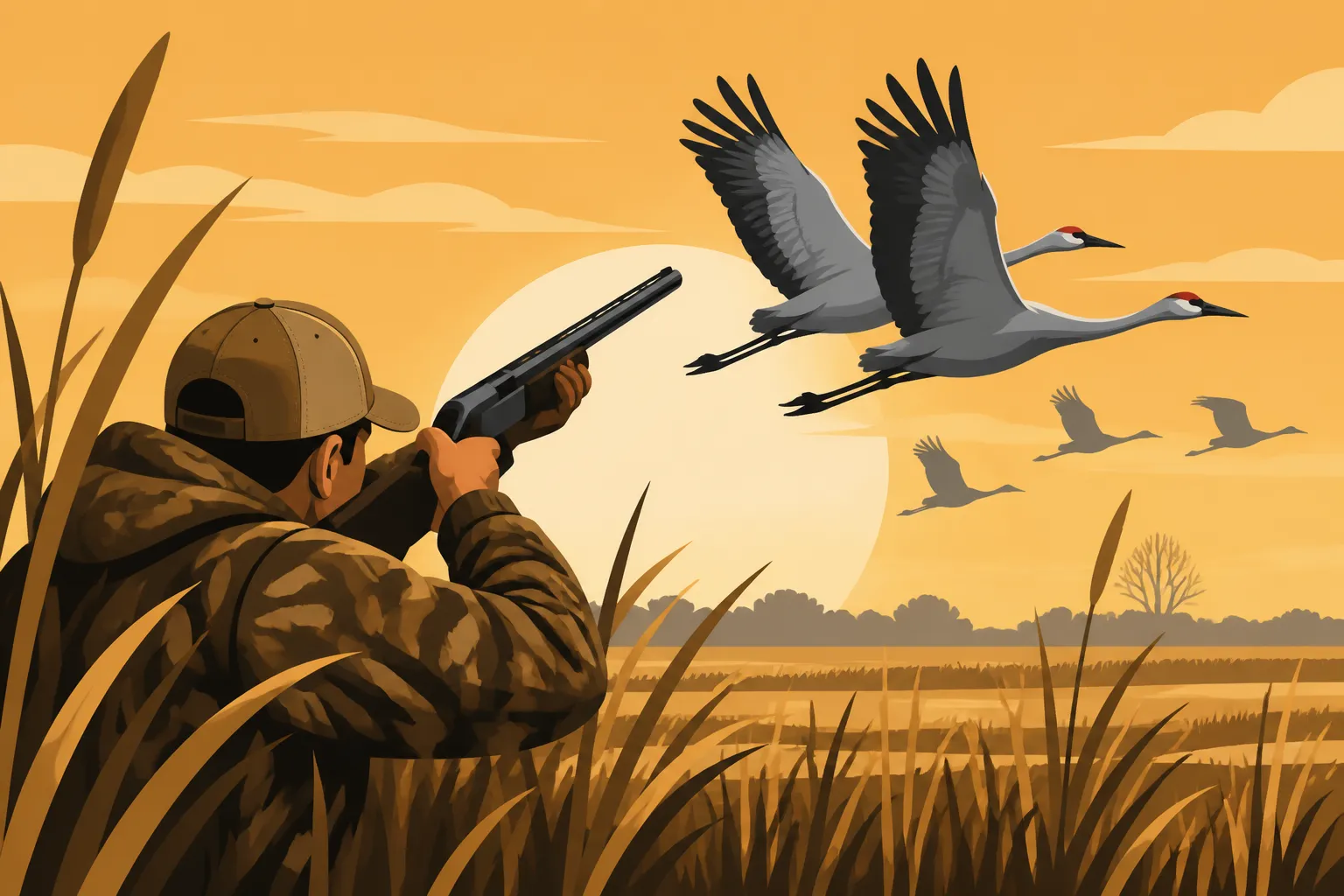
Cranes have incredibly sharp eyesight. This means that impeccable concealment is non-negotiable. Forget sitting out in the open, or even in a fence line without extensive cover. Layout blinds are arguably the most effective choice for field hunting cranes. They allow you to lie completely hidden within the field, blending in with the stubble. Ensure your layout blind is well brushed in with local vegetation – whatever is in the field you’re hunting. Cut stubble, corn stalks, or other field debris can be used to break up the outline of the blind.
If layout blinds aren't an option, or if the field offers natural depressions or thick vegetation, A-frame blinds or natural blinds built into a heavy fence line might work. The critical factor is that you must be completely invisible from above. Cranes will pick out anything unnatural. Pay attention to shadows; early morning or late afternoon sun can cast long, revealing shadows from an inadequately concealed blind. Plan your blind placement carefully, taking into account the sun's position and the wind direction. Remember that even the smallest exposed patch of skin or bright clothing can be enough to flare a wary flock.
Hunting Techniques and Field Ethics
Executing the hunt itself requires precision, patience, and strict adherence to ethical practices. Sandhill Cranes are a prized game bird, and ensuring a clean, ethical harvest is paramount.
Approaching the Field and Setting Up
Once you’ve scouted your field and prepared your gear, the approach and setup need to be executed with utmost stealth and efficiency. Arrive well before first light, ideally 60-90 minutes before legal shooting time. This allows you ample time to set up your decoys, position your blinds, and brush everything in without disturbing any early-arriving birds or being exposed to their keen eyes. Drive vehicles as far away from the setup as possible, or better yet, hide them completely. Cranes can spot vehicles from miles away.
Consider the wind direction carefully. Cranes will almost always land into the wind. Your blind should be positioned downwind of your decoy spread, with the landing zone directly in front of you. This gives you the best shot opportunities as the birds cup their wings and commit to land. Work quickly and quietly, minimizing chatter and light. Once your setup is complete, get into your blind and stay put. Patience is a virtue when hunting cranes; they might not show up immediately, but when they do, you need to be ready and completely hidden.
Shooting Opportunities and Shot Selection
Sandhill Cranes are large birds with a substantial wingspan, making them appear deceptively slow in the air. However, they are incredibly tough birds, requiring a good shot to bring down cleanly. When they commit to your spread and start working in, wait until they are directly over your landing zone, lowering their gear, or even have their feet down. Don't take long-range "sky-bust" shots; this often results in wounded birds that fly off.
For ammunition, non-toxic shot is mandatory for all migratory game birds in Manitoba, including Sandhill Cranes. Steel shot is the most common choice. Opt for larger shot sizes, such as BB, 1, or 2, to ensure adequate penetration and knockdown power. A 12-gauge shotgun with a modified or improved modified choke is a good starting point. As for lead, cranes require a generous lead, especially on crossing shots. Practice swinging through the bird and maintaining your follow-through. It’s an art form that comes with practice, and missing high and behind is a common error. Always aim for the front half of the bird to hit vital organs. More information on proper shot can be found in our guide on Non-Toxic Shot for Manitoba Waterfowl.
Retrieving Birds and Post-Hunt Care
Once you've made a clean shot and a crane is down, mark its location immediately. Cranes can be surprisingly difficult to find in tall stubble, even after a solid hit. A good retrieving dog is an invaluable asset for crane hunting, as they can quickly locate downed birds, minimizing potential waste. If you don't have a dog, carefully note landmarks and walk directly to where you saw the bird fall. Spread out your hunting party to conduct a thorough grid search if necessary. Wasting game meat is illegal and unethical, so every effort must be made to recover all birds.
After retrieval, field dressing your cranes quickly will help preserve the meat quality, especially on warmer days. Remove the entrails and allow the carcass to cool down. Crane meat, particularly from the breast, is often compared to beef and is absolutely delicious when prepared properly. Store the birds in a cooler with ice, ensuring proper air circulation. For more comprehensive information on proper handling, consult our article on Meat Care in Manitoba's Cold Snaps. Always leave evidence of sex on the bird as required by regulations during transport, typically one fully feathered wing.
Rules, Regulations, and Conservation
Hunting Sandhill Cranes in Manitoba isn't just about the thrill of the hunt; it's also about upholding ethical standards, understanding the legal framework, and contributing to conservation. Adhering to all rules and regulations ensures the future of this unique hunting opportunity.
Season Dates and Bag Limits
Manitoba's Sandhill Crane season dates and bag limits are set annually, and they can vary slightly from year to year. Generally, the season for Sandhill Cranes in Manitoba opens in early September and runs through early October, coinciding with their peak migration through the province. For specific, up-to-date dates, it's crucial to consult the current Manitoba Hunting Guide or visit the provincial government's hunting regulations website. You can also reference our guide on When Sandhill Crane Season Opens for typical timings.
Daily bag limits typically allow for a generous number of cranes, often around five birds per day, with a possession limit of double the daily bag. However, these numbers are subject to change, so always double-check before heading out. Understanding these limits is paramount not just for legality, but also for sustainable harvesting. We, as hunters, play a vital role in ensuring these populations remain healthy and abundant for future generations.
Licence Requirements and Federal Permits
To hunt Sandhill Cranes in Manitoba, you'll need more than just good scouting and decoys. First, you must possess a valid Manitoba hunting licence. For residents, this typically means a resident game bird licence. Non-residents, including those from other Canadian provinces or international hunters, will have specific non-resident licence requirements. Our comprehensive article on Manitoba Hunting Licences and What They Cost delves into these details.
In addition to the provincial licence, Sandhill Cranes are migratory game birds, which means federal regulations also apply. This requires all hunters of migratory game birds to possess a valid Federal Migratory Game Bird Hunting Permit, which includes the Canadian Wildlife Habitat Conservation Stamp. This stamp, often referred to simply as the "Habitat Stamp," is mandatory and the funds generated from its sale go directly towards wetland and habitat conservation projects across Canada. You can learn more about this in our article, The Habitat Conservation Stamp Requirement. These permits are easily purchased online or at post offices. Always carry all required licences and permits with you while hunting.
Conservation Efforts and Sustainable Hunting
Manitoba's Sandhill Crane population is generally healthy, a testament to effective wildlife management and conservation efforts. Hunters are an integral part of this conservation success story. Through licence fees and the purchase of the Habitat Stamp, hunters directly fund critical research, habitat preservation, and population monitoring initiatives. This sustained funding is essential for understanding crane populations, migration dynamics, and ensuring hunting remains a sustainable activity.
However, vigilance is always necessary. Factors like habitat loss due to agricultural expansion, climate change impacting migration patterns, and potential disease outbreaks could affect crane numbers. Responsible hunting practices, such as accurate identification of species, adherence to bag limits, and minimizing crippling losses, are all part of our collective responsibility. Supporting organizations like Ducks Unlimited Canada and the Delta Waterfowl Foundation, who are actively involved in wetland conservation in Manitoba and across the flyways, also contributes significantly to the long-term health of not just cranes, but all migratory birds. By staying informed, following the rules, and practicing ethical hunting, we ensure that the haunting rattle of the Sandhill Crane will continue to grace Manitoba's skies for years to come.
| Decoy Type | Pros | Cons | Ideal Use Case |
|---|---|---|---|
| Full Body | Most realistic, excellent visibility | Expensive, bulky, heavier to transport | Highly pressured areas, smaller spreads for realism |
| Silo (Silhouette) | Affordable, lightweight, easy to transport | Less realistic from certain angles, flat profile | Large numbers for visibility, less pressured areas |
| Shell | More 3D than silos, stackable | Less realistic than full bodies, can blow over | Mixed with full bodies, adding volume to spreads |
| Motion/Flapping | Adds crucial movement, highly visible | Mechanical issues, batteries, can be costly | Enhancing realism, attracting distant birds |
Disclaimer
Hunting regulations and conditions can change. Always consult the most current Manitoba Hunting Guide and relevant federal regulations before planning any hunting trip. This guide is for informational purposes only and does not supersede official government documentation. It is the hunter's responsibility to be aware of and comply with all applicable laws.