Field Setups a Waterfowl Guide Provides
For many waterfowl hunters, the dream of sprawling decoy spreads, perfectly hidden blinds, and flocks of ducks or geese cupping their wings is often met with the daunting reality of logistics, time, and sheer physical effort required to create such an ideal setup. Trying to replicate those picture-perfect scenes you see in hunting magazines can feel like an impossible task when you're doing it all yourself, especially when you factor in the ever-changing weather and bird movements across Manitoba's vast landscapes. This guide will walk you through the intricate world of field setups that experienced waterfowl guides in Manitoba bring to the table, showcasing exactly how they transform a plain stubble field or marsh edge into a magnet for migratory birds, saving you countless hours and maximizing your hunting success.
The Core Challenge of Effective Waterfowl Field Setups
Successfully hunting waterfowl, especially in a place like Manitoba known for its incredible migrations, isn't just about good shooting; it's profoundly about presentation. The birds, whether it's a flock of Canada geese winging their way south or a squadron of mallards looking for a safe landing, are incredibly sharp. They've seen countless spreads, encountered various calls, and learned to spot anything out of place from hundreds of feet in the air. This natural wariness is amplified when you consider the sheer number of hunters vying for their attention during the peak of the season.
Why DIY Setups Often Fall Short
Many solo or small-group hunters arrive at a field with a dozen or two decoys, maybe a few silhouette blinds, and a call or two. While this can certainly work on occasion, especially with less pressured birds or during inclement weather, it often falls short of consistently drawing in wary flocks. The sheer scale required for truly effective setups, particularly for geese, is often underestimated. You might spend hours setting out a modest spread, only to have birds flare at 200 yards, leaving you frustrated and wondering what went wrong. It’s not just about having decoys; it’s about having the right decoys, in the right numbers, placed in the right way, for the right species, in the right conditions. And then there's the concealment, which is equally, if not more, critical.
The Guide's Advantage: Expertise and Equipment
This is where a professional waterfowl guide truly shines. They aren't just taking you to a field; they're bringing years of local knowledge, a significant investment in specialized gear, and a deep understanding of bird behavior gleaned from countless hours spent in the field. They know the subtle nuances of topography, prevailing winds, and how birds are reacting on a particular day. Their equipment cache far surpasses what most individual hunters can accumulate, from hundreds of full-body decoys to specialized blinds that disappear into the landscape. This combination of insight and inventory allows them to create setups that are simply beyond the scope of a typical DIY effort, maximizing your chances of a memorable hunt. For instance, when you're considering a trip to a prime waterfowl destination, platforms like BookYourHunt or GoHunt often list guides who specifically highlight the quality and scale of their field setups as a major selling point.
Decoy Spreads: The Art and Science of Attraction
The foundation of any successful waterfowl hunt is the decoy spread. It's the visual invitation to passing birds, signaling a safe place to rest and feed. But it’s not just about throwing out a bunch of fake birds; it's a strategic arrangement designed to mimic natural feeding and resting patterns, accounting for species, wind, and the overall landscape.
Goose Spreads: Mass and Movement
For geese, especially the formidable Canada goose, a guide's spread is often characterized by its sheer size and realism. We're talking hundreds of decoys, not dozens. These aren't just shell decoys either. Most guides will deploy a significant number of full-body decoys, often flocked for a non-glare, ultra-realistic appearance. They might incorporate several hundred, mimicking a massive flock feeding in a stubble field. Beyond static decoys, movement is crucial. Guides utilize motion decoys like "zombie" or "agitator" decoys that simulate birds stretching, preening, or fighting for food, breaking up the static appearance of the spread. Flapping-wing decoys or flags, often called "wingers," are also strategically placed to create the illusion of birds landing, drawing the eye of distant flocks. The typical setup often involves a main body of feeding decoys, with a landing zone "hole" directly in front of the blinds, usually upwind, where geese prefer to land. Setting a Goose Spread in Swathed Barley or Hunting Snow Geese Over a Big Spread would be excellent resources to understand the specific tactics involved with these types of setups.
Here’s a look at common goose decoy types a guide might use:
| Decoy Type | Description | Primary Use | Advantage |
|---|---|---|---|
| Full-Body | Three-dimensional, highly realistic, often flocked. | Main body of spread, maximum realism. | Most convincing, especially in clear conditions. |
| Shell | Two-dimensional top shell, sits on a stake. | Adds bulk to the spread, cost-effective for numbers. | Lighter, easier to transport in large quantities. |
| Silhouette | Flat, two-dimensional profile, sticks into the ground. | Fills out spread quickly, adds perception of depth. | Very light, quick to deploy and retrieve. |
| Rag/Socks | Lightweight fabric "sock" on a stake, moves in wind. | Mass for large snow goose spreads, simulates movement. | Extremely portable, creates immense numbers rapidly. |
| Motion Decoys | Full-bodies with wind-activated or battery-powered movement. | Adds realism and attracts attention from afar. | Breaks up static nature, signals active feeding. |
| Flapping Wingers | Flags or powered decoys mimicking landing birds. | Draws attention, provides crucial landing cues. | Highly visible, triggers "landing reflex." |
Duck Spreads: Diversity and Precision
While goose spreads focus on mass, duck spreads often emphasize diversity and natural movement, especially when targeting dabblers like mallards, pintails, and wigeon. A guide will typically deploy a mix of species-specific decoys, reflecting what's common in the area. Mallard decoys are a given, but often pintails, wigeon, and even a few teal or divers might be added to create a natural "puddle" look. Waterfowl guides will often use specialized keel-weighted decoys designed to ride realistically on the water or in shallow field puddles.
Beyond species, movement remains paramount. Jerk cords, where a hunter subtly pulls a line to create ripples and bobbing motion among a cluster of decoys, are a staple. Spinning-wing decoys, often called "spinning-ducks" or "mojo ducks," are almost universally deployed. These battery-operated decoys create a flash and motion that can be irresistible to distant ducks, drawing their eye and encouraging them to investigate. The guide positions these strategically, often on the upwind side of the landing zone, so incoming birds see the motion as they approach. The goal is to make the spread look alive and inviting, signaling a safe haven with plenty of food.
Blinds and Concealment: Disappearing Into the Landscape
Having the most realistic decoy spread in the world is useless if the birds spot you. Waterfowl have incredible eyesight, and they've evolved to associate unnatural shapes or movements with danger. A guide's expertise in concealment is arguably as important as their decoy knowledge.
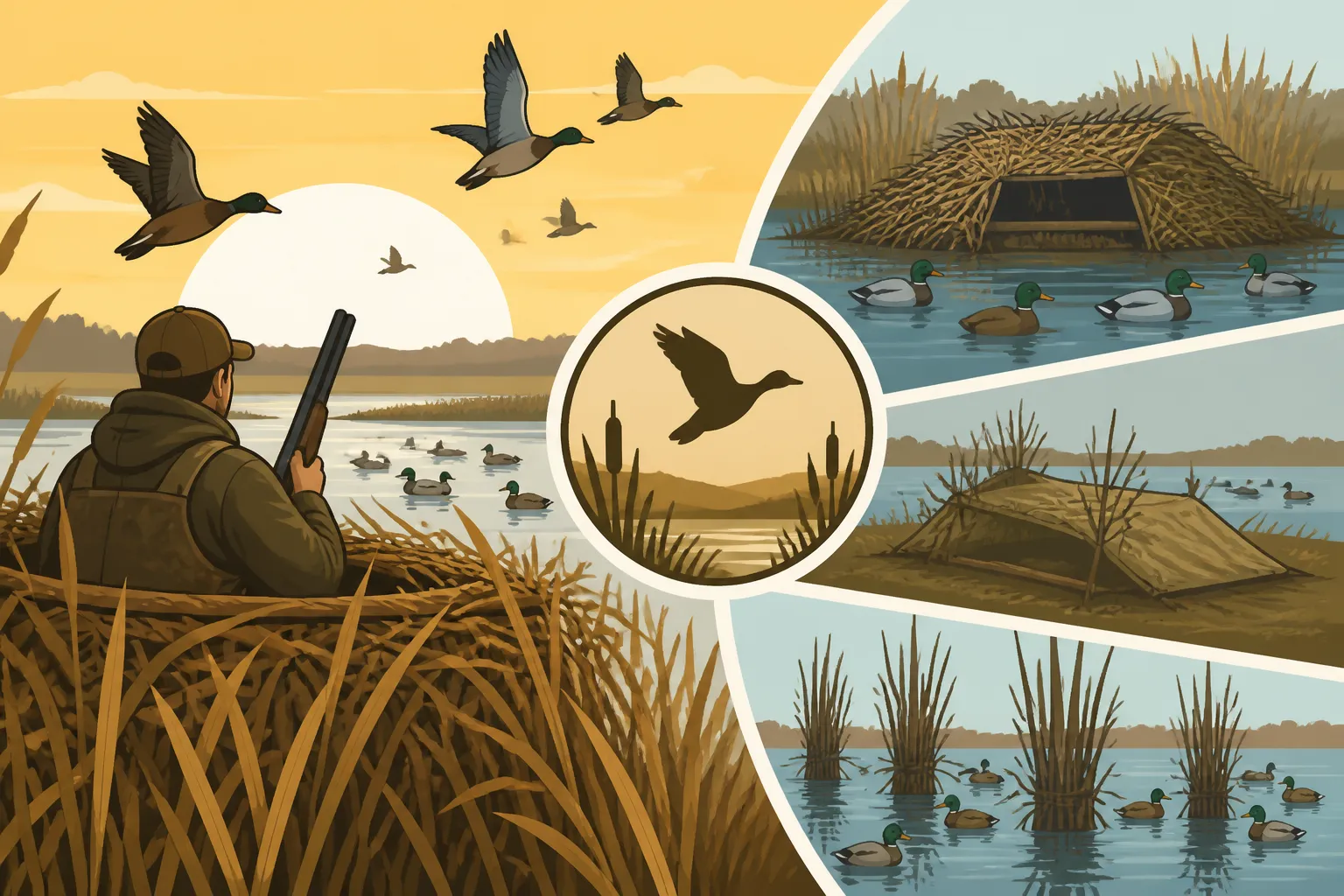
Layout Blinds: The Ultimate Field Hide
For field hunting, especially for geese, layout blinds are the industry standard for guides. These low-profile blinds allow hunters to lie down almost flat, blending seamlessly into stubble fields, cut corn, or fallow ground. Guides often own a fleet of these, ensuring every hunter has one. They're not just tossed out; they are meticulously brushed in with natural vegetation from the surrounding field – stubble, weeds, cornstalks – to break up their outline completely. A good guide will spend considerable time ensuring these blinds are truly invisible, often having them pre-positioned and brushed in before hunters even arrive. The ability to pop up quickly for a shot, without spooking incoming birds, is critical. Think about the preparation needed when Hunting a Swathed Grain Field at Dusk – a well-camouflaged layout blind makes all the difference.
Pit Blinds and A-Frame Blinds: Permanent and Semi-Permanent Solutions
In some locations, especially on private land or dedicated hunting areas, guides might utilize more permanent solutions. Pit blinds, dug into the ground and covered, offer near-perfect concealment and comfort, though they are geographically fixed. A-frame blinds, or panel blinds, are more portable than pits but offer superior concealment compared to layouts in certain situations, like along a treeline or a bush edge. These are typically camouflaged with heavy netting and natural foliage, resembling a brush pile or natural cover. The choice between these blinds depends on the specific field, the species being hunted, and the long-term strategy for a given hunting spot. A guide’s familiarity with different terrains, such as Hunting a Bluff Between Two Fields or Hunting a Shelterbelt Between Two Fields, dictates which blind type will be most effective.
Strategic Placement for Optimal Shots
Beyond the type of blind, its placement within the spread is critical. Guides understand the flight patterns and landing preferences of different species. Blinds are almost always placed downwind of the main decoy spread and the designated landing zone. This forces incoming birds to commit to flying over the spread into the wind, presenting broadside or slightly quartering shots at optimal ranges as they put their feet down. The guide will often position the blinds in a slight crescent or V-shape, ensuring all hunters have a clear line of sight to the landing zone without inadvertently shooting towards another hunter. The ability to read the wind and predict bird approach is a skill honed over many seasons, something a good guide provides.
Calling, Scouting, and Other Essential Gear
While decoys and blinds form the physical setup, a waterfowl guide's toolkit extends far beyond these. Their knowledge of calling, continuous scouting efforts, and the use of specialized support gear are equally vital in sealing the deal.
The Art of the Call
Calling is an art, and a seasoned waterfowl guide is often a master of it. They don't just blow a call; they interpret the birds' reactions, adjusting their cadence, volume, and tone based on whether the flock is distant, locked up, or flaring. For geese, a guide will use a range of calls – short-reed goose calls for the deeper, more guttural honks of Canada geese, often intermixed with clucks and murmurs to mimic a contented feeding flock. For ducks, a mallard call is primary, with rapid quacks, contented feeding chuckles, and comeback calls to lure wary birds. Guides also know when not to call, a subtle but crucial distinction. Over-calling can spook birds just as easily as poor calling. Their goal is to sound natural, inviting, and to react dynamically to what the birds are doing.
Constant Scouting and Adaptability
One of the most valuable services a waterfowl guide provides is continuous scouting. Unlike a hunter who might get a day or two to scout, guides are often out daily, sometimes multiple times a day, observing bird movements, feeding patterns, and preferred resting areas. This relentless scouting allows them to pinpoint exactly where the birds want to be and, crucially, to understand how those patterns shift with weather, hunting pressure, and feed availability. If birds were in Field A yesterday but moved to Field B today due to a change in wind or a new cut field, the guide knows this and will adjust the hunt location accordingly. This adaptability is key to consistent success. Without this constant intelligence, you're essentially hunting blind. This is why resources that connect hunters with guides often emphasize the guide's local knowledge, reflecting their daily scouting efforts. A site like GoHunt might help you research guides who have a proven track record of finding birds even when conditions are tough.
Support Gear and Logistics
Beyond the main hunting components, guides manage a plethora of support gear and logistical challenges. This includes ATVs or UTVs for quick deployment and retrieval of hundreds of decoys, especially in muddy conditions. Decoy bags, sleds, and trailers are essential for moving bulky equipment. They often provide heaters for blinds on those bone-chilling Manitoba mornings, ensuring client comfort. They'll have extra ammunition, first aid kits, and communication devices for emergencies. They also handle the necessary permits and permissions for hunting on private land, which can be a significant hurdle for independent hunters. Understanding Getting Permission for a Goose Field or Hunting Manitoba's Second Deer Licence GHAs highlights the importance of navigating these logistical details. A guide ensures all these elements are in place, allowing you to focus solely on the hunt itself.
The comprehensive field setup provided by a professional waterfowl guide in Manitoba is a game-changer for many hunters. It encompasses not just an impressive array of decoys and blinds but also a deep well of knowledge, tireless scouting, and meticulous logistical planning. This means less time struggling with equipment and more time focused on the exhilarating experience of watching birds commit to a perfectly executed spread.
Disclaimer
This article is for general informational purposes only and does not constitute professional advice. Laws, prices and regulations vary by location and change over time. Consult a qualified professional for guidance on your specific situation.