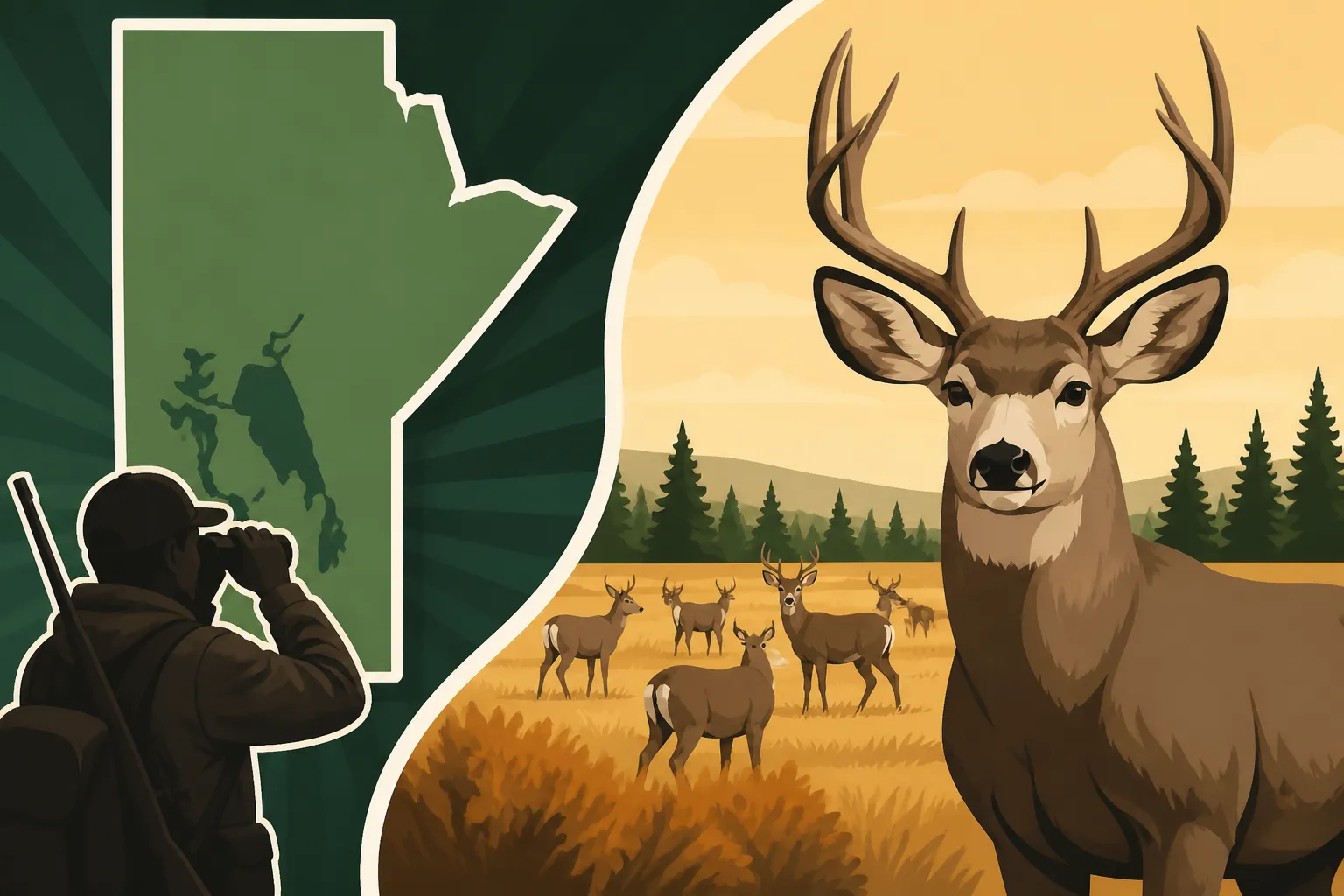
Whether Manitoba Has Many Mule Deer
It's a question many hunters new to Manitoba, or even some long-time residents, often ponder: do we have mule deer here? Given our proximity to provinces and states where they thrive, it's a natural assumption, but the reality can be a bit more nuanced and, for some, a little disappointing. This guide will dive deep into the presence of mule deer in Manitoba, where you might – just might – encounter them, how to tell them apart from our abundant whitetails, and what you need to know about hunting them here.
Where Mule Deer Actually Live in Manitoba
Let's cut right to it: if you're picturing vast herds of big-eared mule deer bounding across Manitoba's prairies and bush, you're likely to be disappointed. While mule deer are technically present in Manitoba, their population is incredibly small and their distribution is highly restricted. They are not a primary game species here, and you're far more likely to encounter one of our numerous whitetail deer.
The Scarce Southwest Pocket
Manitoba's mule deer population is primarily concentrated in a very specific, limited area: the extreme southwestern corner of the province. We're talking about the rough, broken country, often near the Saskatchewan and North Dakota borders. Think of areas like the Turtle Mountain region or the Pembina Valley slopes. These areas offer the more arid, rugged habitat that mule deer prefer, which is quite different from the vast agricultural plains or dense boreal forest that makes up most of Manitoba. Even in these pockets, their numbers are low, and sightings are considered rare and noteworthy events. You won't find them widely distributed across the parkland or the Interlake region, where whitetails reign supreme. If you're trying to find them, focusing your scouting efforts on these specific regions, perhaps using tools like GoHunt to analyze terrain and potential habitat, would be your best bet, but manage your expectations for a true mule deer hunt.
Transient Visitors and Isolated Incidents
Beyond these small, established pockets, any other mule deer sightings in Manitoba are usually of transient individuals. These might be bucks that have wandered in from Saskatchewan or North Dakota, pushed by pressure, looking for new territory, or simply exploring during the rut. These individuals rarely establish permanent populations outside the core southwestern range. They are like fleeting ghosts, passing through. For the average hunter pursuing deer in Manitoba, focusing on the strong whitetail population is the practical reality. Even experienced local hunters rarely stumble across a mule deer, let alone target one. This isn't to say it's impossible, but it highlights just how uncommon they are across the vast majority of the province.
Telling a Whitetail From a Mule Deer
This is arguably the most crucial section for any hunter in Manitoba, especially if you happen to be in one of those rare areas where a mule deer might show up. Misidentification can lead to serious issues, as mule deer are managed very differently than whitetails, and you might not even have a legal tag for them. While most hunters are familiar with whitetails, spotting a mule deer for the first time can throw you off.
Key Visual Identifiers
The differences between whitetails and mule deer are pronounced if you know what to look for, but in a fleeting moment, with adrenaline pumping, it can be easy to make a mistake. The most obvious difference, and where mule deer get their name, is their ears. Mule deer have significantly larger ears, often described as "mule-like," that are much longer than a whitetail's and are typically held more upright. Their antlers are also distinct: mule deer antlers typically fork and then fork again, creating a "bifurcated" pattern, whereas whitetail antlers usually have a main beam with tines branching off it.
Another telling sign is their tail. A whitetail's tail is broad and bushy, typically brown on top and pure white underneath, and when alarmed, they raise it high, revealing the "flag" that gives them their name. Mule deer, on the other hand, have a narrower, rope-like tail that is either pure white with a black tip or entirely white, and they usually hold it down, flicking it from side to side when alarmed, rather than flagging it high. Their gait is also different; mule deer often have a distinctive "stotting" or "bounding" gait, where all four feet hit the ground simultaneously, especially when escaping, while whitetails typically run with a more fluid, galloping motion.
Lastly, their coloration and body shape can offer clues. Mule deer often appear stockier, with a more robust build, and their coats tend to be a more uniform grayish-brown. Whitetails can vary, but often have a more reddish-brown summer coat and a sleeker appearance. Pay attention to the face as well: mule deer often have a distinctive white patch on their rump and a more pronounced dark forehead.
Here's a quick table to help you compare:
| Feature | White-tailed Deer | Mule Deer |
|---|---|---|
| Ears | Shorter, proportionate to head | Very large, "mule-like" |
| Antlers | Main beam with individual tines branching off (typical) | Bifurcated (forked and re-forked) |
| Tail | Broad, bushy, brown top, white underside; flags when alarmed | Narrow, rope-like, usually white with black tip; held down, flicked |
| Gait | Fluid run/gallop | Stotting/bounding (all four feet together) |
| Rump Patch | None (tail is the "flag") | Distinctive white rump patch |
| Coloration | Variable, often reddish-brown in summer | More uniform grayish-brown |
For a more comprehensive comparison, you might find articles like "Telling a Whitetail From a Mule Deer" useful to study the subtle differences in detail before you head out.
Legal Ramifications of Misidentification
It cannot be stressed enough: if you're hunting deer in Manitoba, your tag is almost certainly for a white-tailed deer. While regulations can shift, mule deer are generally protected or require very specific, highly restricted tags that are almost impossible to obtain for the average hunter. Shooting a mule deer on a whitetail tag, or without any tag at all, is a serious offense that can lead to significant fines, loss of hunting privileges, and confiscation of your firearm and game.
Always be 100% certain of your target before you pull the trigger. If there's any doubt about whether it's a whitetail or a mule deer, especially in those border areas, it's always best to let the animal walk. No trophy is worth the legal trouble and the black mark on your hunting record. Familiarize yourself with all the current regulations by checking the provincial hunting guide or the Manitoba Hunting Licences and What They Cost page before you embark on your hunt.
Why They Aren't More Common Here
Understanding why mule deer are so scarce in Manitoba helps put their presence, or lack thereof, into perspective. It’s not just random chance; a combination of historical factors, habitat suitability, and interspecies competition plays a significant role.
Habitat Preferences and Limitations
Mule deer thrive in more open, rugged, and arid environments. They prefer broken terrain, badlands, coulees, and scrubland – landscapes that offer both cover and browse but aren't necessarily dense forest or flat, wet agricultural fields. While southwestern Manitoba has some of this terrain, it's limited in scope. As you move further east and north into the province, the landscape transitions into the vast, flat agricultural lands and then into the dense, often swampy, boreal forest. These environments are simply not conducive to large mule deer populations.
Our rich agricultural fields, while excellent for some species, don't provide the diverse browse and protective cover mule deer prefer in large enough contiguous blocks. The extensive wetlands and dense bush, while perfect for Moose Across Manitoba's Boreal Forest or Black Bear Hunting in Manitoba and even our resilient whitetails, lack the specific habitat mix that mule deer need to truly thrive and expand their range.
Competition with White-tailed Deer
Another significant factor is the overwhelming dominance of white-tailed deer in Manitoba. Whitetails are incredibly adaptable creatures, thriving in almost every habitat type found in the province, from the farmlands to the bush country. They are prolific breeders and very resilient. When two deer species occupy similar niches, the more adaptable and aggressive species often outcompetes the other.
Whitetails are known to be more aggressive when it comes to resource competition, and they often carry diseases that mule deer are more susceptible to. Over time, the sheer numbers and adaptability of the whitetail population have effectively limited the ability of mule deer to expand beyond their very specific, preferred habitats. They just can't get a foothold against the established whitetail population across most of the province. This dynamic is a natural part of wildlife ecology and contributes directly to why White-Tailed Deer, Manitoba's Most Hunted Animal are so numerous here.
What to Do If You See One
So, you're out Hunting Manitoba's Southwest Farmland or exploring a remote corner, and you see what you think might be a mule deer. What's your next move?
Observation and Identification First
First and foremost, put down your weapon and pick up your binoculars. This is a moment for observation, not immediate action. Take your time. Look for all the identifying features we discussed: the ears, the tail, the antler configuration, the rump patch, and even the way it moves. Is it a clear mule deer? Or could it be a whitetail with an unusual rack or a particularly large set of ears? In situations like this, having a good field guide or even a quick reference on your phone (if you have service, which can be spotty in remote Manitoba!) can be invaluable. This is where diligent pre-hunt preparation, including studying game identification, really pays off.
Remember, even if you are certain it's a mule deer, you still likely cannot legally harvest it. Your primary goal here is to correctly identify the animal for future reference and to ensure you don't make a costly mistake.
Reporting Sightings and Understanding Regulations
If you positively identify a mule deer, especially outside of the known southwestern range, consider reporting the sighting to Manitoba Conservation. Wildlife biologists are always interested in tracking rare or transient species to better understand population dynamics and range expansion. You can usually find contact information for your regional conservation office in the annual hunting guide.
Furthermore, it’s imperative to consult the most current version of the Manitoba Hunting Guide issued by the provincial government. This guide will outline specific regulations regarding mule deer. In most cases, there is no open season for mule deer for general resident hunters, and if there is, it's typically through a special draw or permit system in very specific Game Hunting Areas (GHAs). Do not assume that because it’s "deer" season, you can harvest any deer you see. Always confirm the species, sex, and GHA specific regulations before you hunt. Staying informed on all rules, including Manitoba's Game Hunting Areas and any specific restrictions, is a core responsibility of every hunter.
Should Manitoba ever implement a draw for mule deer, it would be extremely limited and competitive. Applying for Manitoba's Big Game Draws is a process in itself, and odds for such a rare species would be exceptionally low. So, for the vast majority of Manitoba hunters, the sight of a mule deer will remain a rare and exciting wildlife viewing experience, rather than a hunting opportunity.
Disclaimer
This article is for general informational purposes only and does not constitute professional advice. Laws, prices and regulations vary by location and change over time. Consult a qualified professional for guidance on your specific situation.