How Logging Cutblocks Change Deer Range
It’s a common frustration for many Manitoba hunters: you spend years learning a piece of deer country, understanding its trails and bedding areas, only to find it completely transformed by logging. That familiar mature bush where big bucks once roamed can become an impenetrable tangle overnight, or worse, bare earth. This guide is all about helping you understand how these logging cutblocks aren't just destructive, but actually create new, vibrant deer habitat, and how you can adapt your hunting strategies to find success in these dynamic environments.
Understanding Deer Habitat Needs in Manitoba
Before we dive into how logging affects deer, it’s crucial to understand what whitetails truly need to thrive here in Manitoba. They're not just looking for any old patch of trees; they're incredibly particular about their homes, constantly seeking the perfect balance of food, cover, and security.
The Ideal Whitetail Environment
Think about a whitetail deer from its perspective. What does it need to survive and, more importantly, to get big and healthy? First and foremost, they need readily available food sources. In Manitoba, this can range from tender forbs and grasses in the spring and summer to woody browse like aspen, willow, and red osier dogwood in the fall and winter. Acorns, if available, are a prime energy source. A diverse landscape, one with a mix of open areas for feeding and dense pockets for hiding, is always going to be a deer magnet.
Beyond food, cover is king. Deer need both thermal cover to shield them from our brutal Manitoba winters and the scorching summer sun, and security cover to hide from predators, including us hunters. Mature conifer stands, with their dense overhead canopy, provide excellent thermal protection against blizzards and cold winds. Thickets of young aspen, dense willow bottoms, or even deep cattail sloughs can offer fantastic security cover where a buck can lie up all day feeling safe and unseen. Water, of course, is a non-negotiable, whether it's a slough, creek, or even melting snow. When all these elements align within a relatively small area, you've found a deer's paradise. Reading Whitetail Sign in Manitoba Aspen can tell you more about what deer are looking for in these mixed environments.
Natural Disturbances and Deer Response
It might seem counterintuitive, but nature itself often creates the very conditions that whitetails thrive in through processes that look a lot like destruction. Wildfires, for example, sweep through vast tracts of forest, burning off old growth and opening up the canopy. While devastating in the short term, the rejuvenated soil and increased sunlight lead to an explosion of new, nutrient-rich forage in the years that follow. Similarly, windstorms can create massive blowdowns, felling old trees and creating tangled messes that provide incredible bedding cover and allow sunlight to reach the forest floor, spurring new growth. Even floods can reshape river valleys, creating new edge habitat as water recedes.
Deer are remarkably resilient and have evolved to exploit these natural disturbances. They don't mourn the loss of an old forest; they adapt and move into the edges of the newly disturbed areas, eagerly browsing on the fresh shoots and finding sanctuary in the new, dense growth that quickly follows. This natural cycle of disturbance and regrowth is a key factor in how forest ecosystems maintain health and biodiversity, and deer are master opportunists within this cycle. This understanding is key to grasping how human-caused disturbances like logging can also create new opportunities.
The Impact of Logging Cutblocks on Deer Range
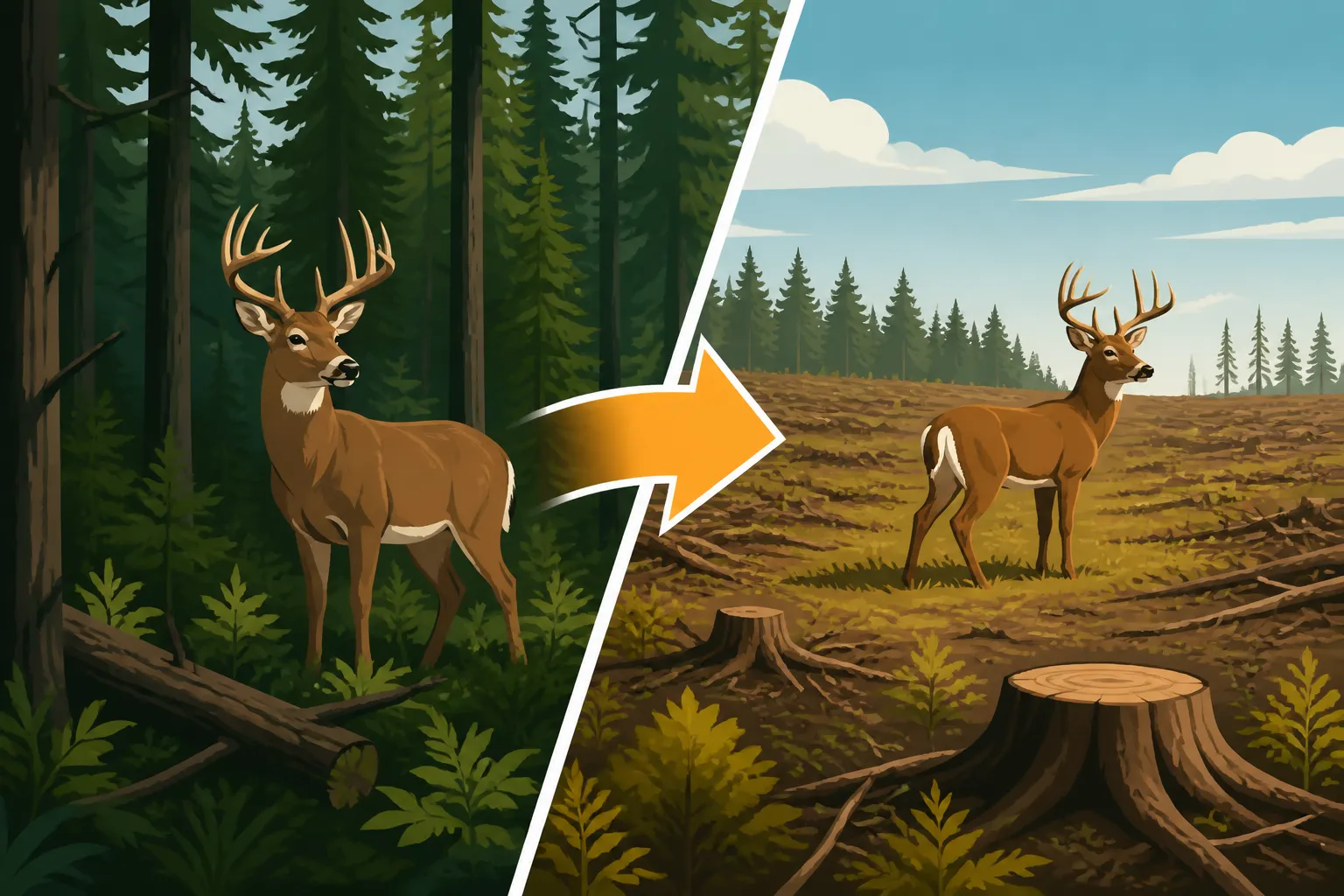
Logging cutblocks, at first glance, can seem like a disaster for deer. A beautiful, mature forest is suddenly gone, replaced by stumps and a barren landscape. However, the story doesn't end there; it's just beginning. The initial shock gives way to a dynamic process of ecological succession that can ultimately create some of the best whitetail habitat around.
Initial Disruption and Short-Term Effects
When the chainsaws start humming and the heavy machinery moves in, it's undeniably disruptive. The sheer noise, the constant human activity, and the felling of trees will cause deer to temporarily abandon the immediate area. They’re seeking peace and quiet, and safety, so they’ll often move to adjacent blocks of undisturbed timber or deeper into unlogged areas. It's a temporary displacement, much like when a new highway is built or a major agricultural project takes over a field.
The immediate removal of mature forest also means the loss of critical thermal and security cover. If the logging occurs during a harsh Manitoba winter, deer can be vulnerable to cold snaps and increased predation, especially if nearby adequate cover is scarce. Food sources, too, are instantly altered. While some deer might browse on downed tops, the primary food available in a mature forest is gone. This initial phase can be tough, particularly for animals that were heavily reliant on that specific patch of woods. It can feel like the hunting is ruined for years, and certainly, the first year or two after a fresh cut, deer activity can be minimal.
Long-Term Habitat Creation and Succession
Here's where the magic, from a deer's perspective, really happens. Once the logging operations cease and nature begins to reclaim the land, cutblocks transform into incredible deer habitat over time. The increased sunlight hitting the forest floor, previously shaded by a dense canopy, sparks a prolific burst of new growth. Early successional plants, like aspen suckers, willow, dogwood, and various forbs, explode onto the scene. These young plants are highly palatable and nutritious, offering an abundant buffet for deer. This dense, regenerating growth provides critical browse that mature forests simply can't offer.
As the cutblock ages, typically within 3 to 15 years, it becomes a thick, impenetrable tangle of young trees and shrubs. This isn't just a food source; it's prime bedding and security cover. A big buck can bed down in the middle of a dense cutblock and feel completely invisible, even to an approaching hunter. The sheer density makes it tough to move through, giving deer the advantage of hearing or smelling you long before you see them. Different logging methods also play a role; clear-cuts, for instance, lead to more uniform early successional growth, while selective logging might create a more varied, patchwork effect of different age classes and residual cover. Tools like GoHunt can be invaluable here, allowing you to examine satellite imagery over time to pinpoint the age of cutblocks and identify where the prime regrowth is occurring. This is especially useful for finding areas that might be less accessible to other hunters. Hunting Whitetails in Manitoba's Bush Country often means embracing these dynamic changes.
Changes in Deer Movement and Density
Deer are incredibly efficient at adapting to their surroundings. As a cutblock matures and becomes a smorgasbord of browse and cover, deer patterns will inevitably shift. What was once a travel corridor through mature timber might become a bedding area. New trails will emerge, connecting the nutritious cutblock to residual stands of cover or water sources. You'll often see an increase in deer density within and around these productive cutblocks, as animals are drawn to the abundant food and impenetrable security.
This shift means that hunting strategies need to evolve. You can't hunt a 10-year-old cutblock the same way you'd hunt a mature aspen stand. Deer might move less frequently during daylight hours if all their needs are met within the dense cover of the cutblock. They'll often feed heavily within the cutblock itself, especially on its edges, during low-light periods. Understanding these changes in movement patterns, where deer are bedding, where they are feeding, and how they are traveling between the two, is crucial for success. You might find deer concentrating in transition zones between a cutblock and a thicker, older stand of timber. Where Manitoba Whitetails Bed in Deep Snow will often be in these very types of dense, protected new growth.
Navigating Cutblocks for Hunting Success
Hunting cutblocks effectively requires a shift in mindset and tactics. It's not always easy, but the rewards can be substantial, as these areas often hold deer that feel incredibly secure and therefore grow to impressive sizes.
Identifying Productive Cutblocks
The key to unlocking the potential of cutblocks lies in knowing which ones to hunt and when. Not all cutblocks are created equal. As mentioned, the sweet spot for deer habitat is generally in cutblocks that are roughly 5 to 15 years old. Younger than five years, and the browse might still be sparse, and cover insufficient. Older than 15-20 years, and the saplings start to grow too tall, shading out the understory browse and becoming less dense for bedding cover.
Utilizing aerial imagery and mapping tools, like those found on GoHunt, is your best friend here. You can look at historical satellite photos to determine when an area was logged and thus estimate its current age. Look for cutblocks adjacent to existing mature timber, water sources, or agricultural fields. These "edge" areas are always prime, as deer can quickly move between feeding and security. Pay attention to topography too; south-facing slopes in cutblocks can provide crucial thermal cover on cold days, warming up faster in the sun. This kind of diligent scouting, even from your computer, can save you countless hours in the field and help you pinpoint high-potential areas. Scouting With Satellite Imagery in Manitoba provides even more detail on this modern approach.
Hunting Strategies for Cutblock Terrain
Once you’ve identified a promising cutblock, the real work begins. Hunting these areas demands patience and often a more aggressive approach than still-hunting open hardwoods.
- Still-Hunting: Moving slowly through a cutblock, taking one step at a time and pausing to scan for movement or signs, can be incredibly effective. The dense cover means deer are often close before you know it. Focus on travel corridors within the cutblock itself, subtle openings, or along edges where they might be feeding. Use the wind to your advantage, as deer will often be bedded facing downwind, relying on their nose to detect danger from behind and their eyes and ears for what's in front.
- Stand Placement: If you can find a natural funnel or pinch point within or immediately adjacent to a cutblock, a stand can be deadly. Look for trails leading into or out of the densest parts of the block, especially those connecting to food sources. Sometimes, placing a stand slightly inside the cutblock, where an older road or skid trail offers a shooting lane, can surprise a bedded buck. Remember that shooting lanes will be tight, so practice accurate, close-range shots. For those brave enough to get deep into the cover, Hanging a Stand on a Manitoba Bush Edge can offer useful tips.
- Driving/Pushing: In larger cutblocks, a coordinated drive with a few hunters can be very successful. Strategically place standers on known escape routes or along edges, while drivers slowly push through the densest cover. Communication and safety are paramount here, as visibility can be extremely limited.
Access and Ethical Considerations
Logging roads provide access to many cutblocks, but always respect active logging operations. Stay clear of heavy machinery and follow any posted restrictions. These roads can also serve as excellent travel corridors for deer, especially at dawn and dusk. However, driving directly into prime areas can spook deer for miles. Consider parking further out and walking in, approaching from downwind.
Ethical hunting in cutblocks also means understanding your capabilities. Shot opportunities can be fleeting and at odd angles. Be absolutely sure of your target and what’s beyond it. Carrying blaze orange is not just a legal requirement in many seasons and GHAs; it's a critical safety measure in these dense, low-visibility environments. How Much Blaze Orange Manitoba Requires is something every hunter needs to know. You might be interested in knowing Legal Rifle Calibres for Big Game if you are taking on these thick-skinned bucks.
Here's a quick overview of how cutblock age generally impacts deer habitat:
| Cutblock Age (Years) | Primary Deer Benefit | Typical Deer Activity | Hunting Opportunity |
|---|---|---|---|
| 1-3 | Limited Browse | Browsing on downed tops, some new growth; high human disturbance. | Low, deer are usually displaced. |
| 3-8 | Excellent Browse, Emerging Cover | Heavy browsing on new growth; some bedding in densest pockets. | Increasing, especially on edges and in transition zones. |
| 8-15 | Prime Cover & Browse | Heavy bedding, feeding, security; deer feel very safe here. | High, challenging still-hunting and strategic stands. |
| 15-25 | Decreasing Browse, Dense Cover | Bedding, but browse diminishing as canopy closes; more travel. | Declining as browse fades, good for travel corridors. |
| 25+ | Mature Forest | Returns to typical mature forest patterns; limited browse. | Hunt as mature timber, less specific to cutblock itself. |
Understanding how logging cutblocks reshape the landscape offers Manitoba hunters a fantastic opportunity to find new, productive ground. While it can be frustrating to see your old stomping grounds change, these areas represent the future of deer hunting in many parts of the province. By learning to read the land, understand deer needs, and adapt your tactics, you can turn what seems like a loss into a huge gain for your hunting success. The whitetails are there, thick and happy, you just need to learn their new playgrounds.
Disclaimer
This article is for general informational purposes only and does not constitute professional advice. Laws, prices and regulations vary by location and change over time. Consult a qualified professional for guidance on your specific situation.