Manitoba’s Turn In Poachers Line
It's incredibly frustrating, isn't it? You spend countless hours scouting, preparing, and following every single regulation, only to hear whispers or even witness blatant acts of poaching. It feels like a slap in the face to every ethical hunter and a direct threat to the wildlife resources we all cherish. This guide is here to demystify Manitoba's Turn In Poachers (TIP) Line, empowering you to effectively report illegal hunting and fishing activities, and understand how your vigilance contributes to crucial conservation efforts.
What Exactly is Manitoba's Turn In Poachers (TIP) Line?
Manitoba's Turn In Poachers (TIP) Line is more than just a phone number; it's a vital program designed to give concerned citizens a confidential way to report illegal activities related to wildlife, fisheries, and Crown land. It's a critical bridge between the public, who are often the eyes and ears on the ground, and the dedicated conservation officers tasked with enforcing our laws and protecting our natural heritage. The program operates on the principle that many hands make light work, especially when it comes to combating persistent and often organized illegal resource exploitation.
This initiative arose from a clear need to involve the public directly in enforcement. Conservation officers can't be everywhere at once, and much of the illegal activity occurs in remote areas or under the cover of darkness. By providing a direct, anonymous channel, the TIP Line allows ordinary Manitobans to become active participants in protecting what belongs to all of us. It acknowledges that hunters, anglers, trappers, and other outdoor enthusiasts are often the first to notice when something is amiss, whether it's a vehicle acting suspiciously in a remote GHA or a group of individuals openly flouting bag limits. Your call, no matter how small or seemingly insignificant, feeds directly into the intelligence network that helps conservation officers build cases and apprehend offenders.
The Purpose Behind the Program
The core purpose of the TIP Line is to deter and apprehend individuals engaged in poaching, illegal trapping, unlawful fishing, and other violations of provincial wildlife and Crown land regulations. These illicit activities don't just affect individual animals; they can have devastating long-term impacts on local populations, disrupt delicate ecosystems, and undermine the sustainable management efforts that legitimate hunters and anglers fund through their licenses and taxes. When someone illegally takes an animal out of season or exceeds limits, they are essentially stealing from everyone who follows the rules and supports conservation.
Beyond just catching offenders, the TIP Line serves as a powerful deterrent. The knowledge that any observer could potentially report illegal activity makes potential poachers think twice. It fosters a sense of collective responsibility for our wildlife, making it clear that the community won't stand idly by while natural resources are abused. It also ensures that the hard work of wildlife biologists, conservation groups, and even other ethical hunters doesn't go to waste because of a few bad apples. The funds generated from fines associated with poaching convictions often go back into wildlife management, completing a cycle of protection and reinvestment that benefits all legitimate users of our wild spaces. For instance, reports about illegal activities can help enforcement focus on areas particularly vulnerable to violations, such as those covered by Manitoba's Moose Conservation Closures.
How Your Report Helps Conservation
Every piece of information submitted through the TIP Line contributes directly to broader conservation efforts. Think of it as puzzle pieces: a single report might seem minor, but when combined with other observations, it can form a complete picture that leads to a successful investigation. Your detailed report helps conservation officers prioritize their patrols, identify hotspots for illegal activity, and allocate resources more effectively. For example, consistent reports of night hunting in a specific GHA can trigger focused patrols, leading to arrests and a reduction in future incidents. Understanding Manitoba's Night Hunting Rules is crucial here, as many violations occur after dark.
Furthermore, the data collected from TIP Line reports can inform policy decisions. If certain types of violations are consistently reported in particular areas or during specific seasons, it can highlight gaps in current regulations or areas where public education needs to be strengthened. It's not just about prosecuting; it's about understanding the scope and nature of the problem to prevent it in the first place. By reporting, you’re not just being a "snitch"; you're acting as a steward for Manitoba's wildlife, protecting populations for future generations to enjoy. Without public participation, the challenges of enforcing wildlife laws across Manitoba's vast and diverse landscapes would be almost insurmountable.
What Kinds of Incidents Should You Report?
It's natural to hesitate, wondering if what you're seeing is truly a violation worthy of a call. Many of us have felt that pang of doubt – "Is it really poaching, or just someone I don't recognize?" But the general rule of thumb with the TIP Line is: if you suspect something is wrong, report it. Conservation officers are trained to investigate and determine whether a law has been broken. Your role is simply to provide the information. Don't worry about being wrong; worry about letting illegal activity go unchecked. Poaching takes many forms, from obvious violations to more subtle, yet equally damaging, acts.
Obvious Poaching Violations
Some poaching incidents are clear-cut and demand immediate reporting. These are the "no-brainers" where you know without a shadow of a doubt that a serious offense is occurring.
- Hunting out of season: Seeing someone actively hunting big game like deer, moose, or elk when the season is clearly closed in that specific Game Hunting Area (GHA). Check Manitoba Big Game Season Dates if you're unsure.
- Exceeding bag limits: Witnessing individuals with more animals than legally allowed, or seeing them take multiple animals when only one tag is held. This is a common way poachers exploit resources.
- Hunting restricted species: Taking an animal that is protected or for which there is no open season, such as certain rare birds or species in conservation recovery zones.
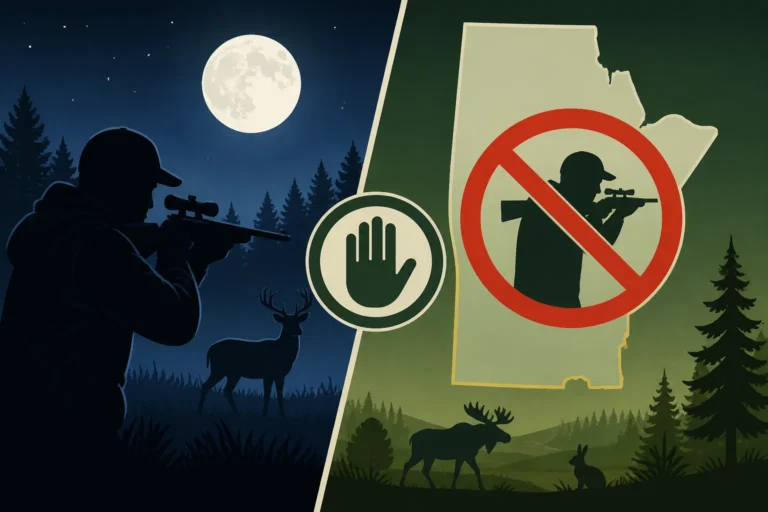
- Spotlighting or night hunting: Using artificial light at night to locate and shoot animals, which is highly illegal and incredibly dangerous. If you see lights sweeping fields or bush and hear shots, it's almost certainly a violation of Manitoba's Night Hunting Rules, unless a specific permit is held for approved activities like predator hunting.
- Hunting on private land without permission: Observing someone hunting on clearly posted private property without landowner consent. Understanding Manitoba Landowner Permission Law is key here.
- Improper tagging: A hunter fails to immediately validate their tag, places it on the wrong species, or attempts to use a tag belonging to someone else. Manitoba Tag Validation Rules are very specific for a reason.
- Wasting game meat: Leaving a significant portion of an animal to spoil, which is not only unethical but illegal under Rules on Wasting Game Meat.
- Commercial poaching: Large-scale operations involving multiple individuals taking animals for illegal sale, often identified by multiple carcasses or parts in suspicious locations.
Grey Areas and Suspected Activity
Sometimes, the situation isn't as clear as a spotlighted deer. You might just have a gut feeling that something isn't right, and that’s perfectly valid. These "grey area" observations are still incredibly important to report.
- Suspicious vehicles: A vehicle driving slowly and repeatedly down a remote road, especially at odd hours, or parked in an unusual location in a known game area. Pay attention to unique markings, trailer types, or equipment.
- Unusual animal carcass finds: Discovering an animal carcass where it shouldn't be, especially if it appears to have been shot or killed out of season, or if only prime cuts of meat are removed, leaving much behind.
- People scouting repeatedly with no obvious intent: While scouting is legal and good practice, if you observe individuals repeatedly driving or walking through sensitive areas, especially during closed seasons or in areas known for high wildlife concentrations, and their behaviour seems furtive or secretive, it's worth noting.
- Unlicensed guiding: If you suspect someone is guiding non-residents without proper licensing, particularly for species that require a guide, this impacts legal operations and resource management.
- Illegal baiting: Discovering large, unusual piles of food used to attract big game outside of legal baiting regulations. While Manitoba Rules on Baiting Big Game exist for some species, others are strictly prohibited.
- Social media posts: If you see someone publicly bragging about taking an animal out of season, exceeding limits, or other clearly illegal acts on social media, collect screenshots and report it.
Remember, your report helps confirm or deny suspicions. It’s better to have a conservation officer check out a situation and find nothing illegal than to let a genuine poaching incident slide.
How to Make an Effective Report to the TIP Line
Making an effective report isn't about being a detective; it's about being an accurate observer. The more precise and detailed your information, the better chance conservation officers have of investigating and taking appropriate action. It's crucial to gather as much factual information as possible without putting yourself in harm's way.
The TIP Line is designed for confidentiality, so you don't have to worry about your identity being revealed. When you call, be prepared to calmly and clearly relay the facts of what you observed. They'll guide you through the questions, but having some key details already organized in your mind or scribbled down can make the process much smoother and more efficient.
Essential Information to Gather
Before you even pick up the phone, try to secure these pieces of information. Even if you can only get a few, every detail helps.
- What did you see? Clearly describe the alleged violation. Was it shooting out of season? Too many animals? Night hunting? Wasting meat? Be specific about the illegal act.
- Where did it happen? This is perhaps the most critical piece of information. Provide the exact location.
- GPS coordinates: If you use a mapping app like GoHunt, mark a waypoint. This is incredibly precise and helpful.
- Road names and nearest intersections: "On PR 247, about 2 km east of Highway 5."
- Landmarks: "Near the old red barn on the north side of the road, just past the railway tracks."
- GHA number: If you know the Game Hunting Area, that helps narrow it down significantly. A precise location, perhaps marked on a GoHunt map, can make all the difference.
- When did it happen? The date and time of the incident are crucial. If it's ongoing, state that. If it happened yesterday, provide the best estimate.
- Who was involved?
- Number of people: How many individuals did you see?
- Descriptions: If possible, note gender, approximate age, hair colour, clothing, or any distinguishing features (e.g., "tall male, red hat, camo jacket"). Do not approach or confront.
- Vehicle description:
- Make, model, colour: "White Ford F-150," "Older grey Dodge Ram."
- License plate number: This is gold. Get the full plate number if you can safely do so. Even a partial plate can be helpful.
- Unique features: Dents, custom decals, specific accessories like a large toolbox, specific tire types.
- Species involved: What kind of animal was it? Deer (whitetail, mule deer if you're sure), moose, elk, bear, waterfowl, etc. How many?
- Evidence: Did you see a firearm? A crossbow? A specific type of decoy spread? Any other tools of the trade?
- Your contact information (optional, but encouraged): While the TIP Line is anonymous, providing your name and number allows officers to follow up if they need clarification or more details. Your identity will remain confidential.
Markdown Table: Essential Reporting Checklist
| Information Type | Details to Gather | Why it's Important |
|---|---|---|
| What | Specific violation (e.g., night hunting, over limit, trespassing) | Identifies the crime |
| Where | GPS coordinates, road names, landmarks, GHA # (e.g., using GoHunt) | Directs officers to the exact spot |
| When | Date and time of incident (or observation) | Establishes timeline and helps with corroboration |
| Who | Number of people, physical descriptions, clothing, unique traits | Helps identify suspects |
| Vehicle | Make, model, colour, license plate, distinctive features | Crucial for tracking and identification |
| Species | Type of animal, number involved | Confirms target and scale of poaching |
| Evidence | Firearms, bows, tools, carcasses, blood, tracks | Provides proof and context for investigation |
Prioritizing Your Safety and Observation
Your personal safety is paramount. Never, under any circumstances, confront or approach individuals you suspect of poaching. Poachers are breaking the law, and you don't know how they might react. Your job is to observe and report, not to intervene.
- Maintain a safe distance: If possible, observe from a distance where you are unseen and unheard. Use binoculars or a spotting scope if available.
- Stay hidden: Use natural cover, your vehicle, or buildings to remain out of sight.
- Do not engage: Avoid making eye contact or drawing attention to yourself. If they spot you, simply drive away calmly and avoid escalating the situation.
- Document safely: If you can discreetly take a photo or video (especially of license plates or unique vehicle features) without compromising your safety, do so. However, a detailed verbal description is always better than a risky photo. Remember, many hunters use tools like GoHunt to mark waypoints, and this can be done without drawing attention. Even when just scouting with your GoHunt app, be aware of your surroundings and any unusual activity.
- Move to a safe location before calling: If you're in a remote area, drive to a place where you have cell service and feel secure before making your report.
Once you have gathered your observations and are in a safe place, call the TIP Line. The number for Manitoba's Turn In Poachers Line is 1-800-782-0076. You can also contact your local Conservation Office directly during business hours. The sooner you report, the better the chances of a successful outcome, especially if the illegal activity is ongoing. Your actions help protect our wildlife, and that makes you a true conservationist.
What Happens After You Make a Report?
It’s completely understandable to feel like your report might just disappear into a black hole once you hang up. Many ethical hunters tell me they worry their call won't make a difference, or that they won't see immediate action. But rest assured, every legitimate report to Manitoba's TIP Line is taken seriously and initiates a process designed to protect our wildlife. The system isn't always instant gratification, but it is thorough and effective.
The Investigation Process
When you call the TIP Line, your information is typically routed to the appropriate regional conservation officer or investigative unit. Here’s a general overview of what happens next:
- Initial Assessment: A trained operator or officer will review your report, assessing the urgency and severity of the alleged violation. Factors like public safety, potential for ongoing damage to wildlife, and the clarity of the information provided all play a role in how quickly and intensely the report is actioned.
- Information Dispatch: If immediate action is required (e.g., active night hunting, ongoing trespass), the information is dispatched directly to officers in the field. They may respond to the scene if they are in the vicinity and available.
- Intelligence Gathering: Even if immediate response isn't possible, your report becomes part of a larger intelligence database. Conservation officers regularly review these reports to identify patterns, hotspots, and repeat offenders. For example, if multiple calls come in about suspicious activity near a specific area of Manitoba's Game Hunting Areas, it could trigger focused surveillance.
- Follow-Up Investigation: Depending on the details, officers may conduct further investigation. This could involve:
- Patrols: Increased presence in the reported area.
- Surveillance: Covert observation to catch offenders in the act.
- Interviews: Speaking with landowners, witnesses, or even the suspected individuals (if appropriate).
- Evidence Collection: Examining scenes for physical evidence like tracks, shell casings, or discarded animal parts.
- Enforcement Action: If sufficient evidence is gathered, officers will take appropriate enforcement action. This could range from warnings to charges, fines, seizure of equipment, and even loss of hunting privileges. The penalties for various violations can be quite significant, as outlined in Manitoba Penalties for Hunting Violations.
The process is often complex and requires careful collection of evidence to ensure successful prosecution. It’s not always as simple as catching someone in the act; sometimes it’s about building a case over time.
Why You Might Not See Immediate Action
It’s completely normal to expect a flashing lights and sirens response, especially if you’ve just witnessed something blatant. However, there are many reasons why you might not see immediate results, and it doesn't mean your report was ignored:
- Officer Availability: Conservation officers cover vast areas, especially in a province like Manitoba. They might be dealing with another incident, engaged in court proceedings, or simply too far away to respond instantly.
- Safety Concerns: Officers must prioritize their own safety and the safety of the public. They may hold back from immediate intervention if the situation is deemed too risky without backup or proper planning.
- Building a Case: Sometimes, immediate intervention isn't the most effective strategy. Officers may choose to monitor a situation over time to gather more evidence, identify accomplices, or understand the full scope of a poaching operation. This long-game approach often leads to more comprehensive arrests and convictions.
- Confidentiality: For obvious reasons, conservation officers cannot share details of ongoing investigations with the public, including those who made the initial report. This can make it feel like nothing is happening, but it's essential for maintaining the integrity of the investigation and protecting sources.
- Insufficient Evidence (Sometimes): While all reports are investigated, sometimes there simply isn't enough corroborating evidence to proceed with charges. This isn't a reflection on your report, but rather the challenges of law enforcement in the field.
Even without seeing direct action, your report has contributed to the effort. It helps officers build a clearer picture of illegal activity, informs their patrol routes, and ensures that the individuals who abuse our natural resources know that the community is watching. Every piece of information helps protect the future of Manitoba hunting, and that’s a legacy worth upholding.
Disclaimer
The information provided in this article is for general guidance and informational purposes only. While every effort has been made to ensure accuracy, hunting regulations in Manitoba can change, and interpretations may vary. It is the responsibility of every hunter and citizen to consult the most current official Manitoba Hunting Guide and relevant provincial legislation for precise and up-to-date rules and regulations. Always confirm specific details with the appropriate authorities before acting.