Manitoba Trespass Law for Hunters
There are few things that can sour a hunting trip faster than the gnawing uncertainty of whether you're even allowed to be where you are, or worse, finding out after the fact that you've unintentionally crossed a line. We've all felt that anxious pit in our stomach, wondering if that distant boundary is public land, private, or perhaps even a restricted zone. This guide is here to untangle the complexities of Manitoba's trespass laws for hunters, giving you the clarity and confidence to navigate the province's diverse landscapes responsibly and legally.
The Foundation of Manitoba's Trespass Law: Understanding the Basics
Understanding what constitutes trespass isn't just about avoiding a fine; it's about respecting land, landowners, and the hunting community as a whole. In Manitoba, the legal framework around trespass aims to protect property rights while also outlining public access where appropriate. It's a balance, and sometimes that balance feels like a tightrope walk for us hunters.
What Constitutes Trespass in Manitoba?
At its core, trespass in Manitoba is about unauthorized entry onto land. It's not just about jumping fences; it can be as simple as stepping a few feet over an invisible boundary line onto property where you don't have permission to be. The key here is the lack of authorization. Whether the land is private property, a municipal lot, or even certain restricted areas of Crown land, if you're there without the express or implied consent of the owner or governing body, you're trespassing.
Think of it this way: you're following a promising game trail, eyes glued to the tracks in the snow. You've been scouting this area for weeks, using tools like onX Hunt to try and pin down property lines, but the terrain is subtle, and a small creek forms what you thought was the boundary. Suddenly, you round a bend and there's a landowner's cabin, much closer than you anticipated. In that moment, even if you didn't intend to trespass, you're likely on their private land without permission. The law doesn't always care about your intent as much as your presence. This kind of accidental crossing is exactly why understanding the nuances of boundaries is so crucial. It’s an easy mistake to make, especially when navigating dense bush or featureless prairie.
Posted Land vs. Unposted Land: A Critical Distinction
Manitoba law draws a significant distinction between "posted" land and "unposted" land when it comes to private property. This distinction primarily affects how a landowner signifies their desire to keep people out, and thus, how a hunter might unwittingly commit an offense.
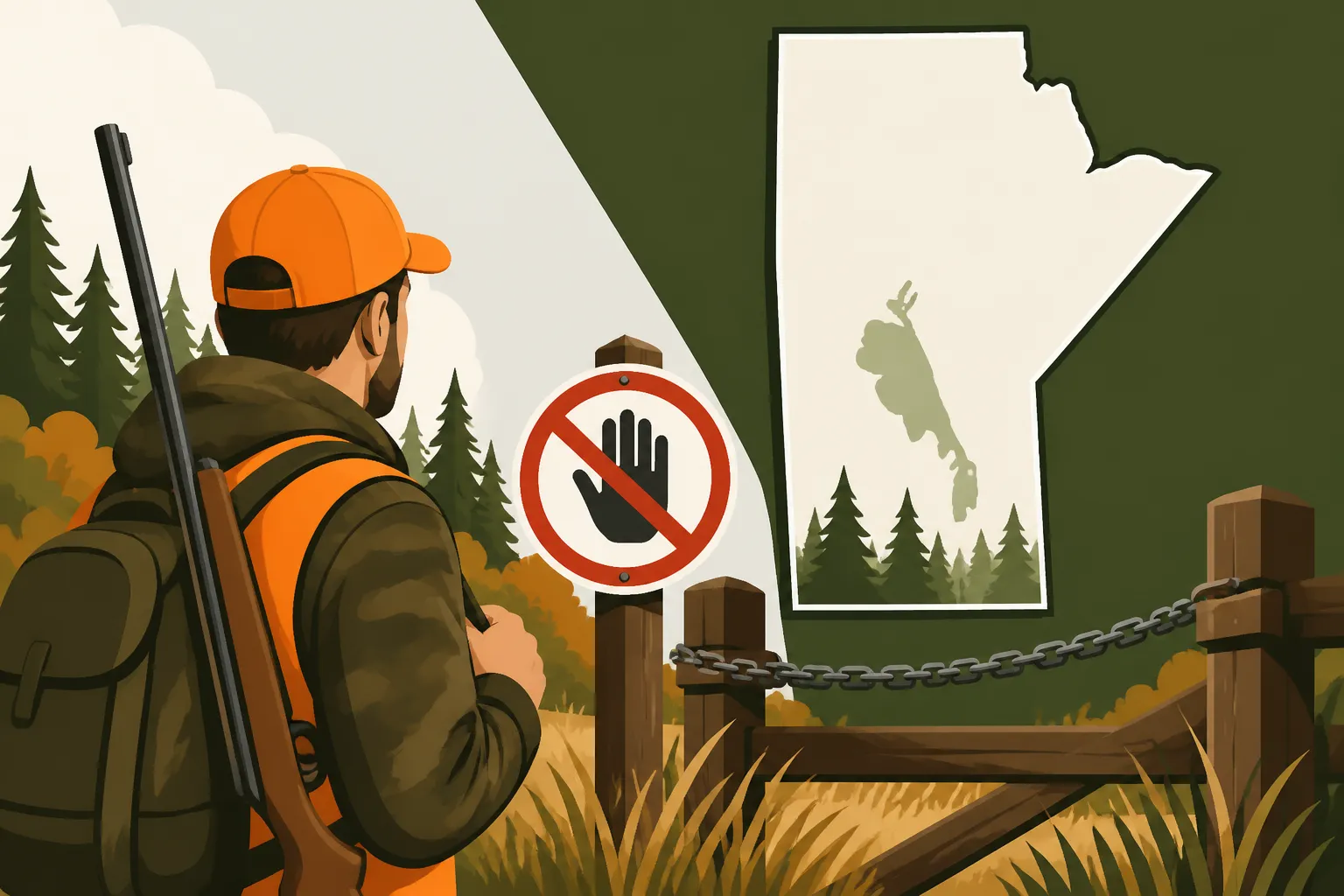
For private land to be considered legally "posted" in Manitoba, it needs clear and visible signs that explicitly prohibit entry or hunting. These signs generally need to be placed at regular intervals, often at corners and along the boundaries, and be conspicuous enough for someone to reasonably see them. Sometimes, a simple fence line without signage isn't enough to make land "posted" in the eyes of the law, but it definitely serves as a warning. On posted land, your mere entry, without permission, is automatically considered trespass. The signs serve as your explicit notice.
Now, on unposted private land, the situation is a bit different, but no less restrictive for hunters. While the signs might not be there, you still absolutely need permission to hunt. The absence of a "No Hunting" sign doesn't imply "Welcome." If you step onto unposted private land to hunt without permission and a landowner confronts you, they can still ask you to leave. If you refuse, then you're trespassing. The frustration here for hunters is often deciphering what constitutes private land in the first place, especially when physical boundaries like fences are absent or dilapidated. Imagine you're walking along what appears to be an open field edge, assuming it's Crown land or that hunting is permitted, only to have a farmer drive up in their truck, clearly unhappy. Your initial entry wasn't a trespass if it was unposted and you hadn't been explicitly told to stay off, but refusing to leave immediately would be. It's always best practice to treat all private land as if it's posted and seek permission.
Navigating Private Land: Permission is Key
This is where the rubber meets the road for many hunters. While the allure of vast landscapes calls to us, a significant portion of huntable land in Manitoba is privately owned. Building relationships and understanding the explicit need for permission isn't just a courtesy; it's a legal imperative.
The Absolute Requirement for Landowner Permission
Let's be crystal clear: if you intend to hunt on private land in Manitoba, you must have permission from the landowner. Period. There are no exceptions for unposted land when it comes to hunting. This isn't just about respecting someone's property; it's the law. Many of us have heard stories, or perhaps even experienced it ourselves, where hunters assume that because an area looks unkempt or unworked, it's fair game. Or maybe, you hunted a certain parcel last year, and the new owner moved in, and you just assumed the previous permission carried over. It doesn't. Every year, with every new parcel, with every change in ownership, that permission needs to be re-established.
The safest bet is always to get written permission. A simple note with the date, the specific land description (like a quarter section), the landowner's signature, and your own, goes a long way. Verbal permission is legally binding, but it's much harder to prove if a misunderstanding arises. Imagine a situation where you've been granted verbal permission, but the landowner's neighbor sees you hunting and calls the authorities. Without written proof, it becomes a "he said, she said" scenario, and you could find yourself in a very uncomfortable position, even if you were completely innocent. Protecting yourself with a simple piece of paper is a smart move. For more on this, check out Manitoba Landowner Permission Law.
Strategies for Asking for Permission
Approaching a landowner can feel daunting, especially if you're not used to it. Many hunters are shy or fear rejection. But with the right approach, you can significantly increase your chances of gaining access. Timing is crucial: avoid asking during busy planting or harvest seasons, or late on a Sunday evening. Weekday afternoons or early evenings are often better. Dress respectfully – no camo or muddy boots when you're knocking on their door. A clean, presentable appearance shows respect.
When you ask, be specific. Don't just say, "Can I hunt your land?" Instead, try, "Hello, my name is [Your Name], and I'm interested in hunting deer on your quarter section, [Legal Land Description]. I've seen some good sign on the southwest corner, near the creek, and I wanted to ask if you'd be comfortable allowing me to bowhunt there this fall." Be prepared to show them exactly where you want to hunt, perhaps even using a mapping app like GoHunt on your phone to point out the specific boundaries you're interested in. Explain your hunting methods – bow, rifle, shotgun – and reassure them about safety. Offer to share some of your harvest, or perhaps even offer to help with a small chore around the farm. Sometimes, just having a conversation and showing respect for their property and livelihood is enough. Many landowners are receptive to responsible hunters. For deeper insights, read Knocking on Doors in Manitoba Farm Country.
Dealing with Denied Permission or Revoked Access
It's going to happen: you'll ask for permission, and you'll get a "no." It stings, especially when you've done your homework and had high hopes. But the absolute best thing you can do is accept it graciously, thank them for their time, and move on. Arguing or trying to convince them will only burn bridges for you and for other hunters in the future. Remember, it's their land, and they have every right to say no, for any reason or no reason at all. Maintaining a positive attitude, even in the face of rejection, is vital for hunter-landowner relations across the province.
What if permission is revoked while you're already hunting? This can be incredibly frustrating. Imagine you've invested days in scouting, hung a stand, and settled in for an evening sit when you get a call or a text from the landowner stating that circumstances have changed and they need you off the property immediately. While disappointing, you must comply. Gather your gear as quickly and safely as possible and leave. The law is on their side, and lingering after permission is revoked instantly turns your presence into a trespass. Always maintain a good relationship; perhaps there's a chance to hunt there again in the future once the issue, whatever it may be, has passed.
Crown Land and Public Access: Knowing Your Rights and Limits
Manitoba is blessed with a substantial amount of Crown land, often referred to as public land. This is where many hunters find their opportunities, but even here, it's not a free-for-all. Understanding where Crown land is, and any specific restrictions that apply to it, is paramount to staying legal.
Understanding Crown Land Access for Hunters
Crown land essentially belongs to all Manitobans, managed by the provincial government, and generally, it's open for public recreation, including hunting. This is fantastic news for hunters who don't have access to private parcels or who prefer the challenge of hunting more remote, undeveloped areas. However, "generally open" doesn't mean "always open" without any rules. It's crucial to confirm that the specific piece of Crown land you're looking at is, in fact, open to hunting and doesn't have any specific restrictions.
The best way to do this is through reliable mapping resources. Tools like onX Hunt and GoHunt are invaluable for overlaying property boundaries and clearly identifying Crown land. You'll often see these areas marked with different colours or designations. Before heading out, always consult these maps and, if possible, cross-reference them with official Manitoba's Game Hunting Areas maps or the provincial government's land use maps. Imagine planning a trip far north into the boreal forest, confident you're on public land, only to discover you've strayed into a First Nation's community land where hunting rules are completely different, or worse, into a protected area. Taking the time to verify saves a lot of headaches, and potential legal issues. Knowing your boundaries on Crown land is just as important as on private.
Areas Where Hunting May Be Restricted on Crown Land
While much of Manitoba's Crown land is open for hunting, there are critical exceptions where hunting is either prohibited, restricted to specific seasons or methods, or requires special permits. These include, but are not limited to, Provincial Parks, some Wildlife Management Areas (WMAs), ecological reserves, and certain designated recreation sites.
Provincial Parks, for example, typically prohibit hunting altogether, though there might be very specific, limited exceptions in some cases. It's never safe to assume. Hunting in a Manitoba Provincial Park details these specific rules, and it's absolutely essential reading if you plan to hunt anywhere near these boundaries. Wildlife Management Areas are Crown land, but they are established to manage wildlife populations and habitat, often leading to specific regulations. Some WMAs might be archery-only for certain species, others might have antler restrictions, and some might even be closed to hunting entirely at certain times. For example, if you're hunting in the Interlake, you might be near a WMA that has very different rules than the surrounding general hunting areas. Always check the annual hunting guide and specific WMA regulations for Manitoba's Wildlife Management Areas before you go. The last thing you want is to be hunting legally on Crown land only to step into a WMA where your rifle is suddenly illegal, or the deer you're targeting is out of season.
Rights-of-Way and Access Corridors
Another area that often causes confusion is the various rights-of-way and access corridors that crisscross Manitoba. These include public roads, provincial highways, municipal roads, railway lines, and utility corridors (like hydro lines or pipelines). While these might offer access through land, they often come with their own set of rules regarding firearm discharge and hunting.
For instance, most jurisdictions have rules about how far you must be from a public road to discharge a firearm, and many prohibit hunting on the road allowance itself. The term "road allowance" refers to the strip of land on either side of a graded road, which is often Crown land but subject to specific restrictions. You can't just jump out of your truck on a provincial road and start shooting. Similarly, railway rights-of-way are almost always private property belonging to the railway company, and hunting or even walking along them without permission is considered trespass and can be extremely dangerous. Utility corridors, while sometimes allowing access for foot traffic, often have rules against hunting or trapping within their boundaries. Imagine spotting a fantastic buck in a clearing under a hydro line. Before you even think about raising your rifle, you need to verify the specific rules for hunting in proximity to or on that right-of-way. Always assume restrictions exist and check the local regulations and Vehicle Rules on Manitoba Crown Land to be safe.
| Land Type | Permission Required? | Posting Requirements | General Hunter Access | Notes |
|---|---|---|---|---|
| Private – Posted | YES | Required (Signs) | No | Entry without permission is immediate trespass. |
| Private – Unposted | YES | None | No | Must leave if asked; hunting still requires permission. |
| Crown Land – General | NO | None | YES | Open to hunting unless specifically restricted. |
| Crown Land – WMA | NO (often) | Often | Conditional | Check specific WMA rules; may have method/species/season restrictions. |
| Crown Land – Prov. Park | NO | N/A | NO (generally) | Hunting usually prohibited; very limited exceptions may apply. |
Consequences of Trespass and Preventing Accidental Violations
Nobody wants to face legal trouble, especially when out enjoying the wilderness. The consequences of trespassing while hunting in Manitoba can be severe, extending far beyond a simple slap on the wrist. Understanding these penalties and, more importantly, implementing strategies to prevent accidental trespass is crucial for every responsible hunter.
Penalties for Trespassing While Hunting
The penalties for trespassing in Manitoba, particularly when associated with hunting activities, are not trivial. Depending on the nature and severity of the trespass, you could face significant fines, potentially running into the thousands of dollars. Beyond the financial hit, you could also face the seizure of your hunting equipment – including your firearm, bow, or ATV – and potentially the loss of your hunting licence and privileges for a period. Imagine losing your prized hunting rifle and being banned from hunting for a year or more, all because of an accidental misstep onto private land.
Furthermore, committing a trespass offense can tarnish your reputation as a responsible hunter and create a negative image of hunters within the community. Landowners are often frustrated by disrespectful individuals, and a single incident can lead to more "No Hunting" signs for everyone. It's important to remember that ignorance of the law is generally not considered an acceptable excuse. As hunters, it's our responsibility to know and understand the rules that govern where and how we pursue game. Encountering a Conservation Officer while on private land without permission can quickly escalate, leading to formal charges and a court appearance. Their powers are extensive, and they are there to enforce these rules. You can learn more about Manitoba Conservation Officer Powers to understand their role.
Retrieving Game from Private Land
This is one of the most agonizing situations a hunter can face: you've made a good shot on an animal, but it's run onto private land where you do not have permission. Your heart sinks. Your first instinct might be to follow immediately to recover your game. However, even in this emotionally charged scenario, the law is clear: you still need to obtain permission from the landowner before stepping foot on their property to retrieve your animal.
This requirement can be incredibly frustrating. You've worked hard, made a clean shot, and now your hard-earned trophy is just out of reach. But illegally entering that land, even for retrieval, is still trespass. It’s a bitter pill to swallow, but violating the law will only compound your problems. Your best course of action is to locate the landowner, explain the situation calmly and respectfully, and ask for permission to retrieve your animal. Be prepared for a "no." If they deny permission, you may be out of luck, and wasting game is also a violation. However, most landowners are reasonable people, and if approached with respect and honesty, they will often grant access, especially if they understand the animal is wounded and you want to prevent suffering. For a detailed breakdown of the legalities and best practices, see Retrieving Game From Private Land in Manitoba.
Proactive Measures to Avoid Trespass
The best defense against trespass is a good offense in the form of diligent preparation and respect for boundaries. Here are some proactive steps every hunter should take:
First and foremost, pre-scouting is non-negotiable. Don't wait until opening morning to figure out property lines. Use satellite imagery and digital mapping tools like onX Hunt or GoHunt extensively from home. Mark out known property boundaries, potential problem areas, and access points. For areas where you suspect private land, make notes to seek permission before you ever step foot there. Scouting With Satellite Imagery in Manitoba can be a game-changer for this.
Secondly, invest in reliable mapping and GPS technology. A handheld GPS or a smartphone app with detailed land ownership overlays is an absolute must-have. These tools can show you exactly where you are in relation to property lines in real-time. Don't rely solely on paper maps, which can be less precise in the field, especially in dense cover. Always carry a backup, like a fully charged power bank for your phone. Knowing Finding Manitoba Public Land Boundaries before you ever leave home is critical.
Thirdly, when in doubt, don't. If you are unsure about a property line, or if you haven't been able to secure explicit permission for a piece of private land, err on the side of caution. It's far better to miss an opportunity than to face legal repercussions, fines, or a strained relationship with a landowner. If you encounter a boundary that's ambiguous, assume it's private and seek clear permission or find another hunting spot. Always be on the lookout for Manitoba Posted Land and Signage Rules and respect them. Your vigilance protects not just yourself, but the future of hunting for all of us in Manitoba.
Disclaimer
This article is for general informational purposes only and does not constitute professional advice. Laws, prices and regulations vary by location and change over time. Consult a qualified professional for guidance on your specific situation.