Hunting a Rock Outcrop in Shield Country
The vast, rugged expanses of Manitoba's Shield Country can feel intimidating, a maze of granite, timber, and water that makes traditional hunting methods challenging. It's easy to feel lost in the sheer scale, wondering how to even begin finding game in such a formidable landscape, especially when everything looks the same. This guide is all about demystifying one of the Shield's most intriguing features: the rock outcrop, and how to effectively hunt these unique formations for big game. We'll dive deep into understanding these geological features and turn them into your strategic advantage.
Understanding Shield Country Terrain and Game Movement
Hunting the Canadian Shield is a completely different ballgame than chasing whitetails in the agricultural belt or moose in the southern boreal. The ground itself, shaped by ancient glaciers, tells a story of hard rock, sparse soil, and a rugged beauty that demands respect and a unique approach from hunters. When you're out there, just seeing endless trees and swamp can be disheartening, but understanding the subtle nuances of the terrain is where success lies.
The Nature of Rock Outcrops in the Shield
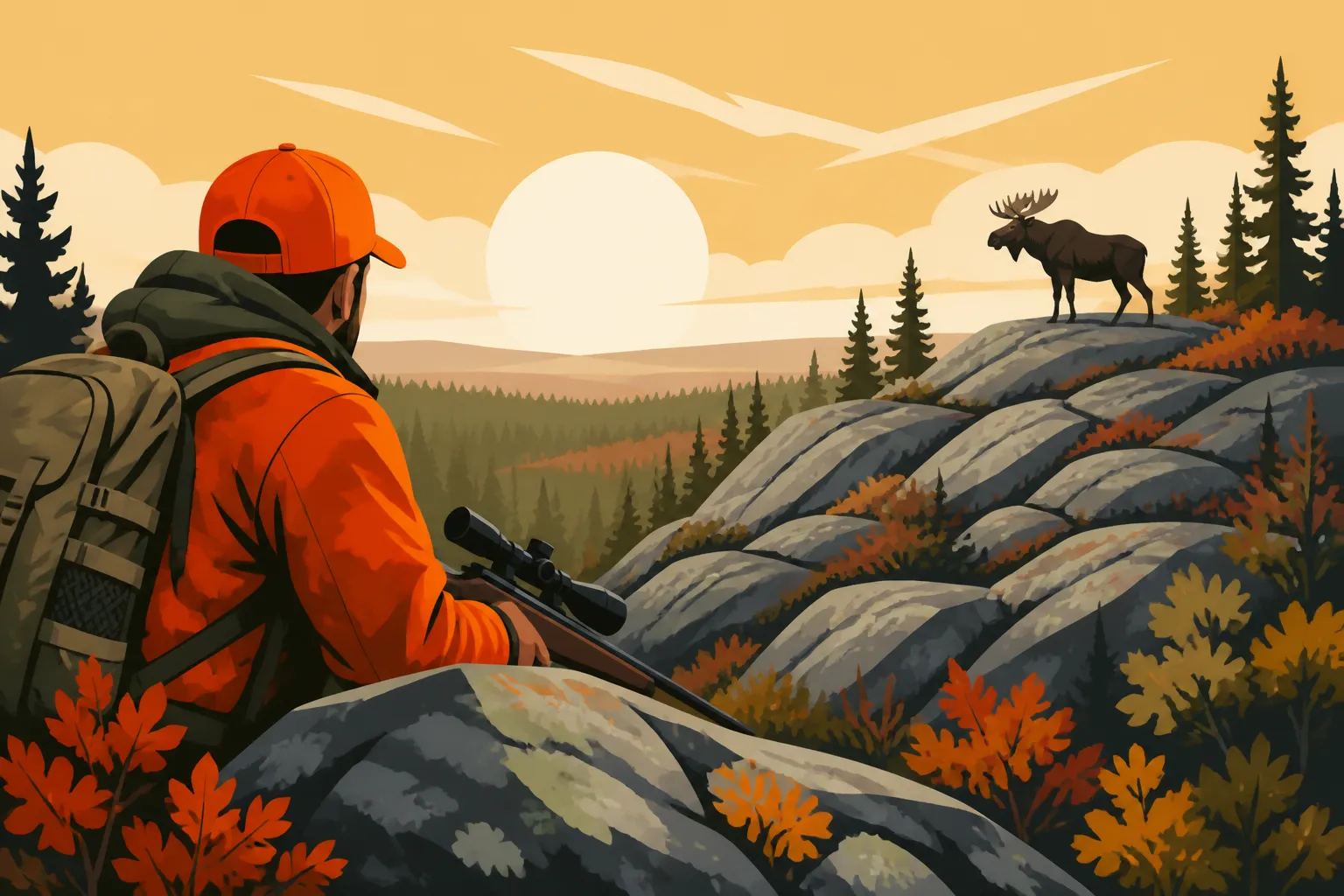
Rock outcrops in Manitoba's Shield Country are essentially exposed sections of bedrock, ancient granite, gneiss, or basalt that resisted glacial erosion or have since been uncovered by time. They often appear as rises, ridges, or barren knobs, breaking the monotony of muskeg, bog, and dense timber. Picture a grey, weathered bald spot amidst a sea of spruce and jack pine, sometimes adorned with stubborn lichens or a few scraggly pines clinging to cracks. These aren't just random bumps in the landscape; they are pivotal features that concentrate game. These outcrops offer elevation, drainage, and often, a different type of vegetation than the surrounding lowlands. They can range from small, car-sized boulders to vast, sprawling granite domes covering acres. Their presence dramatically alters the micro-climate and vegetation, creating pockets of appeal for various game species that you might otherwise overlook in the vastness of the bush. It's truly a unique habitat that hunters need to learn to "read" effectively. If you're looking to understand the broader context of these hunting grounds, a great starting point is Hunting Manitoba's Eastern Shield Country.
How Game Animals Utilize Outcrops
You might wonder why a deer, moose, or bear would care about a bare rock face. The truth is, these outcrops provide a variety of benefits that draw game. For moose, a dry, elevated spot away from the wet, buggy lowlands can be a welcome bedding area, especially if it's got some browse nearby. Bears often use the rocky crevices for dens, or the sunny slopes for feeding on berries that mature earlier in the drier soil. Whitetails, though less common in the deeper Shield, will seek out these drier, elevated spots for bedding, especially if they offer good visibility and a thermal advantage. Predatory animals like wolves and coyotes also use these high points as vantage points for surveying their territory, making them strategic locations to scout. The sheer elevation, even a few feet, can offer a much-needed dry spot to rest, avoid insects, or simply get a better view of potential threats or food sources.
Think about it from the animal's perspective: you're trying to stay dry, safe, and fed in a landscape that's often wet, buggy, and densely vegetated. An outcrop, especially one with a southern exposure, might be the first place to melt snow in spring, providing early green-up. In the fall, it can be a sun-drenched sanctuary.
| Game Animal | Primary Use of Rock Outcrops | Hunting Season Considerations |
|---|---|---|
| Moose | Bedding, escape cover from wet areas, vantage points. | Early season: insect relief. Late season: dry beds. |
| Black Bear | Den sites, sunning spots, early berry foraging. | Spring: emerging from dens, sunning. Fall: berry foraging. |
| Whitetail | Bedding (dry), escape from deep snow, vantage. | Less common in deep Shield, but seek high, dry ground. |
| Wolf/Coyote | Vantage points, travel corridors along ridges. | Year-round: high visibility areas for hunting. |
| Small Game | Shelter, foraging for lichens/moss, escape cover. | Year-round. |
Seasonal Considerations for Outcrop Hunting
The time of year dramatically influences how game animals use rock outcrops. In spring, as the snow melts, south-facing outcrops often become bare first, drawing bears looking to sun themselves and find early forage. As summer progresses and insects become a menace, higher, breezy outcrops offer respite for moose and deer from biting flies and mosquitoes. Come fall, especially during the rut, bucks and bulls might scent-check these elevated areas, or use them as travel corridors between feeding and bedding areas. A particularly cold or wet late season can see animals seeking out the drier, warmer microclimates an outcrop provides.
In the deep winter, these formations can become strategic travel routes when the surrounding lowlands are bogged down with deep snow, or they can offer wind-swept areas where foraging is easier. Understanding these seasonal shifts is crucial for planning your hunt. For instance, you wouldn't hunt a spring bear the same way you'd hunt a late-season whitetail in proximity to an outcrop. Each season presents a different set of challenges and opportunities when you're focusing on these unique geological features.
Scouting and Interpreting Rock Outcrops
Before you even step foot in the bush, modern tools can give you a significant advantage in locating and understanding rock outcrops. The vastness of the Shield demands smart scouting, and you don't want to waste precious hunting time trying to figure out the landscape on the fly.
Satellite Imagery and Topographic Maps
Your adventure in hunting rock outcrops really begins at home with a good mapping system. Services like onX Hunt are invaluable here. You can literally spend hours studying satellite imagery, looking for those tell-tale grey or lighter patches that indicate exposed rock. Pay attention to how these outcrops connect to other features like water bodies, old logging roads, or muskeg. Look for linear patterns that might suggest a ridge system, or isolated patches that could be prime bedding areas. Topographic maps, whether digital or physical, will show you elevation changes, which are key. Even a 10 or 20-foot rise in elevation can create a significant outcrop that holds game.
When looking at these maps, identify the highest points and any abrupt changes in contour lines. These are your potential outcrops. Trace their paths, note adjacent cover, and look for pinch points or funnels created by the rock and surrounding wetlands. These mapping tools allow you to virtually "walk" the terrain before you're physically there, saving you countless steps and increasing your efficiency once you hit the ground. You might also consult resources that provide general habitat analysis, as some hunters find GoHunt useful for understanding broad ecosystem patterns, even if it’s more geared to western hunts, the principles of habitat assessment are universal. A thorough digital scouting session can reveal a lot, helping you understand where to focus your limited time on the ground. This initial homework is paramount, and it really sets the stage for a successful hunt. For more on this, check out Scouting With Satellite Imagery in Manitoba.
On-the-Ground Reconnaissance
Once you've identified potential hotspots on your maps, it's time to hit the ground. Nothing beats boots-on-the-ground scouting to confirm your suspicions and read the finer details. This is where you verify what you saw on onX Hunt. Are those grey patches actually accessible? Is the cover around them as good as it looked from above? Walk the edges of the outcrops, explore the cracks and crevices, and look for signs of animal activity. Pay attention to rub lines on trees bordering the rock, old beds in the sheltered pockets, or even discarded antlers. Look for tracks along the base or on softer patches of ground where game might be moving between the outcrop and other features.
During your recon, identify potential stand sites that offer good visibility and shot opportunities, keeping in mind the prevailing wind. Understand the access points to the outcrop – where animals are likely to approach and depart. Are there natural barriers like steep faces or thick alders that funnel movement? Take note of water sources nearby, even small seeps or puddles in the rock itself. These can be crucial attractants in dry periods. Always be thinking about the wind, sun, and cover, and how they interact with the outcrop to provide sanctuary or travel routes for game. The more time you spend exploring these areas without hunting pressure, the better your understanding of their true potential will be.
Reading Sign on Outcrops
Reading sign on a rock outcrop can be a bit different than in soft soil or heavy timber. Tracks might be scarce on the hard rock, so you'll need to focus on other indicators. Look for scats, which can often be found in more sheltered or lower-lying areas around the base of the outcrop. Hair snagged on rough bark or sharp rock edges can tell you what species is frequenting the area. Rubs and scrapes on trees around the edges of the outcrop are clear indicators of deer or moose activity, especially during the rut. In more open areas, if there's any vegetation, look for browsing.
Perhaps the most crucial sign to look for on an outcrop itself are bedding areas. Animals, especially deer and bears, will seek out sheltered pockets, depressions, or leeward slopes on these rocky formations to bed down. These spots will often have compressed leaves, matted grass, or simply a worn-down patch of earth. Pay attention to the orientation of these beds—they'll almost always be positioned for scenting danger (windward) and watching for movement (downwind), while also providing protection from the elements. Finding fresh beds tells you animals are actively using the outcrop. Even small game, like snowshoe hare, can leave trails and droppings that indicate a generally healthy ecosystem.
Hunting Strategies for Rock Outcrops
Hunting rock outcrops requires a blend of patience, stealth, and a keen understanding of animal behavior in this specific environment. It's not about blind luck; it's about making smart, informed decisions.
Still-Hunting and Stand Placement
Still-hunting is often incredibly effective in and around rock outcrops. The broken terrain, natural sound-dampening qualities of the rocks, and varied vegetation allow you to move slowly and deliberately, scanning constantly. Move at a snail's pace, stopping often, and using binoculars to pick apart every shadow and texture. The goal is to spot game before it spots you, especially if you're on a Hunting a Shield Country Rock Ridge where visibility can be good in certain directions. Use the natural contours of the rock and any available timber to break up your silhouette.
For stand placement, look for areas where the outcrop creates a natural funnel or pinch point, or where it offers an elevated position overlooking a known travel corridor or feeding area. A treestand on the edge of an outcrop overlooking a swampy draw can be a goldmine, particularly for moose or bear. Ground blinds can also be effective if you can tuck them into a rock crevice or behind a cluster of evergreens, offering excellent concealment. The key is to be comfortable, quiet, and positioned to take advantage of whatever the terrain dictates. Remember to always consider your entry and exit routes to minimize disturbance.
Calling Strategies in Rugged Terrain
Calling can be very effective in Shield Country rock outcrop hunting, especially for moose and black bears. The hard rock surfaces can help amplify sounds, allowing your calls to carry further, but they can also create echoes that make it hard to pinpoint the origin of a sound, both for you and the animal. For moose, cow calls and bull grunts can be powerful. Position yourself strategically, perhaps with the wind in your favor, overlooking a clear travel route to the outcrop. If you're calling a bull in, make sure you have shooting lanes clear in the direction you expect him to approach. The ruggedness of the terrain means they might not come in straight, so anticipate their route.
For black bears, a distressed fawn or rabbit call can sometimes draw them in, especially if they are actively foraging nearby. During the spring, bears emerging from their dens might be curious. When calling, always be prepared for a close encounter. The thick cover and uneven ground can make spotting an approaching animal difficult until it's very close. Be mindful of how your calls might bounce off the rock faces and confuse game, so calling intermittently and listening for responses is crucial. You don't want to over-call, but rather to pique their interest and draw them in to investigate. This type of terrain is ideal for calling because animals often feel secure in the broken cover.
The Importance of Wind and Thermals
In any hunting scenario, wind is your number one priority, but it's especially critical in the varied topography of rock outcrops. Elevated positions, sharp drops, and dense timber can create unpredictable thermal currents and swirling winds. Always hunt with the wind in your favour, meaning it should blow from the animal towards you. This seems obvious, but in rugged country, predicting wind direction can be tricky. Carry a wind-checker and use it constantly.
Thermals, the rising and falling air currents caused by temperature changes, are also paramount. In the morning, as the sun heats the ground, air tends to rise (uphill thermals). In the evening, as the air cools, it tends to fall (downhill thermals). Animals often move with these thermals, using them to their advantage for scenting. Understanding this can help you predict animal movement patterns. If you're hunting an outcrop in the morning, position yourself so your scent is carried upwards, away from the low-lying areas where animals might be bedding. In the evening, reverse that logic. A well-placed stand that accounts for both wind and thermals can give you a significant advantage in catching game off guard.
Gear and Safety for Shield Country Outcrop Hunts
Hunting in Manitoba's Shield Country is an incredible experience, but it's also demanding. The remote nature and rugged terrain mean you need to be self-sufficient and prepared for anything. This isn't your backyard woodlot hunt, and cutting corners on gear or safety can lead to serious trouble.
Essential Gear for Rugged Terrain
When you're traversing rock outcrops, thick bush, and potentially swampy areas, your gear needs to be up to the task. Start with solid, waterproof hiking boots with good ankle support – skipping this can quickly lead to injury. Layered clothing is essential; the weather in the Shield can change rapidly from warm sun to biting cold, even within a single day. A waterproof and windproof outer shell is a non-negotiable.
Beyond clothing, a reliable backpack filled with essentials is key. Think about navigation: a GPS unit (like your phone with onX Hunt maps downloaded offline) and a traditional compass with a physical map are critical backups, because cell service is often non-existent. A good quality headlamp, fire-starting kit, first-aid kit, water filter, and emergency food rations are also must-haves. Don't forget sharp knives for field dressing, game bags, and enough rope or paracord for various tasks. If you're heading out in colder months, consider things like Winter Truck Kit for a Manitoba Hunt to ensure your vehicle is ready for the conditions.
Navigating and Safety in Remote Areas
The Shield Country is vast, and it’s surprisingly easy to get disoriented, even with good mapping tools. Always let someone know your hunting plan, including your intended route, where you're parking, and when you expect to return. Stick to your plan, and if you deviate, update your emergency contact if possible (e.g., via a satellite messenger). Travel with a partner if possible, especially in remote areas.
Be mindful of the terrain. Rock outcrops can be slippery when wet or icy, and hidden crevices can be dangerous. Always watch your footing. If you find yourself lost, the first rule is to stay calm. Consult your map and GPS, try to identify familiar landmarks, and retrace your steps if possible. If all else fails, stay put, signal for help (three shots, three whistles), and conserve your energy. Having a good understanding of What to Do If You Get Stuck in the Bush is not just smart, it's potentially life-saving. Remember that hunting here means you are truly on your own, sometimes for days.
Meat Care in Harsh Conditions
Successfully harvesting an animal in the Shield Country is only half the battle; getting the meat out and cared for properly is the next big challenge. The remoteness often means a long pack-out, and the variable temperatures can quickly spoil meat if not handled correctly. Field dress your animal immediately and thoroughly to begin cooling the carcass. If temperatures are mild, skinning the animal and quartering it right away will help it cool faster. Game bags are absolutely essential for protecting the meat from dirt, flies, and debris during the pack-out.
In colder weather, you might have more time, but still, prioritize rapid cooling. If you’re hunting in a period with fluctuating temperatures, knowing how to handle Meat Care in Manitoba's Cold Snaps is critical. If you have a long distance to travel, consider making multiple trips or using a game cart if the terrain allows (which is rare in true Shield country). Sometimes, it might even be necessary to build a temporary shelter over the meat, hang it high, and return with additional help or transportation. Always be thinking about how you'll get that meat out before you even pull the trigger, as the decision can dictate where and how you hunt a particular animal.
Disclaimer
This article is for general informational purposes only and does not constitute professional advice. Laws, prices and regulations vary by location and change over time. Consult a qualified professional for guidance on your specific situation.