Scoring a Typical Whitetail Rack
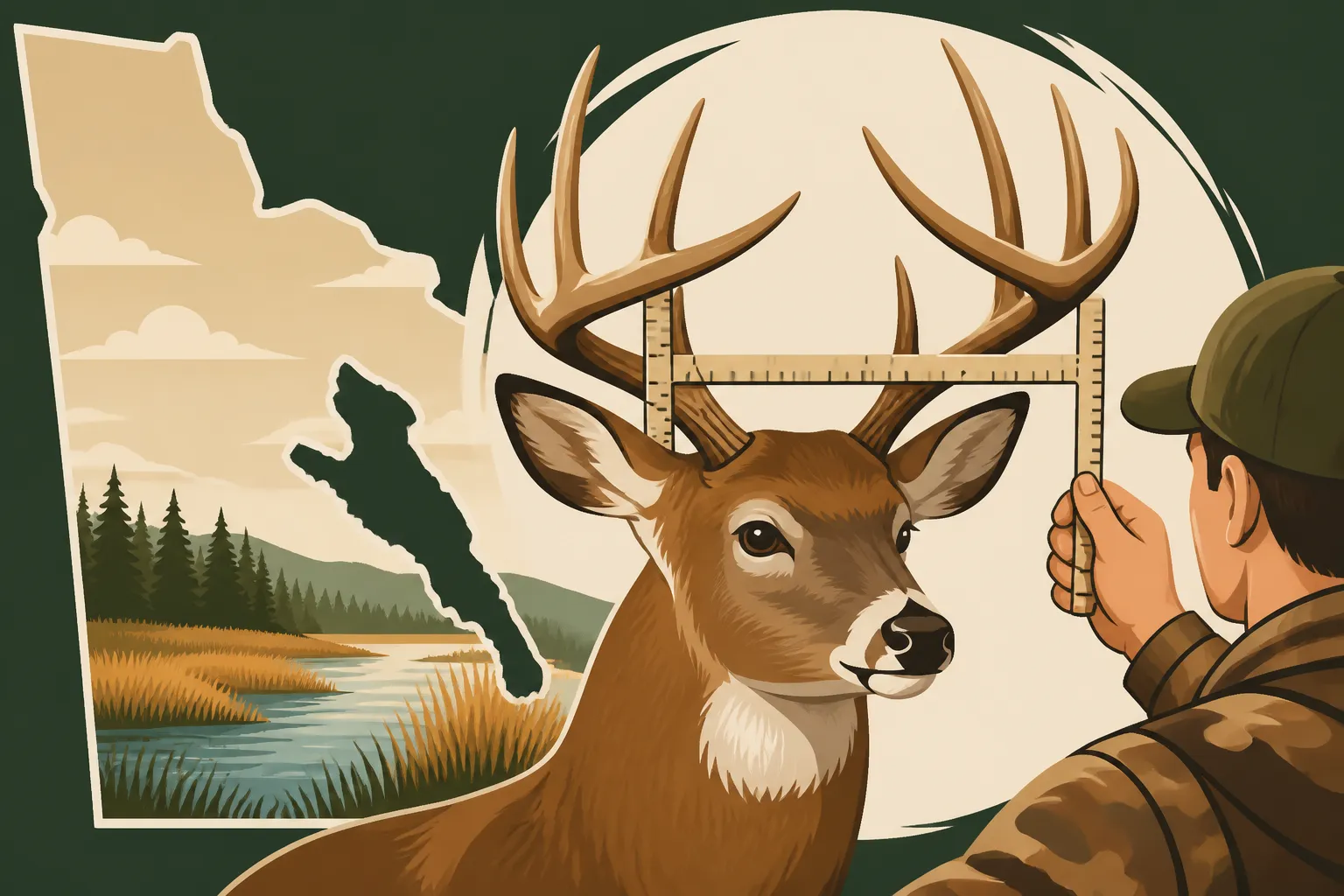
You’ve just taken down a beautiful Manitoba whitetail, and as you stand over that magnificent animal, admiring its rack, a thought always creeps in: "How big is this thing, really?" It's a natural curiosity, especially when you see those impressive, symmetrical antlers. Trying to figure out how to put a number to that feeling can feel a bit daunting, with all the talk of "typical" and "non-typical" and various measuring systems. This guide is here to walk you through the process of scoring a typical whitetail rack, helping you understand each step and what makes your buck truly special.
Understanding the Boone and Crockett System for Typical Whitetails
When we talk about scoring big game antlers in North America, especially whitetail, we're almost always referring to the Boone and Crockett Club's scoring system. It's the gold standard, and for good reason: it’s meticulously designed to provide a consistent, objective measure of antler quality. But for typical whitetails, there’s a specific emphasis on something that might not be immediately obvious to a casual observer.
Why "Typical" Matters
The distinction between a "typical" and "non-typical" rack is crucial in scoring. A typical whitetail rack is prized for its symmetry and classic, clean antler growth. Imagine two sides that mirror each other almost perfectly – that's the ideal typical rack. All points generally grow upwards from the main beam, following a predictable pattern (brow tines, then the next set, and so on). Hunters often have a special reverence for typical racks because they embody that classic, iconic deer silhouette.
When you're dealing with a typical rack, the scoring system heavily rewards that symmetry. The goal is to measure the true, symmetrical potential of the animal. If a rack has a lot of extra points, drop tines, or unusual growth that breaks this clean, symmetrical pattern, it generally falls into the "non-typical" category. While non-typicals are amazing in their own right and have their own scoring system, for a typical score, any significant asymmetry or abnormal points will lead to deductions, affecting the final net score. It’s all about finding that perfect, balanced set of antlers.
The Basic Components of a Score
Scoring a typical whitetail rack involves measuring several key components. Think of it like building a house – each measurement is a brick, contributing to the overall structure. You’ll be looking at the length of the main beams, the length of each individual point (often referred to as G-points), and the circumference of the main beams at various spots (H-measurements). Then, of course, there’s the inside spread of the antlers.
The real trick, and often the frustrating part, comes with understanding deductions. For a typical score, symmetry is paramount. If one side's main beam is longer than the other, or a G2 point on the left is shorter than the G2 on the right, those differences get subtracted from the gross score. The final number, known as the "net typical score," reflects the total growth after accounting for these asymmetrical elements. It's a meticulous process, but it ensures that only the most symmetrical and impressive racks earn the highest typical accolades.
Essential Tools for the Job
Before you even think about putting a tape measure to your hard-earned trophy, gather your tools. You'll need a flexible steel tape measure, often one that's about 1/4-inch wide, which allows for accurate measurement around curves and along beams. A thin, flexible steel cable or even a piece of strong string can be helpful for finding the exact path of the main beam or the longest edge of a point. You’ll also want a pencil and an official Boone and Crockett score sheet, which you can usually download online. This sheet guides you through each measurement, making sure you don't miss anything.
Having a partner can also make a huge difference, especially when trying to hold the tape measure precisely while reading the numbers. They can help stabilize the rack or verify measurements, which is always a good idea. And, of course, a little patience is probably the most essential "tool" of all. If you’ve recently refreshed your knowledge with a Manitoba Hunter Education Requirements course, you’ll know that attention to detail is key in all aspects of hunting, and scoring is no exception.
Step-by-Step Guide to Measuring Your Manitoba Typical Rack
Now that you have your tools and a basic understanding, let's get into the nitty-gritty of measuring. Remember, precision is your best friend here. Don't eyeball anything; every fraction of an inch counts. It’s a rewarding process, almost like reliving the hunt as you carefully handle your buck's antlers.
Main Beam Length and Tip-to-Tip Spread
The main beams are the foundation of your buck’s rack, and they are usually the longest single measurement. To measure the main beam, start at the burr – that rough, bony ring just above the skull where the antler meets the head. From there, follow the outside curve of the beam all the way to its tip. The tape measure should lay flat against the antler's curve, not pulled taut in a straight line. Do this for both main beams. Write down both measurements carefully on your score sheet.
Next, you'll tackle the spread measurements. The "inside spread" is the widest point between the main beams, measured straight across the skull. Lay your tape measure flat, perpendicular to the center line of the skull, from the inside edge of one main beam to the inside edge of the other. Do not take this measurement from the outside of the beams or from the very tips, which would give you a "greatest spread" or "tip-to-tip spread" – those are interesting figures but not used for the inside spread in the Boone and Crockett typical formula. The inside spread is often the most visually impressive part of a Manitoba buck, and can tell you a lot about What a Big Manitoba Whitetail Weighs as a whole.
Measuring Points (Tines) – G1s, G2s, and Beyond
This is where many people get a little confused. What constitutes a "point" for scoring? According to Boone and Crockett, a point must be at least one inch long and longer than it is wide at one inch up from its base. Any smaller than that, and it's generally considered a burr anomaly, not a scorable point.
You'll measure each point from the top of the main beam, along its longest edge, to its tip. Points are usually designated as G1, G2, G3, and so on. The G1 is your brow tine, the point closest to the deer's face. The G2 is the next point, and so forth, moving along the main beam. Be meticulous; sometimes points can be curved or have unusual growth. Use your flexible tape to trace the longest path. Measure each corresponding point on both the left and right sides of the rack. For instance, you'll measure the left G1 and the right G1, then the left G2 and right G2, ensuring you track these pairs for later deduction calculations. These well-developed G-points are a hallmark of healthy Reading Antler Growth After a Wet Year, reflecting good nutrition and age.
Girth Measurements (Circumferences)
The circumference measurements, often called "H-measurements," give you an idea of the mass or thickness of the main beams. There are typically four of these taken on each main beam, designated H1, H2, H3, and H4.
- H1: This is the circumference taken at the smallest point between the burr and the G1 (brow tine).
- H2: Measured at the smallest point between the G1 and G2 tines.
- H3: Taken at the smallest point between the G2 and G3 tines.
- H4: Measured at the smallest point between the G3 and the tip of the main beam. If your buck only has two G-points, you'd take H3 between G2 and the beam tip, and H4 halfway between H3 and the beam tip.
Again, consistency is key. Always find the smallest circumference in that section. Use your flexible tape, wrap it snugly around the beam, and note the measurement. Record all eight H-measurements (four for each side) on your score sheet. These girth measurements truly showcase Why Manitoba Bucks Grow Heavy Bodies and dense bone, which contribute significantly to a trophy score.
Accounting for Asymmetry and Deductions
This is often the part that confuses hunters, but it's fundamental to the typical scoring system. While you might have a massive gross score, the net typical score is what truly matters for the record books, and that's where deductions come into play. It's about recognizing the subtle imperfections in an otherwise beautiful, symmetrical rack.
Understanding the Concept of Deductions
For a typical whitetail, the scoring system actively penalizes asymmetry. This isn't about shaming the deer for not being perfectly symmetrical – very few are! Instead, it’s about providing a clear standard for what constitutes a "typical" trophy. Every measurement you took (main beam length, G-points, circumferences) has a corresponding measurement on the other side of the rack. Deductions are calculated by identifying the differences between these matching measurements.
Let's say your left main beam measures 25 inches, and your right main beam measures 24.5 inches. The difference of 0.5 inches is a deduction. Similarly, if your left G2 is 9 inches and your right G2 is 8 inches, that 1-inch difference is another deduction. You'll go through every pair of matching measurements on your score sheet, calculate the difference, and add up all these differences. This total sum is your "deductions" amount. It’s a meticulous task, highlighting why GoHunt often provides detailed scoring guides and why accuracy is crucial if you're chasing those record-book numbers like those found in Manitoba's Trophy Record Book.
Identifying and Measuring Abnormal Points
Abnormal points are any points that do not follow the typical growth pattern of a whitetail rack. These can be kickers, drop tines, points growing off another point, or anything that isn't a clean, upward-growing G1, G2, G3, etc. For a typical score, abnormal points are a bit of a nuanced subject, and this is where most people get confused.
Here's the key: the length of abnormal points is not added to your gross score when you're scoring a typical whitetail. They simply aren't considered part of the typical framework. However, their presence can contribute to deductions in a different way. If an abnormal point is growing where a normal point should be, and it creates a significant asymmetry with the other side, that difference in the overall symmetrical structure will be deducted. But generally, the specific length of an abnormal point is measured and recorded, but it's not part of the additive process for a typical score. It's usually noted for informational purposes or if the rack were to be scored as non-typical. For a pure typical score, focus on the differences between matching typical points for your deductions.
Calculating Your Net Typical Score
Once you’ve meticulously measured all the main beams, G-points, circumferences, and your inside spread, and you’ve calculated all the side-to-side differences that make up your deductions, it's time for the final calculation.
First, you'll sum up all your positive measurements: both main beam lengths, all individual G-point lengths, all circumference measurements, and your inside spread measurement. This total is your Gross Typical Score. It represents the full growth of the antlers before accounting for any asymmetry.
Then, you take your Gross Typical Score and subtract the Total Deductions you calculated earlier. The number you're left with is your Net Typical Score. This is the number that gets submitted to organizations like Boone and Crockett for official records. Even if a buck doesn't "make the book," a high net typical score is still a fantastic achievement and a testament to the animal's genetics and health within Manitoba's Game Hunting Areas. It's a challenging but rewarding process, akin to carefully detailing What Counts for a Manitoba Trophy Record for future generations.
Common Pitfalls and Tips for Accurate Scoring
Scoring a rack isn’t a race, and it’s surprisingly easy to make small errors that can add up. Whether you’re just curious about your personal best or aiming for a spot in the record books, a few simple tips can help ensure your measurements are as accurate as possible.
Don't Rush It – Take Your Time
This isn't a quick job. Scoring a trophy rack correctly takes patience and a careful hand. It’s not uncommon for experienced scorers to spend an hour or more on a single rack, especially a complex one. Trying to rush through it, especially if you’re excited after a successful hunt during When Manitoba's Whitetail Rut Peaks, can lead to mistakes. Double-check every measurement. Sometimes it helps to measure both sides of a pair (e.g., both G2s) back-to-back to catch any inconsistencies.
Consider taking a break and coming back to the rack with fresh eyes. What might seem obvious on the first pass might reveal subtle nuances after a short rest. Getting a second opinion from a hunting buddy or even having them assist by holding the tape can greatly improve accuracy. Remember, the goal is to honor the animal with the most precise measurement possible.
Understanding "Official" Scoring
While it’s incredibly satisfying to score your own buck, understand that if you believe your animal is a record-book contender, it will need to be officially scored by a certified measurer. These individuals have undergone training and adhere to strict guidelines set by organizations like Boone and Crockett. There's also usually a mandatory drying period—typically 60 days—after the animal is harvested before an official measurement can take place. This allows the antlers to stabilize and prevents any shrinkage from affecting the score.
This official process ensures that every entry in the record book has been evaluated under the same rigorous standards. If you've been putting in the work Hunting Whitetails in Manitoba's Bush Country and believe you have a truly exceptional animal, researching the official scoring process is your next step. Websites like GoHunt often have resources or articles discussing these standards, preparing hunters for what’s required to get their Manitoba trophies officially recognized.
Celebrate the Experience, Not Just the Number
Ultimately, while the numbers are fun and can be a source of pride, the true value of any hunting experience lies in the adventure, the challenge, the connection to nature, and the memories made. A score is just one way to quantify a trophy, but it doesn't define the hunt. Whether your buck scores in the triple digits or not, the story behind it – the scouting, the tracking, the shot, and the respect you showed the animal – is what truly matters.
Don't let the pursuit of a specific score overshadow the profound experience of harvesting a magnificent Manitoba whitetail. That feeling of accomplishment, the meat you bring home, and the moments shared with friends and family are priceless. The score is a bonus, a way to appreciate the incredible growth of the animal you pursued, and perhaps to compare it with Manitoba's Top Typical Whitetails in the record books. But the memories? Those are truly what lasts a lifetime.
Disclaimer
This article is for general informational purposes only and does not constitute professional advice. Laws, prices and regulations vary by location and change over time. Consult a qualified professional for guidance on your specific situation.