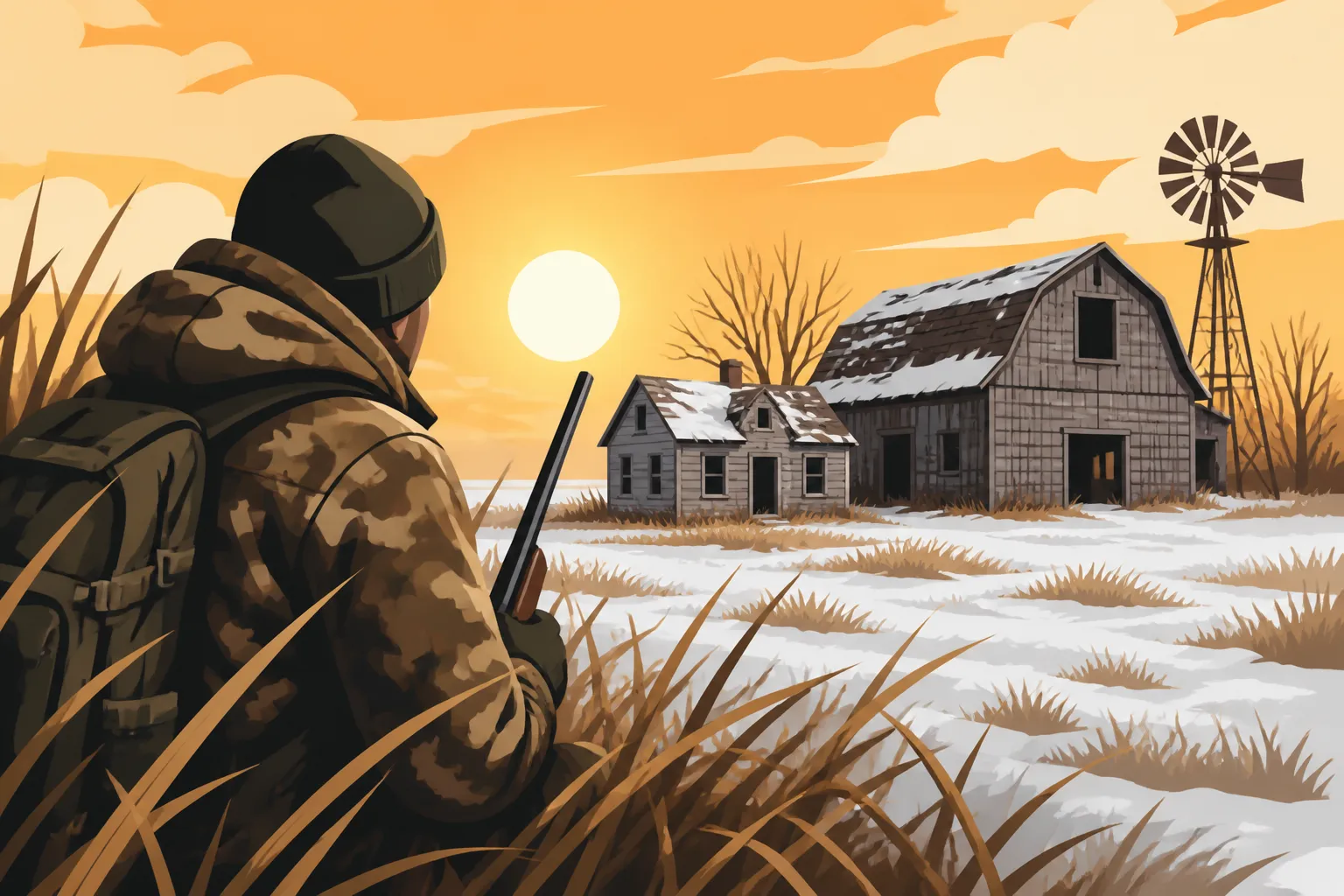
Hunting an Abandoned Farmyard
Finding those truly undisturbed pockets where game feels safe can be one of the biggest challenges for hunters in Manitoba, especially with increasing pressure on accessible land. Many often overlook what might be right under their noses or just a short drive away: the forgotten, overgrown solace of an abandoned farmyard. This guide is here to shed light on why these relics of the past are prime hunting grounds and how you can ethically and effectively hunt them.
The Undeniable Appeal of Abandoned Farmyards for Hunters
An old, deserted farmyard might look like just a collection of decaying buildings and forgotten machinery to some, but to a seasoned hunter, it’s a beacon of opportunity. These sites, left to reclaim by nature, transform into incredible havens for wildlife, offering a unique blend of cover, food, and security that's hard to find elsewhere. The very elements that make them abandoned are what make them so attractive to game.
Natural Cover and Food Sources Abound
Imagine a typical Manitoba farmyard that's been left untended for decades. What you'll find is often a remarkable transition from manicured plots to wild, untamed growth. This includes mature shelterbelts of poplar, spruce, or willow that have grown into impenetrable thickets, providing dense thermal and visual cover. Old barns, granaries, and even collapsed sheds offer overhead protection, often becoming bedding areas for deer or dens for smaller predators. Beyond mere shelter, these places become unexpected food buffets. Forgotten apple trees, wild berry bushes like saskatoons or pin cherries, and overgrown gardens provide seasonal forage. Fields that once grew crops are now choked with natural grasses, weeds, and volunteer grains that attract deer, turkeys, and upland birds. It’s a microcosm of varied habitat, all concentrated in one relatively small area. Wildlife, particularly whitetail deer, thrive on this diverse vegetation and the security it provides from predators and, crucially, from human disturbance. This layered habitat creates a complex ecosystem that supports a variety of species throughout the year.
Shelter from the Elements and Human Pressure
One of the most compelling reasons game animals gravitate towards abandoned farmyards is the superior shelter they provide. Manitoba winters can be brutal, with deep snow and biting winds. The dense evergreen shelterbelts, sturdy old buildings, and even the depressions left by foundations offer critical thermal cover, allowing animals to conserve energy. During the fall hunting seasons, when pressure mounts in surrounding bush and agricultural fields, these abandoned sites become natural sanctuaries. Deer, bears, and even moose can retreat into the thickets and dilapidated structures, feeling secure from the constant movement and noise of hunters in more traditional areas. The combination of dense cover, reliable food sources, and reduced human intrusion makes these spots invaluable. Animals learn quickly where they can find respite, creating predictable travel patterns and holding areas that hunters can exploit with careful scouting and strategy. This ability to offer both physical protection from the weather and psychological protection from human activity solidifies their role as critical wildlife magnets.
Locating and Legally Accessing These Forgotten Hotspots
Finding an abandoned farmyard isn't always as simple as spotting a dilapidated barn from the highway. It requires diligent research and, perhaps more importantly, careful navigation of land ownership and trespass laws. The effort, however, is often well worth it when you uncover a hidden gem.
Researching Potential Locations with Modern Tools
In today's digital age, finding potential abandoned farmyards is easier than ever, though it still demands some keen detective work. Start with online mapping tools like Google Maps or specialized hunting apps such as GoHunt. Look for tell-tale signs: square-shaped clearings in otherwise wild bush, distinct tree lines that don't quite match natural patterns, remnants of driveways, or even faint outlines of old building foundations. Overgrown fields adjacent to bush or marshland can also indicate former agricultural activity. Switching between satellite view and topographic maps can reveal subtle changes in elevation or vegetation that suggest past human settlement. Sometimes, you'll see small, isolated clusters of mature trees that stand out in a landscape of younger growth – these often mark an old homestead. Pay attention to areas near existing agricultural lands, particularly those that might have been less productive or harder to access, as these were often the first to be abandoned. Historical aerial imagery, if available for your target area, can be incredibly insightful, showing the evolution of the landscape and highlighting areas that were once active farms.
Navigating Permission and Trespass Laws in Manitoba
Once you've identified a promising location, the next, and arguably most critical, step is to determine land ownership and secure explicit permission to hunt. In Manitoba, regardless of how abandoned a property looks, it is still owned by someone, and hunting without permission is trespassing, a serious offense. The "abandoned" look does not mean "public access." You can start by checking municipal property assessment maps, often available online through the local RM (Rural Municipality) office, or by visiting the land titles office. These resources can help you identify the registered owner.
Once you have a name, the real work begins: reaching out. This can be intimidating, but a respectful, well-prepared approach can make all the difference. Be polite, explain why you're interested in their property (highlighting how you've noticed it provides good habitat), and assure them you will respect their land, leave no trace, and adhere to all safety regulations. Offer to share any game you harvest. Remember, landowners have a lot of concerns, from liability to property damage. Addressing these proactively can ease their mind. For a deeper dive into these regulations, understanding Manitoba Landowner Permission Law is essential. Never assume silence means consent, and always get permission in writing if possible, even a simple text message exchange documenting the agreement can be helpful.
Mastering Hunting Techniques in a Farmyard Setting
Hunting an abandoned farmyard requires a blend of traditional hunting wisdom and an understanding of how game uses these unique, semi-structured environments. It's not quite a dense forest hunt, nor is it purely an open field scenario; it’s a tactical blend of both.
Strategic Stand Placement and Silent Approach
When you’re setting up in an abandoned farmyard, think about the game’s primary motivations: food, cover, and escape routes. Prime stand locations will often be along the edges of dense shelterbelts, overlooking old orchards or overgrown gardens, or near pinch points created by dilapidated buildings or old fence lines. Consider the prevailing wind direction; it’s even more critical here because the structures and thickets can create unpredictable wind currents. Hang your stand downwind of expected travel routes or bedding areas. If you're hunting whitetails, understanding Reading Whitetail Sign in Manitoba Aspen can help you pinpoint those key travel corridors within the old farmyard.
Your approach to the stand must be as silent and undetectable as possible. Game animals, particularly mature bucks, are extremely wary, and they’ve likely chosen these spots for their security. Plan your entry route to avoid walking through obvious game trails or disturbing potential bedding areas. Use natural depressions, existing fence lines, or the cover of old buildings to conceal your movement. Dawn and dusk are prime times, but also when game is most active and alert. Setting up a ground blind camouflaged against an old outbuilding or a dense thicket can also be incredibly effective, allowing for more forgiving movement than a treestand, especially if you plan on sitting all day.
Utilizing Natural Funnels and Bottlenecks Effectively
Abandoned farmyards are often crisscrossed with remnants of human activity that, over time, become natural funnels and bottlenecks for wildlife. Old fence lines, even if partially collapsed, can guide deer movement. Overgrown hedgerows or thick tree lines that once bordered fields now act as linear cover, pushing animals along predictable paths. The foundations of old barns or houses can create subtle barriers, forcing deer to walk around them, often creating distinct trails.
Look for these natural constrictions. A narrow gap between a dense poplar bluffs and a crumbling foundation, or a low point in an old stone wall, could be a perfect ambush site. Animals will often take the path of least resistance, especially when moving between bedding and feeding areas. During periods of heavy snowfall, these funnels become even more pronounced as animals stick to trails with less resistance. Observing where trails converge or narrow is key. Using a mapping application like GoHunt, you can mark these potential funnels during your scouting trips and plan your hunt accordingly, even identifying secondary trails that might be used by a wise old buck looking to circumvent the most obvious routes.
Calling and Scent Control in Tight Spaces
Hunting in the somewhat confined environment of an abandoned farmyard introduces specific challenges and opportunities for calling and scent control. Unlike wide-open fields or sprawling forests, the "walls" of buildings, dense thickets, and even machinery can create unique acoustic environments. Calls, whether a grunt tube for deer or a squeaker for coyotes, might travel differently, sometimes amplified, sometimes muffled. Experiment with rattling volume in open parkland and how it carries in these more contained areas. You might find that softer, more subtle calls are incredibly effective here, mimicking the natural sounds of animals moving through heavy cover.
Scent control becomes paramount. The structures and dense vegetation can trap air currents and scents, making it easier for game to pick up your presence. Utilize every tool in your arsenal: scent-free clothing, scent eliminator sprays, and even natural earth scents to mask your human odor. Pay close attention to wind currents around buildings and within thickets; they can swirl unpredictably. Consider placing a scent wick with an attractant (where legal) in a direction that pulls game past your stand without alerting them to your position. Remember, mature animals in these hidden sanctuaries are often there precisely because they’ve learned to avoid human scent and disturbance. Your commitment to scent control needs to be absolute.
Species Specific Opportunities in Abandoned Farmyards
While often thought of for deer, abandoned farmyards in Manitoba offer fantastic opportunities for a variety of game species, each drawn to the unique blend of food, cover, and relative seclusion these sites provide.
Whitetail Deer and Their Habits in Old Homesteads
Whitetail deer absolutely thrive in abandoned farmyards. These areas often represent the perfect blend of thick thermal cover (dense shelterbelts, old buildings), diverse food sources (volunteer grains, old fruit trees, native browse), and a sense of security from human disturbance. Mature bucks, in particular, will often seek out these pockets, especially during the rut when they are pushing does or looking for a secure bedding area to rest. During the early archery season, or when Hunting Manitoba's September Archery Opener, you'll often find deer feasting on apples or saskatoons. As the season progresses into late fall and early winter, they’ll rely heavily on the thermal cover of thick evergreens and the remnants of old crops.
Scouting these areas means looking for classic whitetail sign: rubs on small trees, fresh scrapes, and well-worn trails leading from thick cover to food sources. Pay close attention to areas where trails might bottleneck due to old foundations or dense brush. Deer will often bed right up against the remnants of old buildings, using them for protection from the elements and a vantage point. The challenges of Hunting Whitetails in Manitoba's Bush Country are often replicated here, just on a smaller, more concentrated scale. The key is to recognize that these aren’t just travel corridors; they are living spaces for deer, offering year-round sustenance and refuge.
Black Bears and Small Game in Overgrown Settings
Beyond whitetails, abandoned farmyards can be surprisingly productive for other species. Black bears, for instance, are opportunistic omnivores drawn to natural food sources. Old apple orchards, berry bushes, and even discarded remnants from past farm life can be powerful attractants, particularly during the spring when bears emerge from hibernation looking for easy calories. If you're considering a Spring Bear Hunting in Manitoba trip, scouting abandoned farmyards with fruit trees or areas where bears might root for grubs could yield excellent results. Always be bear-aware in these areas, and ensure you're familiar with bear safety protocols.
For small game hunters, these locations are goldmines. The dense cover and varied forage create ideal habitats for snowshoe hares, ruffed grouse, and Hungarian partridge. You might find snowshoe hares bedding down in thick willow runs or amongst old machinery, while grouse could be flushing from overgrown edges or beneath fruit trees. Calling coyotes at first light from an elevated position overlooking an old farmyard can also be highly effective, as they are often drawn to the rodents and small game inhabiting these areas. The potential for a mixed-bag hunt, combining big game scouting with small game opportunities, makes abandoned farmyards a truly versatile hunting spot.
Safety and Ethical Considerations in Old Farmyards
Hunting in abandoned farmyards brings with it a unique set of safety considerations and ethical responsibilities that extend beyond typical bush or field hunting. Prioritizing safety and respecting the property are paramount.
Navigating Hazards and Structural Integrity
Walking through an abandoned farmyard is not like walking through a pristine forest. You're entering an environment that can be riddled with hidden dangers. Old buildings can be structurally unsound, with rotting floors, collapsing roofs, and jagged pieces of metal or wood. Old wells might be uncovered or poorly covered, posing a severe fall risk. Hidden pits, discarded farming equipment, broken glass, and rusty nails are common underfoot hazards. Always scout these areas thoroughly in daylight, paying close attention to where you step. Wearing sturdy, puncture-resistant boots and perhaps even carrying a walking stick to probe uncertain ground is highly recommended. Never enter a building that looks unstable, and be extra cautious after heavy rains or snowfall, as these conditions can further weaken structures and obscure dangers. This is a place where slow, deliberate movement is not just a hunting strategy, but a critical safety measure.
Respecting the Property and the Landowner's Trust
Securing permission to hunt an abandoned farmyard is a privilege, not a right, and maintaining that privilege hinges entirely on your ethical conduct. Treat the property with the utmost respect. This means packing out everything you pack in – no trash, no spent casings, no food wrappers left behind. If you use a treestand, ensure it doesn't damage trees and remove it completely at the end of the season. Avoid driving vehicles into sensitive areas unless explicitly permitted. If you harvest an animal, ensure you perform proper field dressing away from any water sources or residential areas, and dispose of offal respectfully and discreetly. Your actions directly reflect on all hunters, and a single act of disrespect can close access for everyone. Leaving the property in better condition than you found it is the ultimate sign of gratitude and the best way to ensure you, and others, might gain access again in the future. Remember, good landowner relations are the backbone of sustainable hunting in many parts of Manitoba.
Comparing Hunting Opportunities: Active vs. Abandoned Farmyards
Understanding the distinct characteristics of both active and abandoned farmyards can significantly enhance your hunting strategy in Manitoba.
| Feature | Active Farmyard (Hunting with Permission) | Abandoned Farmyard (Hunting with Permission) |
|---|---|---|
| Game Motivation | Primarily food (crop fields, stored grains), some shelter (shelterbelts) | Shelter, diverse food (wild berries, old orchards, volunteer grains), security |
| Human Activity | High (machinery, daily routines, livestock, residents) | Very low to none (occasional passerby, historical interest) |
| Cover Density | Moderate (shelterbelts, outbuildings, standing crops) | High (overgrown thickets, dense brush, dilapidated structures, mature trees) |
| Food Variety | Monoculture crops, supplemental feed for livestock | Wild fruits, berries, native browse, volunteer grains, diverse weeds and grasses |
| Game Pressure | Variable, often high if adjacent to public land or popular hunting routes | Generally lower, as many hunters overlook these spots or find access challenging |
| Scouting Focus | Crop edges, pinch points between fields, trails to and from bedding | Dense cover, old foundations, overgrown orchards, mature shelterbelts, wellheads |
| Primary Species | Whitetail deer, waterfowl, coyotes | Whitetail deer, black bear, ruffed grouse, snowshoe hare, coyotes |
| Safety Concerns | Livestock, active machinery, residents, fence lines | Structural collapse, old wells, sharp metal, hidden debris, potential asbestos in old buildings |
| Access Difficulty | Often requires direct conversation with active landowner | Requires research to identify owner, often takes persistence to gain permission |
Disclaimer
Please remember that hunting regulations, seasons, and access rules can change frequently. Always consult the most current Manitoba Hunting Guide and relevant provincial legislation before planning any hunt. Ensure you have all necessary licenses and permits, and adhere strictly to all safety guidelines and ethical hunting practices. Obtaining explicit landowner permission is always required for hunting on private land, regardless of how "abandoned" it may appear. This guide is for informational purposes only and does not constitute legal advice.