Hunting Elk on Manitoba Grain Land
It can be incredibly frustrating to know elk are in the area, maybe even spotting them from the highway, but then feel completely lost when it comes to actually hunting them on Manitoba’s vast grain lands. Their patterns can seem unpredictable, darting between fields and cover, making it tough to figure out where to even start. This guide is here to break down the unique challenges and effective strategies for successfully hunting elk right here in Manitoba’s agricultural heartland, giving you the confidence to pursue these magnificent animals where they thrive among the crops.
Understanding Elk Behavior on Grain Land
Hunting elk in Manitoba’s grain country isn't like chasing them in the mountains of the Rockies. Here, their lives revolve around the bounty and cover that agricultural fields and their fringes provide. To be successful, you first need to understand why they're there and how they use the landscape.
Why Elk Are Drawn to Agriculture
Elk are adaptable creatures, and while many picture them in dense forests, Manitoba’s grain lands offer an irresistible buffet and strategic shelter. The primary draw is, unequivocally, food. Fields of corn, especially, provide high-energy forage that allows elk to pack on weight before winter. They’ll also readily feed on other crops like alfalfa, clover, winter wheat, and even leftover stubble from harvested barley or oats. It's a readily available, nutrient-rich food source that's often far easier to access than searching for browse in dense bush.
Beyond the food, these agricultural landscapes offer crucial cover. Large cornfields, standing canola, and even tall stubble can provide surprising visual concealment, allowing elk to feel secure while feeding. More importantly, the shelterbelts, bluffs, and brushy drainages that crisscross farmland provide essential bedding areas and escape routes. These pockets of dense cover, often overlooked by the casual observer, are vital for elk to rest, digest, and escape pressure.
Water sources are another critical factor. Farm dugouts, sloughs, creeks, and even irrigation ditches provide the hydration elk need, often located conveniently close to their preferred feeding and bedding areas. A strategic hunter will always consider the proximity of all three – food, cover, and water – when trying to pinpoint where elk might be.
Seasonal Movement Patterns
Elk movements on grain land are heavily dictated by the agricultural calendar and their own biological rhythms. Early in the season, during late summer and early fall, elk might be found in smaller family groups, frequenting fields adjacent to thicker bush where cows are still raising calves. They'll gravitate towards mature crops like corn and alfalfa during this time, often feeding heavily at night and retreating into dense cover at dawn.
As September progresses into October, the rut kicks in. This is when bulls become more vocal and less cautious, pushing out into open areas to gather cows. They'll often utilize those same grain fields as staging areas for breeding, and you might hear bugles echoing across vast expanses of stubble. Once the rut winds down, typically by late October, elk shift back into a more focused feeding pattern. This post-rut period is characterized by intense foraging as they try to regain condition before winter, often concentrating in fields with remaining food sources like corn or winter wheat.
Winter brings a different dynamic. Deep snow can push elk into more sheltered areas, but they will still rely heavily on standing crops or bale grazes for sustenance. Their movements might be more restricted, often moving from a secure bedding area in a bluff or heavy timber pocket to a nearby food source, repeating the pattern daily. Understanding these seasonal shifts is key to knowing where to focus your efforts. For a deeper dive into their range, consider learning about Manitoba's Elk Herds and Their Range.
Recognizing Elk Sign in Farmland
Spotting the actual animals can be tough in this environment, but their sign tells a story. Fresh tracks in soft soil or muddy field approaches are a dead giveaway. Look for large, heart-shaped hooves, often larger than a deer's, and pay attention to whether they are traveling singularly or in a group. Droppings are another clear indicator: elk scat is typically larger and more elongated than deer pellets, often found in piles where they've been feeding or bedding.
Feeding sign is everywhere once you know what to look for. In standing crops like corn, you'll see flattened rows where they've walked through, broken stalks, and chewed ears. In harvested fields, look for trampled stubble and areas where they've been pawing through snow for leftover grains. Elk are also prone to rubbing their antlers on trees, utility poles, or fence posts, especially during the rut. These rubs can be significantly larger and higher than deer rubs, tearing up bark and leaving clear evidence of a bull’s presence.
Lastly, don't underestimate bedding areas. While elk might bed in the middle of a large cornfield, they often prefer the security of dense brush, shelterbelts, or heavy cover along a river break. Look for flattened grass or depressions in these areas, especially on south-facing slopes in winter for warmth or shady, cool spots in early fall. A fresh bed, still warm to the touch, tells you an elk was there very recently.
Scouting Strategies for Grain Land Elk
Effective scouting is the bedrock of successful elk hunting in Manitoba's grain country. You can't just show up on opening day and expect to stumble upon them. It requires preparation, observation, and a methodical approach.
Leveraging Technology and Maps
In today's hunting world, technology is your best friend. Start with digital mapping tools. Platforms like Google Earth or the specialized mapping features offered by GoHunt allow you to scrutinize vast tracts of farmland from your couch. Look for key topographical features that might funnel elk: shelterbelts, tree lines, bluffs, river bends, and drainage ditches. Pay close attention to the interface between dense bush or timber and open agricultural fields. These "edges" are prime travel corridors and feeding locations.
Identify different crop types if possible through satellite imagery, as elk will favor certain fields at different times of the year. For instance, a standing cornfield will be a major attractant. Topographical maps, whether digital or paper, can reveal subtle elevation changes that might create a natural funnel or a hidden bedding bench. Don't forget to use these tools to distinguish between Crown Land and private property. Understanding Reading a Manitoba GHA Map Before You Go and Scouting With Satellite Imagery in Manitoba can provide crucial advantages.
By layering different map types, you can create a detailed plan of attack, marking potential access points, glassing locations, and likely elk travel routes before you even step foot in the field. This pre-scouting saves immense time and helps you focus your efforts where it matters most.
Boots on the Ground Reconnaissance
While technology is great, nothing beats putting boots on the ground. Once you’ve identified promising areas on your maps, it’s time to confirm your suspicions in person. Drive the back roads during dawn and dusk, slowly, with your windows down, listening for bugles or spotting elk in fields. A good set of binoculars or a spotting scope is indispensable for glassing distant field edges and tree lines without disturbing the animals.
When you're out, pay attention to fresh tracks and droppings, especially in muddy field entrances or around water sources. Walk the edges of shelterbelts and bluffs adjacent to fields, looking for rubs and beds. The key is to be as stealthy as possible, as elk in farmland can be incredibly sensitive to human presence. Try to scout on windy days, as the wind helps carry your scent away and masks any sounds you might make.
Crucially, much of Manitoba’s grain land is private property. This means knocking on doors and asking for permission is often a non-negotiable part of your scouting. Start early, well before the season, and be polite, respectful, and prepared to be told no. Building rapport with landowners is absolutely vital for consistent access year after year. For more on this, check out Getting Private Land Permission in Manitoba.
Timing Your Scouting Efforts
The best time to scout depends on the season you plan to hunt. If you're targeting the early archery season or the opening of rifle season, late summer scouting (August into early September) is critical. This allows you to identify summer feeding patterns, specific crop preferences, and general herd locations before hunting pressure changes their routines. You'll want to see which fields they’re frequenting and which corridors they use to get there.
If you’re primarily interested in the rut, which typically peaks in late September and early October, you’ll want to be scouting in the weeks leading up to it. This is when bulls become vocal, and you can locate them by listening for bugles at dawn and dusk. Understanding their preferred staging areas during this intense period is invaluable. This is also when they might be found out in the open more often, making them easier to spot.
For late-season hunts, especially after crop harvest, your scouting should focus on identifying the last remaining food sources. Elk will consolidate around standing corn, unharvested fields, or specific bale grazes. Their patterns often become more predictable in deep winter as they conserve energy, moving directly from bedding to feeding. Each phase requires a slightly different focus in your scouting efforts.
Effective Hunting Tactics for Grain Land Elk
Once you've done your homework and understand where the elk are likely to be, it's time to put those observations into action. Hunting elk in grain country demands a blend of patience, strategy, and adaptability.
Ambushing Travel Corridors
Elk, like most animals, are creatures of habit. They will often use the path of least resistance or the most secure route when moving between bedding and feeding areas. In grain country, these travel corridors are often defined by natural features: the edge of a shelterbelt bordering a field, a treed creek bottom winding through open ground, a bluff connecting two pockets of cover, or even a fence line that breaks up a vast expanse of crops.
Setting up an ambush point means positioning yourself in one of these corridors well before elk are expected to move. This could involve hanging a treestand along a well-used game trail on a bush edge or setting up a ground blind in a strategic pinch point. Consider the wind direction carefully; elk have an incredible sense of smell, and a shifting wind can quickly give you away. GoHunt's wind prediction tools can be really helpful here. Think about where the elk will come from and where they're going, then place yourself slightly downwind, with good shooting lanes. This tactic often works best during the low light hours of dawn and dusk when elk are most actively moving between cover and feed.
Patience is paramount. You might sit for hours, or even days, without seeing an elk. But when they do appear, they’ll often be moving with purpose along these established routes, presenting a shot opportunity. For more specific location strategies, you might find tips in Hunting a Bluff Between Two Fields or Hunting a Willow Run for Whitetails.
Calling and Decoying Strategies
Calling can be highly effective for elk in the rut, even in open grain country. Bulls become very vocal, responding to both cow calls and rival bugles. During the peak of the rut, using an aggressive bugle can challenge a dominant bull and draw him in, thinking another bull is invading his territory. More subtle cow calls can also be effective, mimicking the sounds of a receptive cow or a lost calf, which can pique a bull's curiosity.
The trick with calling in open country is often to call less, and with more realism. Over-calling can make elk wary. Use terrain features like rises or shelterbelts to conceal yourself and force the bull to come looking. If you’re not seeing the elk, but hear them bugling, sometimes a soft, pleading cow call is enough to get them to reveal themselves or come a little closer.
Decoys can also play a significant role. A life-sized cow decoy, or even a partial decoy, can draw a wary bull into shooting range, especially if he can't immediately pinpoint the source of a call. Always set up with the wind in your favor and the decoy positioned in front of you, drawing the bull's attention away from your hiding spot. Remember that elk are social animals, and these visual cues can be very persuasive. For specialized advice, consider Bugling Elk in Manitoba's Parkland.
Stalking and Spot-and-Stalk Approaches
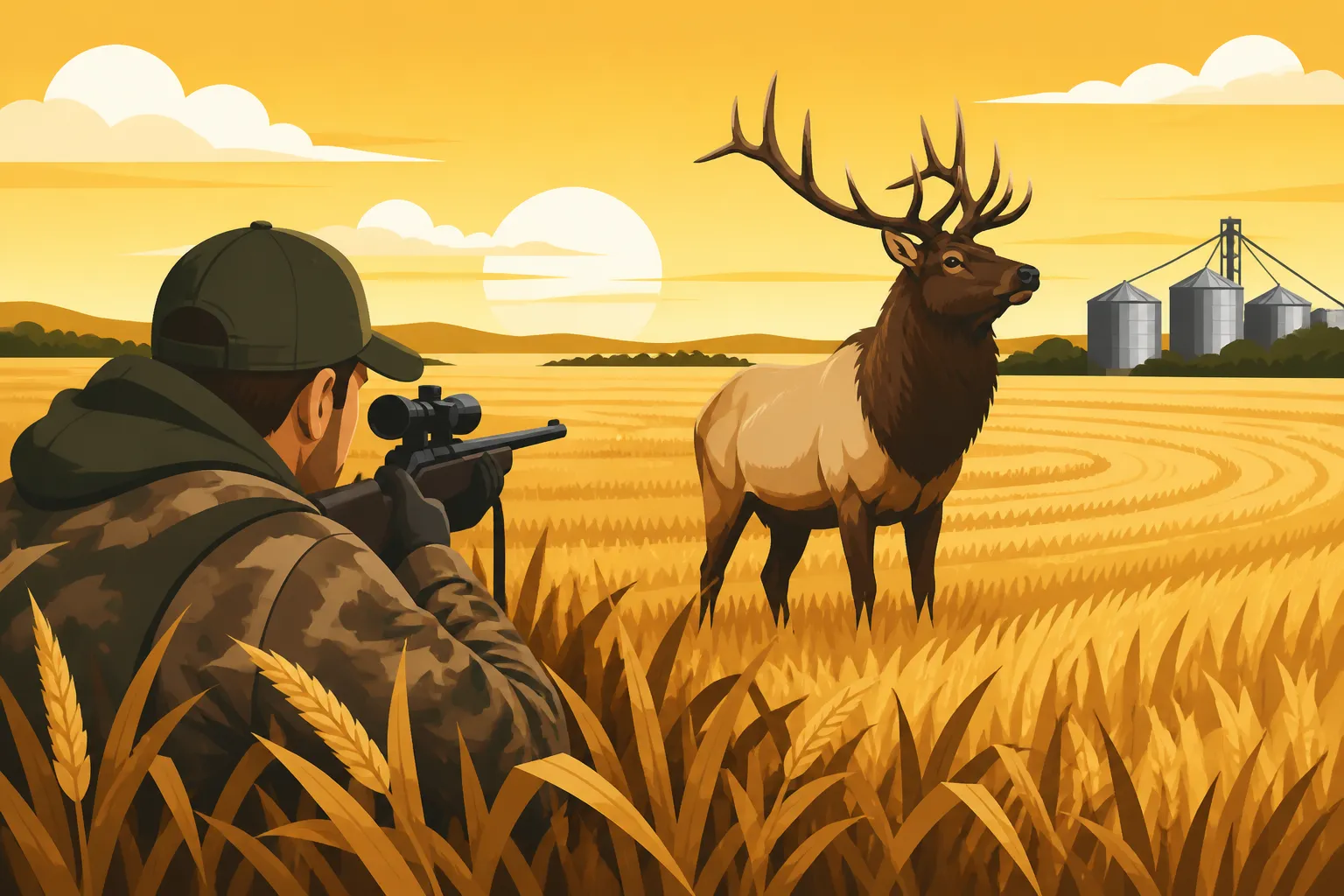
Spot-and-stalk hunting for elk in Manitoba's grain fields requires incredible patience, keen observation skills, and favorable conditions. This method is often most successful when elk are feeding in large, open fields or are bedded in isolated pockets of cover. The first step is to locate the elk, often by glassing from a distance with high-quality optics. Once spotted, a careful assessment of the terrain, wind, and the elk's behavior is necessary.
The wind is your absolute master in a stalk. You must stay downwind of the elk at all times. Use every bit of available cover – fencelines, drainage ditches, crop rows, even the standing crops themselves – to approach undetected. Move slowly, deliberately, and be prepared to freeze for extended periods if the elk become alert. One wrong move, one glint of sun, or one whiff of human scent, and they’re gone.
Stalking is best done on moist ground after a rain, which muffles your footsteps, or on windy days where the noise of the wind helps mask your movement. You need to be able to close the distance for a clean, ethical shot without being seen or heard. It's a challenging but incredibly rewarding way to hunt, especially when you're hunting elk on Manitoba grain land where cover can be sparse.
Overcoming Challenges and Ethical Considerations
Hunting elk on Manitoba's grain lands presents a unique set of challenges that extend beyond just finding the animals. Navigating private land, dealing with other hunters, and ensuring a responsible harvest are all critical aspects of a successful and ethical hunt.
Navigating Private Land and Permission
As mentioned, a significant portion of Manitoba's prime elk habitat in the grain belt is privately owned. This means that securing landowner permission isn't just a courtesy; it's a legal and ethical requirement. Hunting without permission is trespassing, a serious offense that can lead to fines, loss of hunting privileges, and damage to the reputation of all hunters. The province even has specific statutes regarding What Manitoba Trespass Law Requires.
The best approach is to start early, ideally months before the season. Introduce yourself to landowners, explain your intentions, and be respectful of their property and their time. Offer to help with chores, share your harvest, or simply be a good neighbor. Leave your contact information and be prepared for rejection; not all landowners will grant permission, and that's their right. A positive relationship with even one landowner can unlock incredible hunting opportunities. Always ask about specific rules they might have regarding vehicle access, field conditions, or areas where they prefer you not to hunt. Remember, you are a guest on their land.
Maintaining good landowner relations is crucial for the future of hunting. One bad interaction can sour an entire community on hunters. Always close gates, avoid driving on wet fields, pack out all your trash, and leave the property better than you found it.
Dealing with Hunting Pressure and Other Hunters
Elk in agricultural areas can become incredibly wary due to hunting pressure. As the season progresses, especially during peak rifle seasons, elk will quickly learn to associate human activity with danger. They might become nocturnal, moving only under the cover of darkness, or retreat into the thickest, most inaccessible cover available. It’s a real headache for hunters, but it’s the reality.
To counter this, try to hunt during weekdays when pressure is typically lower, or focus on areas that are harder to access, which often see less hunter traffic. This might mean walking an extra mile or two from a main road, or using an ATV (where permitted) to get deeper into remote corners of Crown Land or large tracts of private land you have permission for. Scouting for areas where other hunters aren't going, or where their approach methods are predictable, can give you an edge.
Hunter etiquette is also essential. Be aware of other hunters in the area. If you see someone already set up or stalking, give them a wide berth. Communication can prevent conflicts, so if possible, make your presence known from a distance without disturbing game. We’re all out there for the same reason, and respecting fellow hunters contributes to a safer, more enjoyable experience for everyone.
Ethical Shot Placement and Game Recovery
Taking a clean, ethical shot is paramount. Elk are large, tough animals, and a poorly placed shot can lead to a long, frustrating, and potentially unsuccessful tracking job, and worse, a wasted animal. Practice regularly with your chosen weapon to ensure you are proficient at various distances, especially in field conditions. Understand elk anatomy thoroughly to know precisely where to aim for the vital organs – the heart and lungs.
In open grain country, shot distances can be longer than in dense bush, so knowing your rifle’s capabilities and your own limitations is critical. Never take a shot you're not confident in. Once a shot is fired, if the elk doesn’t drop immediately, give it time, then begin a diligent tracking effort. Look for blood, broken branches, disturbed ground, and listen for sounds. Even if you only have a little blood, every single drop matters. Take your time, mark the last spot of blood, and grid-search the area.
If you are unable to recover the animal, you have an ethical obligation to continue searching thoroughly, and potentially to involve other hunters or even a tracking dog. Wasting game meat is illegal and goes against the very core of responsible hunting. Be prepared with a good first-aid kit, a sharp knife, and game bags for proper field dressing and meat care, especially if you're a ways from your vehicle. Consider the information in Meat Care in Manitoba's Cold Snaps to ensure your hard-earned harvest is preserved properly.
Comparative Elk Hunting Tactics on Grain Land
Here's a quick overview of some common tactics and their considerations for Manitoba's grain country:
| Tactic | Pros | Cons | Best Conditions |
|---|---|---|---|
| Ambush/Stand Hunting | High success if elk patterns are known; lower effort | Requires detailed scouting; long sits in a blind/stand; wind crucial | Regular movement patterns; dawn/dusk; rut; cold weather |
| Calling | Can draw elk from cover; exciting and interactive | Elk can be call-shy; over-calling can spook; requires good cover | Rut period; good cover to conceal caller; calm winds |
| Spot-and-Stalk | Very active; adaptable to elk location | Requires keen optics, physical fitness, good stalking skills; wind | Open fields; good visibility; windy conditions to mask movement |
| Still-Hunting | Slow, methodical, quiet movement | Requires extreme patience; easy to spook elk; challenging in thick cover | Dense cover adjacent to fields; light rain or wind; fresh snow |
Disclaimer
The information provided in this article is for educational and informational purposes only and is not a substitute for official hunting regulations. Hunters are responsible for knowing and adhering to all current Manitoba hunting regulations, licensing requirements, and safety guidelines. Always consult the latest Manitoba Hunting Guide and relevant government resources before planning any hunt. Hunting carries inherent risks; always prioritize safety and ethical practices.