Hunting a Jack Pine Ridge Up North
The vastness of northern Manitoba's bush country can feel incredibly intimidating, especially when you're staring at a map wondering where on earth to begin looking for game. It's not like the open farmland where you can glass for miles. Up here, the trees swallow everything, and finding those pockets where animals concentrate, like a good jack pine ridge, can feel like searching for a needle in a haystack. But don't despair! This guide is here to walk you through understanding, locating, and effectively hunting those often overlooked but highly productive jack pine ridges in Manitoba's north, turning that overwhelming feeling into a strategic advantage.
Understanding the Jack Pine Ridge Ecosystem in Northern Manitoba
When you venture into northern Manitoba, particularly the boreal forest belt, you'll quickly notice how the landscape changes. The open prairie gives way to dense stands of conifers and mixed woods, and among these, the jack pine ridges stand out. They might not look like much at first glance – often a bit scraggly and tight – but they are crucial habitats for many of our northern game animals.
Why Jack Pines Thrive Up North
Jack pines are truly resilient trees, perfectly adapted to the rugged conditions found in Manitoba's northern reaches. They aren't picky about soil, often thriving in the thin, sandy, and sometimes rocky soils that other tree species struggle with. This is why you'll often find them on higher, drier ground, forming distinct ridges. These trees are also pioneers, often being among the first to recolonize areas after a wildfire. In fact, fire is an integral part of their life cycle; their cones are serotinous, meaning they often require heat from a fire to open and release their seeds, leading to dense stands of new growth.
The climate up north, with its harsh winters and shorter growing seasons, also plays right into the jack pine's hand. They are incredibly cold-hardy, shrugging off temperatures that would devastate less robust species. This hardiness, combined with their ability to grow densely, creates a unique forest structure. Imagine walking through a mature jack pine stand: the canopy might be relatively open higher up, but closer to the ground, especially in younger stands, it can be an impenetrable tangle of branches. This density, particularly when combined with the relief of a ridge, sets the stage for prime wildlife habitat. It's a tough environment, but for the jack pine, it's home, and that resilience translates directly into the kind of cover and sustenance that draws game.
Wildlife Drawn to These Ridges
So, what makes these jack pine ridges such magnets for wildlife? It all comes down to the resources they offer. While they might not be packed with lush browse like a willow flat, they provide invaluable thermal cover, protection from predators, and strategic travel corridors.
For big game like moose and white-tailed deer, jack pine ridges offer shelter from biting winds and deep snow, especially as winter sets in. A dense stand of jack pine can be several degrees warmer than open areas, and the canopy helps intercept snow, keeping the ground underneath less deep and easier to travel. You might not find a moose actively feeding in the middle of a mature jack pine stand, but you'll certainly find them bedded down, chewing their cud, or using the edges for security. Deer, particularly the big-bodied bucks we find in the north, use these ridges as core bedding areas. They'll often bed on the leeward side of a ridge, using the elevation and thick cover to detect danger while conserving energy. Why Northern Bucks Carry More Body Mass is a testament to the harsh conditions they endure, and these ridges are key to their survival.
Black bears also frequent these areas. The dense cover provides excellent denning sites – they might dig into the side of a ridge or find a natural hollow among the roots. They also use the ridges as travel routes, especially when moving between different feeding areas. And where there's big game, you'll find predators. Wolves often patrol these ridges, using them as high ground to survey their territory and intercept prey moving through. For smaller game, ruffed grouse absolutely love the dense understory and mixed edges that often accompany jack pine stands. You'll hear their thunderous wingbeats as they flush from the thick cover, seeking refuge. Even elusive creatures like lynx will stalk snowshoe hare through the security of these dense pine thickets.
Scouting and Locating Promising Jack Pine Ridges
Finding game in the vast northern bush isn't about blind luck; it's about understanding the landscape and using modern tools to narrow down your search. Jack pine ridges can be subtle, but with a keen eye and the right resources, you can pinpoint potential hotspots long before you set foot in the woods.
Mapping Your Way to Potential Hotspots
Before you ever leave the comfort of your home, or even when you're sitting in camp, mapping tools are your best friend. Start by looking at detailed topographic maps. Ridges, by definition, are higher ground, so you'll be looking for tight contour lines indicating elevation changes. But not all ridges are created equal. Focus on those that have a distinct, often slightly darker, canopy signature on satellite imagery. This usually indicates a mature, dense stand of jack pine. Brands like onX Hunt or GoHunt offer excellent digital mapping platforms that allow you to overlay satellite imagery with topographic data, making it incredibly easy to identify these features.
Look for key junctions and transition zones. A jack pine ridge that runs alongside a low-lying spruce-bog, a beaver pond, or a creek offers both high, dry bedding and easy access to water or different forage types. These "edge habitats" are absolute magnets for game. Pay attention to fingers of higher ground that extend into swampier areas – these act as natural travel corridors. Similarly, look for ridges adjacent to old clear-cuts or burned-over areas. While the ridge itself might be dense, the regenerating growth in a nearby cut or burn can provide excellent browse, meaning animals will use the ridge for cover and the adjacent areas for feeding. Don't forget to check the orientation of the ridge; a south-facing slope might offer more warmth during sunny winter days, while a north-facing slope might hold snow longer, providing cooler bedding in early fall. This kind of detailed Scouting With Satellite Imagery in Manitoba can save you countless hours in the field.
Boots-on-the-Ground Reconnaissance
Once you've identified some promising areas on your map, it's time for some boots-on-the-ground reconnaissance, whether it's pre-season scouting or on-the-spot observation during your hunt. Nothing beats actual time in the woods for confirming what your map shows and finding those crucial, smaller details.
When you're walking a jack pine ridge, move slowly and methodically. Your goal is to read the forest floor like a book. Look for fresh rubs on smaller pine trees, especially during the rut when bucks are signaling their presence. Scrapes, though perhaps less common deep within a dense jack pine stand, can still appear on the edges or along travel routes where the cover transitions. Keep your eyes peeled for tracks – look for well-worn game trails winding through the densest parts of the timber, or trails leading up and over the ridge from adjacent lowlands. Droppings will tell you if animals are regularly using the area and even what they've been eating.
Your scouting should also focus on identifying bedding areas. Often, these will be on the leeward side of the ridge, out of the wind, or in the thickest clumps of pines that offer the most visual security. Look for flattened areas in the needles or snow, and keep an eye out for fresh scent. Pay attention to natural funnels or pinch points on the ridge – places where the terrain forces animal movement into a narrower path. These are prime spots for setting up a stand or planning a still-hunt. Remember to look for water sources too. While the ridges themselves are dry, a nearby spring or a low-lying area with standing water will draw animals. Reading Whitetail Sign in Manitoba Aspen might focus on a different tree, but the principles of sign reading are universal and apply perfectly to these northern pine stands.
Hunting Strategies for Jack Pine Ridges
Hunting jack pine ridges isn't like hunting open country. It demands different tactics, a patient approach, and an understanding of how animals move and use this specific environment. You're often dealing with tighter visibility and denser cover, which means getting close and moving quietly are paramount.
Still-Hunting and Stalking the Ridges
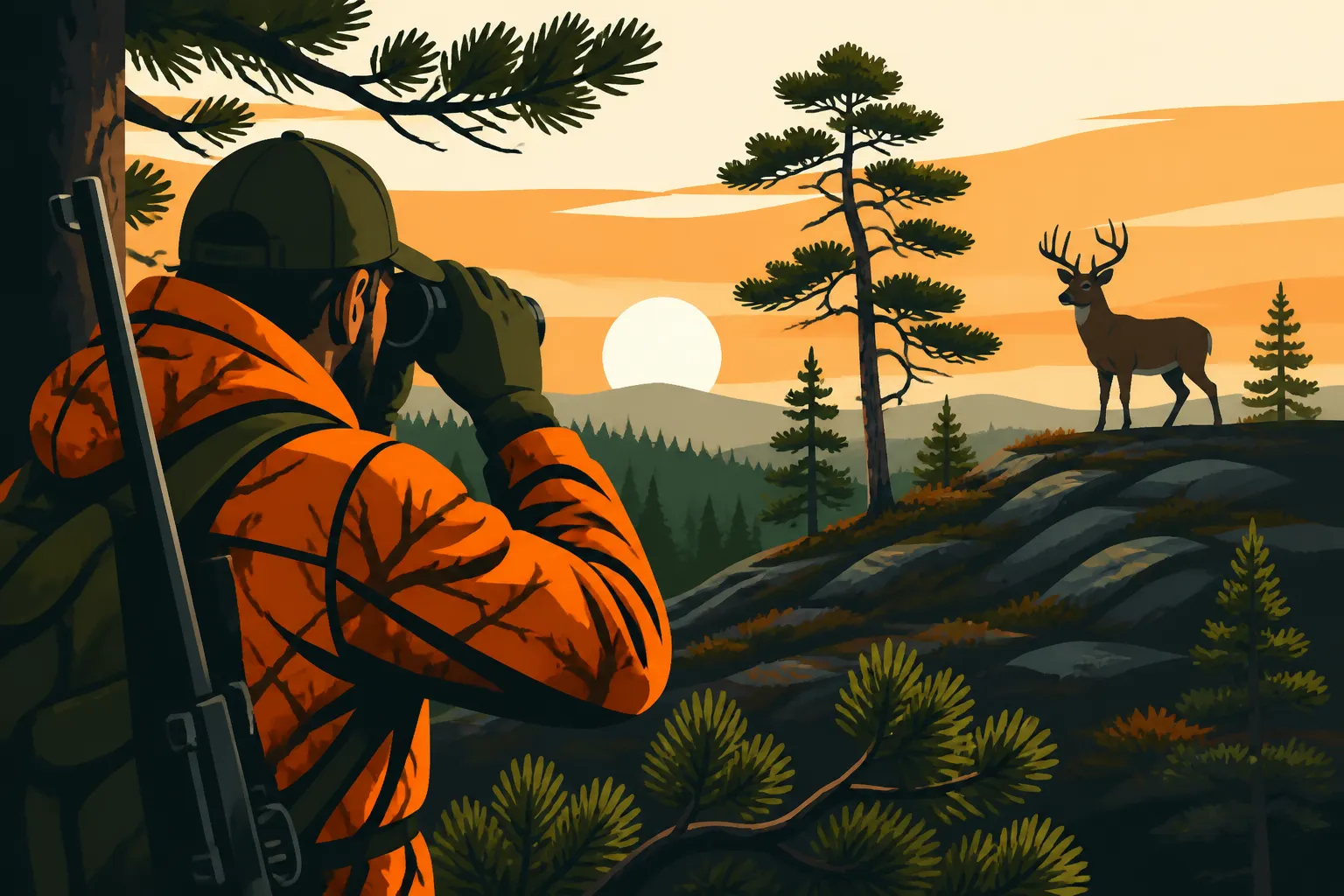
Still-hunting is arguably one of the most effective methods for hunting jack pine ridges. It requires immense patience and a deliberate, ultra-slow pace. You're not just walking; you're hunting every single step. Think of it as a moving ambush. Take one or two steps, then pause, scanning every shadow, every tree trunk, every flicker of movement. Use your binoculars to pick apart the dense cover ahead. The goal is to see the animal before it sees you, giving you time to react.
Movement through jack pine can be incredibly noisy due to the dry needles on the ground and the stiff branches. This means you need to prioritize quiet foot placement and clothing that doesn't rustle. Use the cover to your advantage: move from tree to tree, staying hidden as much as possible. Always be mindful of the wind. A jack pine ridge can create swirling air currents, but generally, you want the wind in your face or quartering. Scent control is vital up north, where animals often grow up with very little human interaction and can be extremely wary. Focus on the edges of the ridge, where animals might be moving from cover to feed, or along the top, where they might travel between bedding areas. This slow, methodical approach is key to success in Hunting Whitetails in Manitoba's Bush Country.
Setting Up for Ambushes and Stands
While still-hunting is often productive, there are certainly times and places on a jack pine ridge where setting up a stationary ambush or a treestand is the smarter play. This strategy is all about predicting animal movement and intercepting them.
Look for natural funnels on the ridge: saddles, narrow sections, or where a game trail crosses a small drainage. Any feature that concentrates animal movement is a prime stand location. Consider the edges where the jack pine transitions to another cover type, like a poplar bluff or a low-lying marsh. These transition zones, or "bush edges," are frequently used by deer and moose. Setting up your stand overlooking such an edge, especially if there's a good game trail, can be highly effective. Hunting a Manitoba Bush Edge emphasizes the value of these transition zones.
Timing is everything. Morning hunts often focus on catching animals moving from feeding areas back to bedding on the ridge, while evening hunts are about catching them leaving the ridge to feed. Use natural cover – a thick pine, a cluster of spruce – to break up your outline. Portable treestands can be great, but even a well-camouflaged ground blind or simply sitting patiently against a tree can work wonders if you're hidden and downwind. Pay attention to sun angle so you're not silhouetted against the sky, and consider how game might approach your position.
Driving and Pushing Smaller Blocks
Driving or pushing smaller blocks of jack pine ridge can be an effective tactic, especially for deer, but it requires careful planning, communication, and a clear understanding of the terrain. This isn't a strategy for every ridge or every hunting party, but in the right circumstances, it can yield results.
This method typically involves a group of hunters: "drivers" who slowly and methodically move through a section of the ridge, pushing game towards "standers" positioned at natural escape routes or funnels. Safety is paramount here. Everyone must know the plan, where others are, and their shooting lanes. Communication, whether by radio or clear pre-arranged signals, is vital. You need to know the boundaries of your drive and the direction of the wind to guide animal movement.
Drives are best suited for smaller, defined blocks of jack pine, especially those that are surrounded by more open ground or clear boundaries like cutlines or trails. They can be particularly effective on days when animals are reluctant to move due to pressure or weather, as the human presence encourages them to get up and go. However, in vast, unbroken jack pine country, or with inexperienced groups, drives can quickly become disorganized and dangerous. For the most part, in northern Manitoba, still-hunting and stand hunting are often more consistently productive for solo hunters or small groups.
Gear and Considerations for Northern Jack Pine Hunts
Hunting in northern Manitoba, especially within the dense jack pine country, presents a unique set of challenges that your gear and preparation must address. This isn't a walk in the park; it's a deep dive into genuine wilderness, and being prepared means staying safe, comfortable, and increasing your odds of success.
Essential Gear for Northern Bush Hunting
When you're heading into the northern bush, packing smart is non-negotiable. The weather can change on a dime, and what starts as a crisp fall morning can quickly turn into a cold, damp, or even snowy day. Layered clothing is absolutely critical. Start with a good moisture-wicking base layer, add insulating layers like fleece or wool, and top it off with a waterproof and windproof outer shell. Choose colours that blend with the forest. For specific species, ensure you have your blaze orange as required – How Much Blaze Orange Manitoba Requires.
Your footwear is paramount. Invest in high-quality, waterproof, and insulated boots that offer excellent ankle support. You'll be traversing uneven terrain, wet spots, and possibly snow. There’s nothing that ends a hunt faster than cold, wet feet. A good quality backpack is essential to carry your extra layers, water, snacks, emergency kit, and any game you might take down. Navigation tools are also crucial: a reliable GPS unit (like those integrated with onX Hunt or GoHunt apps on your phone) backed up by a physical compass and map. Cell service can be spotty or non-existent up north, so don't rely solely on your phone. A satellite communication device, like an inReach or SPOT messenger, can be a literal lifesaver for emergency contact.
Of course, your chosen firearm or bow must be appropriate for big game. Ensure it's sighted in and you're proficient with it. Pack enough ammunition, a good quality knife for field dressing, and game bags. Don't forget bug spray in the early season – the mosquitoes and black flies up north can be relentless! And when the deep cold truly sets in, items like hand warmers, an insulated thermos with a hot drink, and extra gloves or mitts are not luxuries, but necessities. Hunting Safely in Deep Winter Cold details many of these exact cold-weather essentials.
Navigating the Unique Challenges
Hunting jack pine ridges comes with its own set of unique challenges that, if not anticipated, can quickly turn a good hunt sour. One of the biggest difficulties is getting disoriented. The dense, often uniform nature of jack pine stands, combined with limited visibility, can make it surprisingly easy to lose your bearings, even with a GPS. Always pay attention to your surroundings, dropping waypoints frequently, and use natural landmarks when possible.
Managing noise is another hurdle. The dry needles and brittle branches underfoot mean every step can announce your presence. This requires an almost exaggerated slow pace, careful foot placement, and choosing paths of least resistance. Wait for gusts of wind to mask your movement, or for natural sounds like distant bird calls or the rush of a creek to cover your approach. The visibility can be extremely limited, often down to mere yards in the thickest sections. This means shots will likely be close-range, requiring quick, decisive action. Practice shooting in tight quarters and be prepared for snap shots.
Finally, be ready for variable conditions. Early season hunts can be plagued by bugs and warm weather, requiring bug nets and careful meat care. Late season hunts will bring deep snow and extreme cold, impacting animal movement and requiring heavy winter gear. Understanding these nuances and planning for them is the mark of a seasoned northern hunter. Being familiar with terrain features like Hunting a Boreal Muskeg Edge will also help you identify where jack pines grow and how animals move in relation to them, ensuring you're not just hunting trees, but intelligently hunting the ecosystem.
| Hunting Method | Pros | Cons | Best Suited For |
|---|---|---|---|
| Still-Hunting | Highly adaptable, covers ground, intimate hunt | Requires extreme patience, quiet movement, good woodsmanship | Solo hunters, finding bedded game, dense cover |
| Stand/Blind Hunt | Allows for long waits, scent control, comfort | Less coverage of ground, relies on predicting movement | Known travel corridors, pinch points, bedding areas |
| Driving (Small Blocks) | Can move reluctant game, good for specific areas | Requires multiple hunters, precise coordination, safety concerns | Defined, smaller blocks of timber, specific scenarios |
Remember, the northern bush is a wild place. Always let someone know where you're going and when you expect to return. Being prepared is the most important lesson you can learn from hunting these incredible jack pine ridges.
Disclaimer
This article is for general informational purposes only and does not constitute professional advice. Laws, prices and regulations vary by location and change over time. Consult a qualified professional for guidance on your specific situation.