Which Crown Lands Allow Night Hunting
Navigating the specific rules and regulations around hunting in Manitoba can often feel like trying to untangle a particularly stubborn knot, especially when it comes to something as specialized as night hunting. For many hunters, the idea of pursuing game after sundown conjures up images of clandestine activities or unclear legalities, leading to understandable frustration and a reluctance to even consider it. But with proper understanding and the right permits, night hunting is a legitimate and often effective method for managing certain predator populations in specific areas. This guide aims to demystify which Crown lands in Manitoba are approved for night hunting, helping you understand the rules, the application process, and how to stay safe and compliant.
Understanding Night Hunting Regulations in Manitoba
The provincial government of Manitoba has implemented a structured regulatory framework to address night hunting, primarily as a tool for wildlife management, particularly concerning predator control. However, these regulations are a delicate balance between effective management and public safety, which is why they are often misunderstood.
The Historical Context of Night Hunting Restrictions
Historically, hunting at night across much of Canada, including Manitoba, has been largely prohibited due to obvious safety concerns. Reduced visibility significantly increases the risk of misidentification of species, targets, and surroundings, posing a danger to hunters themselves, other outdoor enthusiasts, and livestock. Furthermore, the use of artificial lights at night was often associated with poaching and unethical hunting practices, leading to a general ban.
However, as certain wildlife populations, particularly coyotes and wolves, expanded and began to impact livestock and other game species, landowners and wildlife managers sought more flexible tools. This led to a re-evaluation, recognizing that under controlled conditions and with proper authorization, night hunting could be a valuable management strategy. The shift wasn't a free-for-all; rather, it introduced a rigorous permit system designed to ensure safety and responsible hunting practices, specifically on designated lands. The frustration for many hunters was the initial blanket ban, and the subsequent confusion about where and how this new, restricted permission applied. For many years, the only recourse was to deal with depredation issues during daylight hours, which often proved ineffective against nocturnal predators.
Key Definitions and Legal Framework
In Manitoba, "night hunting" specifically refers to hunting during the period from one half-hour after sunset to one half-hour before sunrise. This isn't just a casual suggestion; it's a strict legal definition enshrined in the provincial hunting regulations. The primary legislation governing night hunting, and hunting in general, falls under The Wildlife Act and its associated regulations. These laws dictate who can hunt, what they can hunt, where, and when.
A crucial distinction to understand is that night hunting in Manitoba is not a general privilege for licensed hunters. It's a special activity requiring a specific "Night Hunting Permit" issued by the Department of Natural Resources and Northern Development. This permit is separate from your general hunting license and often comes with very specific conditions regarding species, location, and methods. Without this permit, any hunting activities during the defined night hours are illegal and subject to severe penalties, including fines, licence suspension, and even potential criminal charges, highlighting the gravity of these regulations. It's also important to familiarize yourself with Manitoba's Night Hunting Rules to ensure full compliance.
Who is Eligible for a Night Hunting Permit
This isn't a permit anyone can just pick up. Eligibility for a Night Hunting Permit in Manitoba is quite restricted. Generally, these permits are issued to specific groups or individuals for very defined purposes.
- First Nations Hunters: Under Treaty and Aboriginal rights, Indigenous hunters often have the right to harvest wildlife year-round, at any time of day or night, for sustenance, cultural, and spiritual purposes. However, even these rights come with responsibilities, especially regarding public safety. In recognition of these rights and for safety, First Nations hunters can apply for a Night Hunting Permit for specific designated Crown lands, ensuring they are operating in approved areas and adhering to safety protocols in populated regions.
- Livestock Producers/Farmers: Landowners who are experiencing ongoing depredation by wolves or coyotes on their livestock can apply for a permit to hunt these predators at night on their own private land or land they lease, provided they meet specific criteria. This is typically a last resort after other mitigation strategies have failed. The intent here is direct protection of property, not recreational hunting.
- Designated Wildlife Managers/Contractors: In some cases, the province may authorize specific individuals or organizations, often professional trappers or wildlife control specialists, to conduct night hunting as part of broader wildlife management programs. This is usually for species control or research purposes and not something a general hunter would be involved in.
It is critical to understand that a general resident hunter with a standard big game or small game licence cannot simply apply for a night hunting permit for recreational purposes. The permits are tied to specific needs and rights. If you are applying, you'll need to demonstrate your eligibility clearly. For instance, a First Nations hunter would typically submit their band number and treaty verification, while a landowner would provide proof of property ownership and evidence of livestock depredation.
Identifying Approved Crown Lands for Night Hunting
The most significant area of confusion for many interested parties is precisely where night hunting is actually permitted on Crown land. It’s not just any patch of public land; it’s a very specific, carefully delineated system.
The Map-Based Approval System
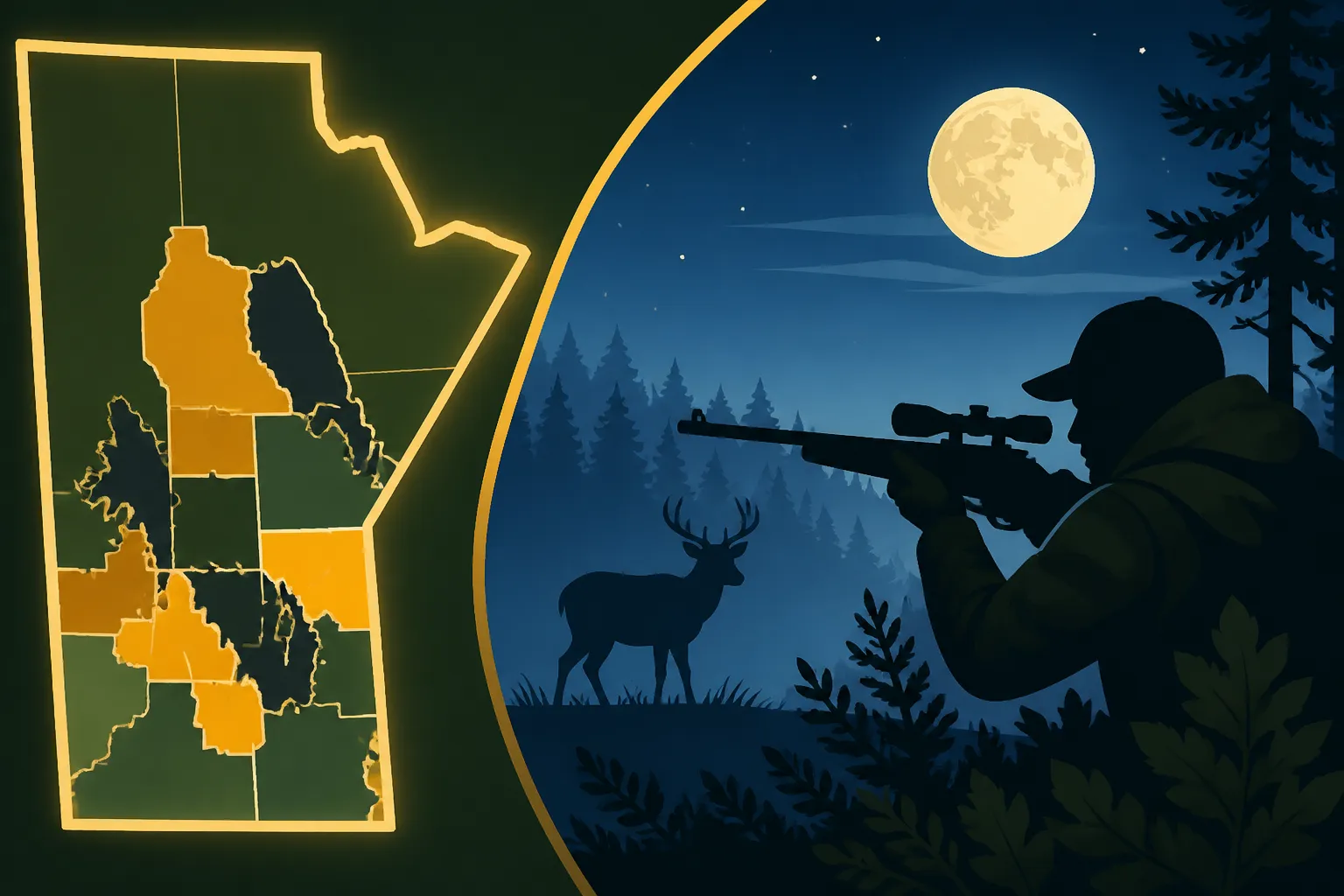
Manitoba has adopted a map-based system to designate Crown lands where night hunting is permitted. This is a critical safety measure, ensuring that these activities are restricted to remote areas, far from residences, communities, and areas of high public recreational use. The official maps are available through the provincial government's website, often under the Sustainable Development or Natural Resources and Northern Development sections. They typically display Game Hunting Areas (GHAs) and clearly highlight specific blocks or regions of Crown land where night hunting with a permit is allowed.
These aren't static maps; they are regularly updated, so always consult the most current version before planning any night hunting activity. Think of it like a specialized zoning map for hunting. You might be accustomed to consulting Reading a Manitoba GHA Map Before You Go for regular season hunts, but night hunting requires an entirely separate layer of authorization. Using an app like GoHunt, which allows you to overlay different land types and regulations, can be incredibly helpful here. While GoHunt might not have every single specific night hunting layer, understanding how to navigate digital maps and cross-reference them with official provincial resources is key. This helps prevent accidental encroachment into unapproved areas, which could lead to severe penalties.
General Characteristics of Approved Areas
The Crown lands designated for night hunting permits generally share several characteristics, all designed to maximize safety and minimize conflict.
- Remoteness: Approved areas are typically found in more remote, sparsely populated regions of the province. This includes vast tracts of boreal forest in Northern Manitoba, parts of the Interlake region, and other areas where human habitation is minimal. The idea is to keep night hunting far away from towns, cottages, and frequently used recreational sites.
- Large, Uninterrupted Blocks: The approved areas tend to be large, continuous blocks of Crown land, providing ample space for safe night hunting operations without being near numerous property lines. This helps reduce the risk of stray bullets impacting private property or unknowingly crossing into non-approved zones.
- Low Population Density: These areas are chosen specifically because they have very few permanent residents. This minimizes the risk to the public, as fewer people are likely to be in the area after dark.
- Predator Management Zones: Often, these designated Crown lands overlap with areas where predator populations, particularly wolves and coyotes, are known to be significant and may pose a threat to livestock on adjacent private lands or exert undue pressure on moose or deer populations. For instance, you might find more approved night hunting land within or bordering GHAs where Hunting Wolves in Manitoba's North is a priority, or where Coyote Hunting Rules Year-Round are already in place during daylight hours.
It’s crucial to understand that even within a GHA that allows night hunting, not all Crown land will be open. You must consult the specific maps for approved night hunting areas, not just general Crown land maps.
Practical Steps to Verify Approved Lands
Given the critical importance of accuracy, verifying approved Crown lands for night hunting requires diligence. Simply assuming a patch of bush is Crown land and therefore fair game at night is a dangerous and illegal mistake.
- Access Official Provincial Maps: Your first and most important step is to always consult the current official maps provided by the Manitoba government. These can usually be found on the Manitoba Natural Resources and Northern Development website. Look specifically for "Night Hunting Designated Lands" or similar titles. These maps will show the specific Approved Crown Land for Night Hunting.
- Utilize Digital Mapping Tools: While the provincial maps are authoritative, tools like GoHunt or other GPS hunting apps can be invaluable for navigation in the field. Once you've identified the approved areas on the official maps, you can often cross-reference or even manually mark these boundaries on your digital maps. This allows for real-time verification of your location relative to approved zones, especially useful when Scouting With Satellite Imagery in Manitoba during your planning stages. Always remember that technology is a tool, not a replacement for official documentation.
- Confirm with the Department: If there's any doubt whatsoever, contact the Manitoba Department of Natural Resources and Northern Development directly. Conservation officers or permit staff can provide clarification and ensure you have the most up-to-date information regarding specific parcels of land. It’s always better to ask than to unknowingly violate regulations.
- On-the-Ground Reconnaissance: Before your hunt, if possible, physically scout the area during daylight hours. Confirm landmarks, access points, and ensure there are no unexpected developments like new residences or increased recreational use that might impact the suitability of the area for night hunting. Pay attention to signs of other human activity.
| Characteristic | Approved Crown Land for Night Hunting | General Crown Land (Day Hunting) | Private Land (for Night Hunting) |
|---|---|---|---|
| Permit Required? | Yes (Specific Night Hunting Permit) | Yes (General Hunting Licence) | Yes (Specific Night Hunting Permit for landowners/lessees) |
| Primary Eligibility | First Nations, Approved Wildlife Managers | General Public with Valid Licence | Landowners/Lessees with Livestock Depredation Issues |
| Location Criteria | Remote, large, low population density, predator management zones | Varies widely: forests, bush, some farmland fringes | Owner's specific property, often near livestock |
| Mapping Required | Critical: Consult specific "Night Hunting Designated Lands" maps | General GHA maps and Crown land maps sufficient | Property lines and own land boundaries, often verified by legal description |
| Species Targeted | Primarily predators (wolves, coyotes) with specific permit | Varies by season/licence (deer, moose, bear, birds, predators) | Primarily predators causing depredation |
| Safety Emphasis | Extremely high: Distance from residences, clear sightlines, strict protocols | Standard hunting safety, awareness of other users | Focused on protecting livestock and preventing misidentification |
| Tech Use (e.g., GoHunt) | Essential for precise boundary verification and navigation | Useful for general navigation, property lines, and scouting | Helpful for understanding property lines and surrounding areas |
Navigating the Night Hunting Permit Application Process
So, you've determined you might be eligible and you've identified potential Crown lands. The next step is the permit itself. This isn't just a formality; it's a rigorous process designed to ensure safety and compliance.
Applying for a Night Hunting Permit
The application process for a Night Hunting Permit is handled directly by the Manitoba Department of Natural Resources and Northern Development. It's not something you can typically do online with your regular hunting licence purchase, nor is it a quick form.
- Contact the Department: The first step is to contact your regional wildlife office or the provincial permit office. They will provide the most current application forms and instructions. Do not rely on outdated information you might find online.
- Gather Required Documentation: You'll need to provide specific documentation based on your eligibility.
- First Nations Hunters: This usually involves proof of Treaty status and possibly documentation from your Band office, indicating the purpose of the hunt (e.g., sustenance).
- Landowners: You'll need proof of land ownership or a lease agreement, details of your livestock, and documented evidence of depredation by predators. This might include reports to Manitoba Agriculture or conservation officers.
- Specify Hunting Area: On the application, you must clearly identify the specific Crown land(s) or private land where you intend to night hunt. This is where your prior research using provincial maps and perhaps tools like GoHunt comes into play. Precision is paramount.
- Outline Species and Methods: You'll need to specify what species you intend to hunt (e.g., coyotes, wolves) and the methods you plan to use, including firearms. Legal Firearms and Bows for Big Game outlines general rules, but night hunting permits may have additional restrictions.
- Safety Plan: The application may require you to outline your safety protocols, especially regarding other users of the land, proximity to residences, and emergency procedures. This underscores the serious nature of the activity.
- Submit and Await Approval: Once completed with all supporting documentation, submit your application. Be prepared for a waiting period, as applications are thoroughly reviewed. There's no guarantee of approval, and permits are often issued with very specific conditions.
Specific Conditions and Responsibilities of Permittees
If your application is approved, your Night Hunting Permit will come with a strict set of conditions and responsibilities that you must adhere to. These are not suggestions; they are legally binding.
- Designated Areas Only: You are only permitted to hunt in the exact Crown land or private land areas specified on your permit. Deviating from these boundaries, even slightly, is a serious violation.
- Species Specificity: The permit will state precisely which species you are allowed to hunt. Do not assume you can hunt any animal at night. For instance, if your permit is for coyotes, hunting a deer, even if mistaken, would be illegal. This is why proper target identification is so critical.
- Method Restrictions: There may be restrictions on the type of firearms, ammunition, or lights you can use. Some permits may specify shotguns only, or limit the type of artificial light.
- Lighting Requirements: Often, permits will detail requirements for specific lighting setups – for example, handheld lights, mounted lights, or thermal/night vision devices, and their proper use to ensure safe target identification.
- Reporting Requirements: You may be required to report your hunting activities, including harvest numbers, to the department within a specified timeframe. This helps the province monitor predator populations and the effectiveness of night hunting as a management tool.
- Public Safety: Permittees bear the ultimate responsibility for public safety. This includes ensuring shots are always taken against a safe backdrop, knowing your target and beyond, and minimizing noise or disturbance to nearby residents (if any). You must always be aware of your surroundings, especially when Hunting Safely in Deep Winter Cold where visibility might be even more limited due to weather.
Consequences of Non-Compliance
The stakes are incredibly high if you don't comply with Manitoba's night hunting regulations. These aren't minor infractions.
- Fines and Penalties: Violations can result in substantial fines, potentially thousands of dollars. These fines are significantly higher than for many daylight hunting infractions due to the increased safety risks.
- Licence Suspension/Revocation: Your hunting privileges in Manitoba can be suspended or permanently revoked. This means you could lose the ability to hunt any species, day or night, for a significant period.
- Seizure of Equipment: Firearms, vehicles, and other hunting equipment used in the commission of an offense can be seized and forfeited. This includes valuable gear like night vision scopes or thermal imaging devices.
- Criminal Charges: In severe cases, especially those involving public endangerment or gross negligence, criminal charges may be laid, leading to jail time. The "Safe Hunting and Shared Management Act" includes provisions for serious penalties for reckless or illegal hunting. For a full understanding of the potential repercussions, you should consult the details on Manitoba Penalties for Hunting Violations.
- Reputational Damage: Beyond legal consequences, illegal night hunting severely damages the reputation of all hunters and undermines the conservation efforts supported by responsible sportsmen and women. It makes it harder for the province to justify legitimate night hunting permits for those who truly need them.
Tips for Safe and Ethical Night Hunting on Crown Land
Even with a permit, night hunting demands an elevated level of vigilance, preparation, and adherence to ethical principles. It's an environment that allows very little room for error.
Essential Gear and Safety Protocols
When hunting after dark, your gear becomes even more critical for both effectiveness and safety. This isn't just about bagging an animal; it's about making it home safely and ensuring no harm comes to others.
- Reliable Lighting: Beyond any mandated lighting on your permit, always carry multiple sources of light: a powerful headlamp with fresh batteries, a backup flashlight, and possibly a lantern for camp. Consider lights with adjustable brightness and red light options to preserve night vision.
- Advanced Optics: Night vision or thermal imaging devices are almost essential for safe and effective night hunting of predators. They allow for positive target identification, crucial for distinguishing between species and ensuring you have a safe shot. Cheaper alternatives like powerful spotlights can work, but they severely limit your field of view and target discrimination.
- Communication Devices: Cell service can be spotty in remote Crown land areas. Carry a satellite messenger (e.g., Garmin inReach) or a two-way radio to ensure you can communicate in an emergency. Where Manitoba Cell Coverage Ends can often coincide with designated night hunting areas.
- First-Aid and Survival Kit: A comprehensive first-aid kit is non-negotiable. Include items for trauma, severe bleeding, and general injuries. A survival kit with fire starters, emergency blankets, and extra food/water is also vital.
- Blaze Orange (Even at Night): While visibility is limited, wearing some blaze orange or other high-visibility clothing while moving to and from your hunting position, or if you need to exit your vehicle, is a sensible precaution.
- Clear Backstops: Every shot taken at night must have an absolutely clear and known backstop. Terrain features like hillsides or heavy brush can provide this. Never shoot towards the horizon or into an unknown area. Use an app like GoHunt to visualize terrain and potential backstops during daylight scouting.
- Designated Shooter: If hunting with a partner, clearly designate who is taking the shot and ensure strict communication. Only one person should be responsible for firing.
Respecting Wildlife and Other Land Users
Ethical hunting extends beyond legal compliance, especially in the low-visibility conditions of night hunting.
- Positive Identification: Never, under any circumstances, take a shot at an unidentified target. This is the golden rule of night hunting. Wait until you are 100% certain of your target's species and that it is indeed the animal you are permitted to harvest. This is where high-quality thermal or night vision is invaluable, allowing for detailed observation before a shot.
- Minimizing Disturbance: While targeting predators, remember that other wildlife might be present. Avoid unnecessary noise or light pollution that could stress non-target animals. If you're Calling Coyotes in Manitoba Farm Country, be mindful of how your calls might impact other species.
- Property Boundaries: Even on Crown land, be acutely aware of any adjacent private property. A Night Hunting Permit does not grant you permission to trespass or to shoot onto private land, even if it's unposted.
- Waste Not: If you harvest an animal, ensure ethical recovery and proper field dressing. This includes Meat Care in Manitoba's Cold Snaps, even if it's a predator. While not always consumed, ethical treatment of the animal post-harvest is a core tenet of hunting.
- Leave No Trace: Pack out everything you pack in. Leave the Crown land as you found it, or better. This is especially important for preserving access for future generations and maintaining a positive image of hunters.
The Role of Technology in Modern Night Hunting
Modern technology has revolutionized night hunting, making it safer and more effective when used responsibly.
- GPS and Mapping Apps: As mentioned, tools like GoHunt are indispensable. They allow you to accurately pinpoint your location on official Crown land maps, track your movements, mark important waypoints, and verify property boundaries in real-time. This reduces the risk of accidentally straying into unapproved areas or private property. Understanding Manitoba's Game Hunting Areas through these apps provides valuable context.
- Night Vision and Thermal Optics: These devices are game-changers. Night vision amplifies ambient light, allowing you to see in near-dark conditions. Thermal optics detect heat signatures, making it easy to spot animals (and people) in complete darkness, through light cover, or even fog. Both are excellent for positive target identification, which is paramount for safety.
- Trail Cameras: While not directly used during the hunt, specialized trail cameras with night vision capabilities can help you scout and pattern nocturnal predator movements on designated Crown land during the day, providing valuable intelligence before your hunt.
- Rangefinders: An illuminated or night-vision compatible rangefinder is crucial for accurately determining distances to your target and the backstop, ensuring ethical shot placement.
However, it's vital to remember that technology is a supplement, not a replacement for good judgment, proper training, and adherence to regulations. Always ensure your use of technology aligns with the conditions of your specific Night Hunting Permit.
Disclaimer
The information provided in this guide is for general informational purposes only and is not intended as legal advice. Hunting regulations in Manitoba can change, and it is the hunter's sole responsibility to consult the most current version of The Wildlife Act and its regulations, obtain all necessary permits and licences, and confirm all relevant details with Manitoba Natural Resources and Northern Development before engaging in any hunting activities. Failure to do so may result in serious legal consequences.